Tag Archives: Middle East
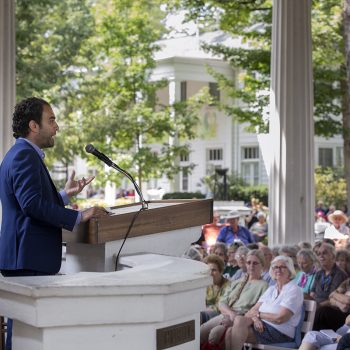
David Rohde, a Pulitzer Prize-winning foreign affairs reporter now with Reuters, recounts his experiences in captivity in Pakistan and sheds light on how radical Taliban militants view the United States. Photo by Eric Shea.

Rohde highlights experiences to address radicalism

What was meant to be an interview with a Taliban commander became a seven-month kidnapping.

To keep up with the competition in journalism, David Rohde wanted to interview a Taliban commander for a book. His opportunity came Nov. 10, 2008.

But when he, Afghan journalist Tahir Ludin and their driver Asadullah “Asad” Mangal arrived at the Logar province for the meeting, the Taliban commander told them he changed the location farther down the road.

A black car was blocking the road ahead. Then two gunmen with Kalashnikov rifles ran toward their car from both sides. Ludin and Mangal moved to the back seat with Rohde, and the gunmen got in the car and continued driving.

“My head was spinning,” Rohde said during Friday’s morning lecture. “I hoped that this was all some kind of mistake — that they had maybe seen me in the back seat and saw a Westerner.”

Read more
Burns

Policy expert Burns closes Pakistan week from US view

Trust: the key component to any relationship, including one between two countries. A lack of trust can lead to difficult times.

The minimal amount of trust between the United States and Pakistan has developed into a troubled relationship, one that faces difficult times and several problems.

Burns will return to Chautauqua Institution for a second consecutive year — this time as the final speaker of Week Five, themed “Pakistan: Straddling the Boundary between South Asia and the Middle East” — during Friday’s 10:45 a.m. lecture in the Amphitheater. He will speak about U.S.-Pakistan relations, Indian-Pakistani history and Pakistan’s role in the Afghanistan War.

Read more
Husain Haqqani, former Pakistani ambassador to the United States, speaks on the damaged alliance between the two countries Wednesday morning in the Amphitheater. Photo by Lauren Rock.

Haqqani: US, Pakistan should focus on friendship, not alliance

Pakistan and the United States have clashing narratives about their alliance.

From the Pakistanis’ perspective, the U.S. and Pakistan have been allies for 60 years, but the U.S. has walked away several times and cannot dictate Pakistan’s foreign policy.

From the Americans’ perspective, Pakistan is not a true ally. Pakistani public opinion remains anti-American despite the amount of aid the country receives, Husain Haqqani said. And Americans question Pakistan’s involvement with terrorists and its ability to fulfill promises.

Haqqani, former Pakistani ambassador to the U.S., spoke about U.S.-Pakistan relations, how that alliance was damaged and Pakistan’s national interest at Wednesday’s morning lecture in the Amphitheater for Week Five, themed “Pakistan: Straddling the Boundary between Asia and the Middle East.”

Read more
kempsatloffispahani

Middle East Update confronts challenges in increasingly volatile region

Geoffrey Kemp, director of regional security problems at the Center for National Interest, will host a Middle East Update at 4 p.m. today and Tuesday in the Hall of Philosophy. After each update, Kemp and guests will take questions from the audience.

“It’s a huge menu of issues, and we only have an hour. So we’ll have more than enough to talk about,” Kemp said.

Today’s guest, Robert Satloff, is executive director of the Washington Institute for Near East Policy. He has written or edited nine books and contributes to a variety of newspapers. Satloff is also the Institute’s Howard P. Berkowitz Chair in U.S. Middle East Policy.

Read more
Ahmed

Ahmed to explain tribal dangers in Pakistan

For the tribal peoples of Waziristan, the mountainous region in northwest Pakistan that borders Afghanistan, every day is like Sept. 11. Every day, people are killed by American drone strikes, Afghan terrorists, Pakistanis looking for terrorists or their own tribal rivalries. American experts have called the region the epicenter of the war on terror.

In 2004, the United States took a major stride forward by helping to establish a democracy in Afghanistan. Although successful in some of the big, Westernized cities, much of the country — which has been made up of tribal regions for centuries — rejects and refuses to recognize the new government.

Ahmed, former Pakistan ambassador to the United Kingdom and Ireland, will discuss those tribal societies at 2 p.m. Monday in the Hall of Philosophy. He will focus on Pakistani tribes and the problems those tribes cause for both Pakistan and the U.S., drawing from his scholarly studies and personal experiences in Pakistan.

Read more
Zakaria

Zakaria to dissect complex dynamics of Pakistan-US relations

Within the Middle East’s Jenga-like geopolitical structure, Pakistan remains an integral yet enigmatic piece.

“Americans often go into these situations thinking there is a very simple divide of good guys and bad guys,” Fareed Zakaria said. “And we’re always supporting the good guys.”

Zakaria, CNN host and Time magazine editor-at-large, will break down Pakistan’s evolving role and its identity at 10:45 a.m. Monday in the Amphitheater. His lecture is the first in this week’s lineup, themed “Pakistan: Straddling the Boundary Between Asia and the Middle East.”

Read more