
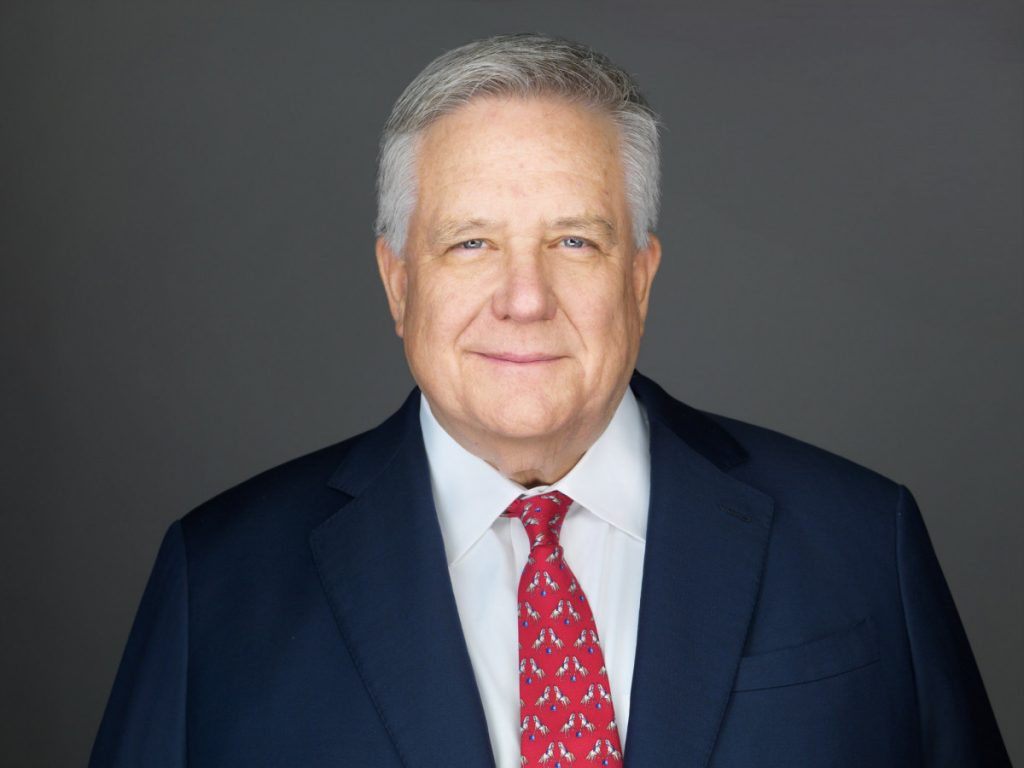
Deborah Treft
Staff Writer
In 2025, Dennis Wilder spoke about the fall of Saigon 50 years earlier for the Chautauqua Women’s Club’s Contemporary Issues Forum.
This season, CIF marks the United States’ 250th Independence Day by bringing Wilder back to reveal some of the little-known but highly intriguing history that he has uncovered about General George Washington’s strategic prowess during the American Revolution.
At 3 p.m. Saturday in the Hall of Philosophy, Wilder will deliver an address titled “Washington’s Spies: Espionage in the Revolutionary War.”
“My fifth great grandfather, Jacob Wilder from Lancaster (Massachusetts), was 17 at (the April 19, 1775 Battles of) Lexington and Concord,” Wilder said. “He was a Minuteman. He held the horses at Bunker Hill (nearly two months later) because he was too young for the battlefield.”
Jacob joined the Continental Army’s artillery at Valley Forge in December 1777. According to Wilder, of the 12,000 enlisted men with whom he fought, a quarter died, a quarter returned home afterwards and half remained in the army.
“He was a matross — he swabbed the cannon down,” Wilder said. “He was so enamored of the Revolution that he named his son Benjamin Franklin Wilder. I’m a direct descendant — the line goes straight down from Jacob to my father — so I’ve studied a lot about that part of the war.”
On June 14, 1775, in Philadelphia, the Second Continental Congress formed the 25,000-person Continental Army, which initially represented the 13 Colonies. Largely composed of young, untrained men, it was just a little over one-fifth the size of the “far better-equipped” 120,000-person British forces and their mercenaries when they were at their peak.
“Washington was remarkable,” Wilder said. “He was only 43 when he became commander. He had some military experience in the French and Indian Wars, but not like this, and his officers were younger. These young men went up against the greatest empire on earth.”
Without accurate intelligence about the various locations of the British Army, defeat would have been a near certainty.
“Washington was a surveyor by profession, so geography was important to him,” Wilder continued. “… At the beginning of the conflict, they were bad at spying.”
Well versed in the dos and don’ts of military spy-craft, Wilder has worked as a senior U.S. intelligence officer and policymaker advising presidents, and held other sensitive positions necessitating the highest level of security clearance.
For instance, Wilder served on the National Security Council as special assistant to the President and senior director for East Asia from 2004 to 2009. He was then appointed senior editor of the President’s Daily Brief, the intelligence publication of the Director of National Intelligence, until 2015 when he became the CIA’s deputy assistant director for East Asia and the Pacific.
Fast forward to last fall when the Government of Japan awarded him the Order of the Rising Sun for his services to US-Japan relations.
Currently, Wilder is a professor of practice at Georgetown University’s School of Foreign Service, a senior fellow of Georgetown’s Initiative for US-China Dialogue on Global Issues, and a visiting professor at Texas A&M’s George H. W. Bush School of Government and Public Service, which is also based in Washington, D.C.
“I’m teaching the history of military warfare from 1927, the beginning of the Red Army (in China),” Wilder said. “My favorite lecture of this course is the future of warfare.”
In this class he talks about the three categories of weapons employed by the U.S. military: 1. A human is in the loop saying “yes” or “no” to the activation of a weapon (as the U.S. has agreed to with the Chinese and the Russians). 2. Humans direct the weapon by giving it a set of parameters and instructions, and then “it does what it’s supposed to do.” 3. The weapon is fully autonomous; “set the algorithms and it goes wherever.”
For instance, the sequence of mathematical instructions set for the fully autonomous weapon that destroyed a girls’ school in southern Iran, its students and their teachers was based on bad data. In this case, they incorporated outdated intelligence about an Iranian naval base.
“That’s the hell of war,” Wilder said. “The other part is neuro-technologies. What kills soldiers on the battlefield more than anything is fatigue; falling asleep and being killed. We can implant a stimulus at a very simple level. But we can also make [soldiers] super-human for two to three hours.”
He continued: “The other thing is the human / computer interface. You can control a computer from your head, and soldiers can communicate via Neuralink. Elon Musk is involved. So the future is just wild. This is all being done without moral guidance. There’s been very little discussion. The Pope has delivered an encyclical, but what else is there?”
In a number of cities today, “you don’t need to have a person following you around,” Wilder said. “It can just be the (surveillance) cameras. The key thing to understand is that human agents can be so knowledgeable.”
Although technology can gauge another nation’s capability-related “secrets” such as the number of tanks a country has amassed along another nation’s border, its intent-related “mysteries” — “what’s in the other guy’s mind” — are “the bottom line” for U.S. military decision-making. It is the human agents living and working within countries of concern who provide that crucial intelligence.
“Although the technology has changed, the fundamentals of spy-craft have not changed,” Wilder said. “… Indeed, the case can be made that without espionage, America may never have become a nation.”