Sophia Rooksberry
Staff Writer
Over the past six months, hundreds of students at local elementary schools have gone on a multi-phase journey to becoming playwrights; a few of these young writers now boast a resume that includes a staging of their work at Chautauqua Institution.
The Young Playwrights Project facilitated this experience, through which teaching artists visit local elementary schools and engage with students over the course of three phases. In the first phase, these artists teach the fundamentals of playwriting and begin to inspire creative flow across classrooms.
“Then we send those students off and they go write their own plays,” Emily Olcott, one of the teaching artists, said. “… In phase two, we come back, go into each and every classroom and read every single play out loud.”
It was during the second phase that Suzanne Fassett-Wright, the Institution’s director of Arts Education and organizer of the YPP, saw students’ confidence begin to build.
“I saw a lot of kids hiding behind their desk at first when they knew it was going to be their play, and then as they were celebrated and as it was acted out, you literally would physically watch them start to lift up,” Fassett-Wright said. “… At the end they were beaming, taking bows.”
This boost in self-assurance is one of the many goals behind the Young Playwrights Project. In addition to giving students the chance to appreciate their own creative voice, the project aims to involve students in Chautauqua’s overall mission.
“When we think about exploring the best in human values here, we talk about centering the arts, we talk about convening important conversations,” Fassett-Wright said. “What more important conversations can we have than with our kids and empowering them to feel that they have a voice in those conversations?”
These crucial discussions took place across 470 different plays that were read aloud during the second phase, focusing on everything from bullying to finding friendships in unlikely places.
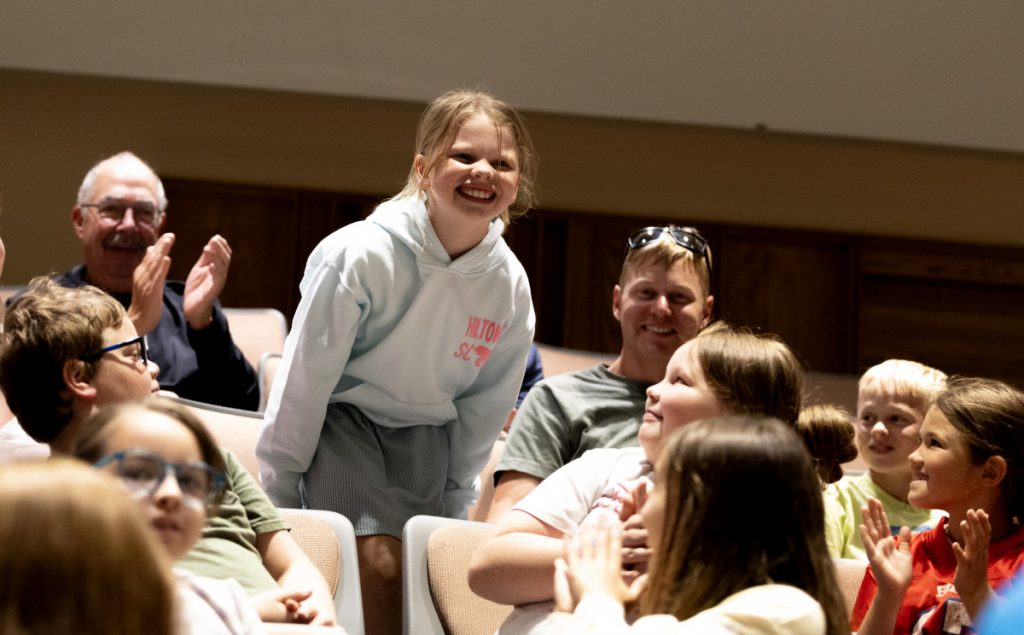
The group of six teaching artists performed nine of these plays on June 18 at Elizabeth S. Lenna Hall. That afternoon, the only thing brighter than the performers’ electric orange T-shirts was the energy of the crowd, comprising hundreds of elementary school students itching to witness their work, or that of their classmates.
From Mr. Mean by David Figueroa, a third grader at Bush Elementary, to The Play Gon’ Wrong by Thea Baehr, a fourth grader at Ring Elementary, the works tackled concepts like caring for the environment, grappling with a friend moving away and rediscovering childlike wonder.
“A theme that I felt coming forward was through The Big Debate, that we can like different things and still be friends,” Fassett-Wright said about the play written by Anna Leone and Olivia Ordines, two third graders at Lincoln Elementary. “I think that was a very important message to be heard right now.”
Each subject offered a glimpse into the minds and lives of local schoolchildren, and Olcott hopes the YPP provided those students with the resources and platforms to creatively express themselves.
“We just hope that (the students) take away from it a love of their own ideas, love of storytelling and a love of writing,” Olcott said. We hope that they feel affirmed in their ideas and in their creativity.”
In addition to the artistic lessons learned by the students, the insights they provided into the lives of young people in the surrounding community were equally impactful on the program’s facilitators.
“We’re super proud to bring these students here, but also to get to visit them in their schools,” Fassett-Wright said. “We learn as much from them about this community and their world as they learn from us about the arts. It truly is a collaboration, and we’re really proud to get to do this engagement work.”