
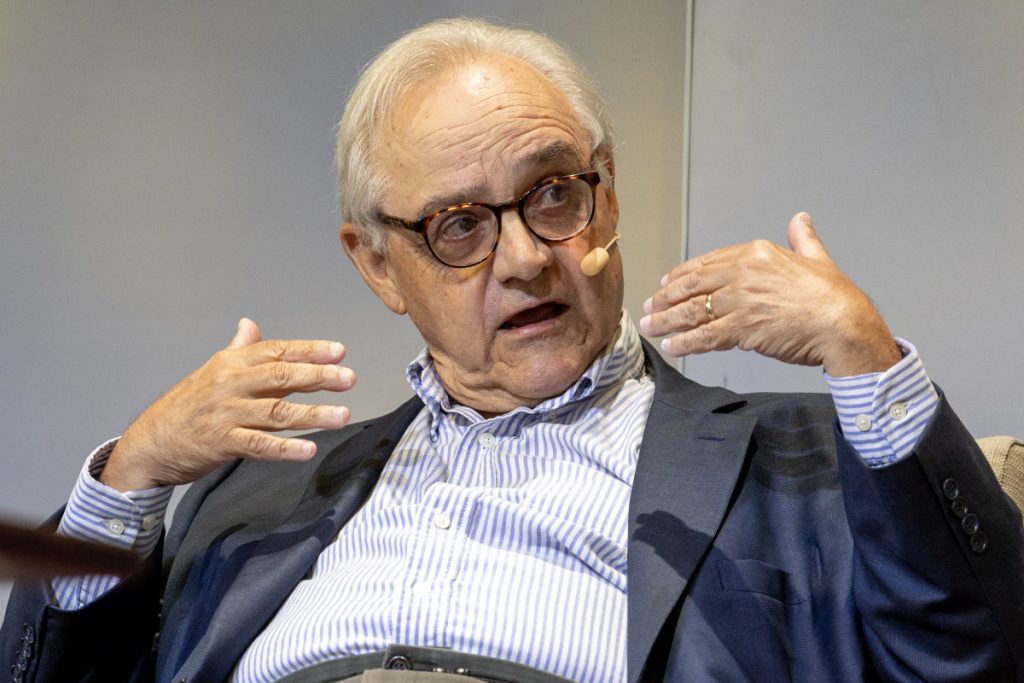
W. Averell Harriman Chair in American Governance E.J. Dionne, Jr. speaks about the link between American culture and politics Thursday in the Amphitheater.
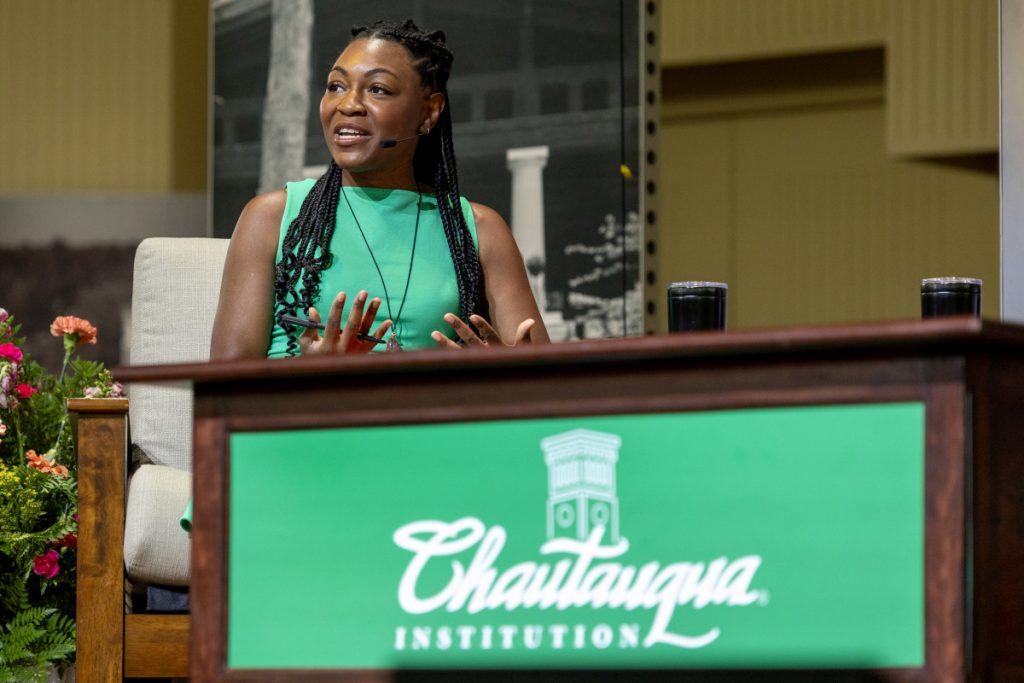
American Enterprise Institute Senior Fellow Christine Emba discusses the role of religion in politics with Dionne.
ARIANNA NEVAREZ
Staff Writer
From culture wars to religion, E.J. Dionne, Jr. and Christine Emba analyzed possible influences on midterms, adding to the weeklong theme of the 2026 election at 10:45 a.m. Thursday in the Amphitheater.
Dionne is a senior fellow and the W. Averell Harriman Chair in American Governance in the Governance Studies program at Brookings Institution, where he focuses on government, elections and religion.
Emba is a senior fellow at American Enterprise Institute, where her work focuses on gender and sexuality, feminism, masculinity, youth culture and social norms.
Their conversation opened with a focus on the overlap between political events and cultural moments.
Dionne said it is hard to disentangle the political and cultural. He said the Civil Rights Movement was an enormous cultural moment in the U.S. because it radically changed the country and its view of race over time.
Emba said the most salient cultural moment of her life was when President Barack Obama was elected to office. She felt she could influence the government and the world. She also said Roe v. Wade made a large cultural impact on women and girls, and that this radicalized a whole generation of women and made them more politically involved.
In discussing the importance of politics in developing and shaping culture, Emba said that Obama was formative to her life. Today, President Donald Trump’s administration holds similar influence over Generation Z, but it represents government as chaotic, untrustworthy and nihilistic.
“There’s a sense that nothing works, and it’s not worth trying, that the American dream may not be available to [people] anymore, that they should be able to keep their heads down and protect themselves because clearly no one in Congress is looking out for them,” Emba said. “I find that really sad and also pretty alarming for the country moving forward because to have participatory democracy, you have to have people who believe in that democracy, who still believe that the institutions can do something for them, instead of viewing them as failures that are not worth being constituted.”
Mass culture used to allow people to connect with one another by watching the same news platforms or sources of entertainment, but Dionne said these experiences are now divided by generation, class and region, creating culture wars. He said the task of politics is to heal these wars, yet it is currently doing the exact opposite.
“Younger Americans grew up almost entirely in a period defined by cultural wars, and that’s had a real impact on how they think and look at politics,” he said.
The introduction of the iPhone was the most significant cultural moment in the past 50 years that eventually had political implications, according to Emba. In the digital age, she said, the algorithm rewards extremism because it makes people excited and emotional, which drives engagement and keeps them logging back onto the apps.
“The impact that being embedded on our phones and on social media, and being fed these very different and very extreme streams of information, has really, really shifted how people come to understand and act in a political situation,” Emba said.
The two then talked about the shifting place of religion in politics, specifically, the role of the pope.
Dionne said Pope John XXIII inaugurated a radical shift in Catholic thinking, particularly about religious freedom and democracy, and more recent popes have moved in a more progressive direction. He said Pope Leo XIV has an important impact on both how the Catholic Church speaks and on the broader political conversation.
Though there has been disaffiliation within Christian religions, Emba said interactions between Trump and Pope Leo XIV have generated significant discussion and, in some cases, people returning to religion after seeing the moral authority the pope carries. She said there is something appealing about Pope Leo XIV publicly stating how society should view immigrants and welcoming the LGBTQ+ community.
“I found that incredibly heartwarming and inspiring, a moment of hope,” Emba said. “… But the moment in which the church and the pope have broken Catholic containment, as it were, is when popes speak up about real questions of morality, about human rights, war, immigration and people see that we can still have these moral conversations in the public square and that somebody is going to stand up for something.”
On the topic of religion in politics, the speakers discussed the Texas Senate race between James Talarico and Ken Paxton. Dionne said Talarico is emphasizing “the demand of Christian faith for social justice and greater equality,” while Paxton is going into the “old culture wars conversation” and challenging Talarico’s masculinity.
He said this election will be a “showdown” between the historically conservative view of politics, culture and Christianity versus “a new conversation” about the interaction of Christianity within politics and culture.
In a discussion about culture influencing the 2026 election cycle, Emba revisited the 2024 election, which was driven by culture war issues, specifically in regard to questions around gender, LGBTQ+ rights and masculinity. But, she said, voters are tired of talking about these issues. Instead, she said she thinks the main focus will be more about class and economic concerns.
To close, Dionne said there is a shift in election culture. He brought up one of the Republican party’s advertisements that ran during the election between Trump and Kamala Harris, which Dionne said incorrectly claimed Harris made transgender issues the center of her campaign. Dionne said in recent 2025 state elections, candidates across the country have tried to run the same kind of advertisement, yet they aren’t working.
“I do think that tells us something potentially about the shift on cultural issues,” Dionne said. “Again, we’re going to see that we’ll have real-time information about this in a few months to see how these issues play out. It’s like Dorothy in the ‘Wizard of Oz.’ It’s not 2024 anymore.”