
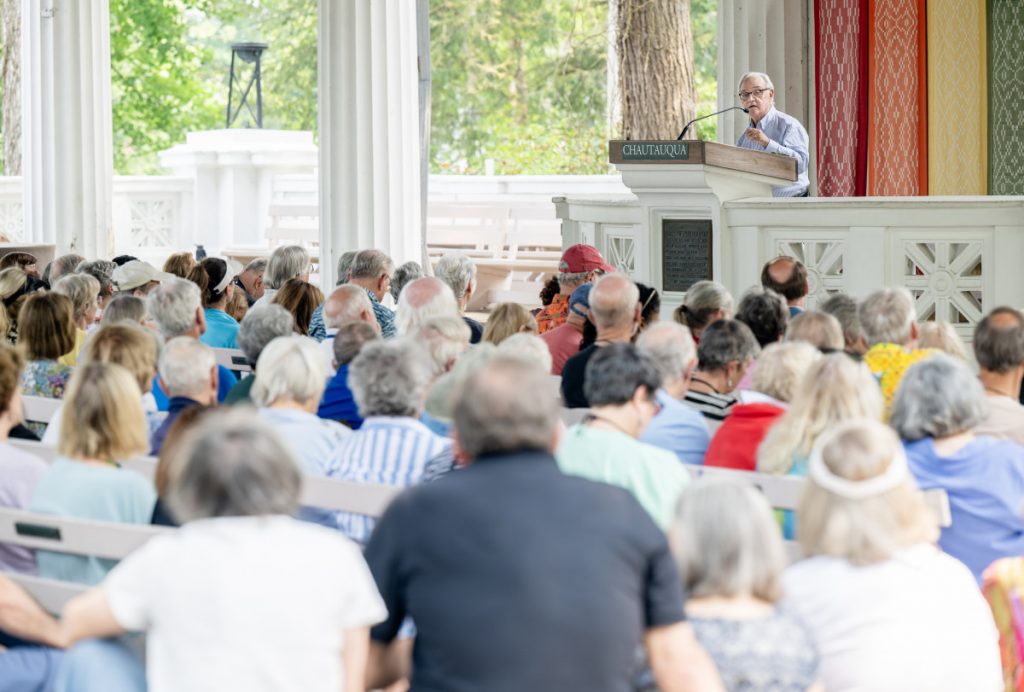
Chautauquans listen to W. Averell Harriman Chair in American Governance E.J. Dionne, Jr. speak about civility in American politics Thursday in the Hall of Philosophy.
LILY RESLINK
Staff Writer
E.J. Dionne, Jr. has been described throughout his life as someone who sees positivity even when it isn’t there, and his positive outlook toward shifting morality was the subject of his 2 p.m. Thursday lecture in the Hall of Philosophy.
Accusations of “toxic positivity” and “hopemongering” aside, Dionne said his outlook on how the U.S. is bound for a positive trajectory is rooted in faith, historical patterns and Stein’s Law: “If something cannot go on forever, it will stop.”
Dionne said he observed the collective mood of the U.S. to be encapsulated in activist Fannie Lou Hamer’s quote: “I am sick and tired of being sick and tired.”
In his Interfaith Lecture, Dionne presented what he said are two “hinge points” in national conversation. One of these points focuses on transformation in how the U.S. approaches moral questions and political debates — “to swing from focusing on issues of individual behavior before highlighting our social obligations: our obligations to each other.” Dionne’s other point argues that U.S. politics is entering a new era, which was birthed out of frustrations, but he anticipates it will end promisingly.
Dionne self-identified as “proudly on the progressive side of politics” before saying, “wherever you may stand on Mr. Trump, I do believe that the approach to politics he inaugurated — coming down that escalator a decade ago — is on the decline.”
He said politics going haywire is not shocking, however, “because so much has gone haywire over this very long quarter century.” The country is ready to move again, according to Dionne.
He said there are promising themes he sees powerfully represented across the country and in election campaigns this year. “We are witnessing, I believe, the return of a politics morality organized around the injustices of our economic system and array of related problems.”
Rather than getting bogged down by political polarization, he said, another lens to view division is being “torn between our affection of individualism and quest for community,” referencing the Declaration of Independence as “a fascinating demonstration of these twin sides of our national character.”
“I like to joke sometimes that the Democrats discovered God in the 2004 exit polls,” Dionne said. He said the controversial polls yielded results of 22% of people voting on the basis of moral values, with 80% of those respondents having voted for George W. Bush.
“Moral engagement with the economy, social justice and technological revolution has deep American roots, both secular and religious, at the high tide of the progressive era,” Dionne said.
Dionne tied this “hinge moment” to a resurgence in the kind of Christian progressivism represented in the words of Martin Luther King, Jr.: “With this faith, we will be able to work together, to pray together, to struggle together, to go to jail together, to stand up for freedom together, knowing that we will be free one day.” Dionne referenced King’s use of the metaphor of carving a stone of hope out of the mountain
of despair.
Dionne said he sees views and language around morality are shifting closer to what King embodies.
“I think this shift goes deeper than electoral politics,” Dionne said, adding that he sees Matthew 25 at the heart of political debate, which calls for mercy on the hungry, sick and imprisoned.
Dionne shared several reasons why he thinks America is in for something different going forward.
Citing U.S. politics in the 1970s, Dionne said it is hard to miss structural similarities between now and the era that “brought down Carter,” which shifted political economic thinking globally to the right.
He pointed to “hyperglobalization and growing inequalities” that he said make current policy not sustainable to continue.
Dionne said the top 20% account for nearly 60% of consumer spending. “It is not a good distribution of income for social justice nor market capitalists. He said wherever you stand on the climate crisis, “rising oil prices remind us that renewable energy is a good idea.”
He said he truly does not know who is fit to lead the country next, but he said he does know Americans “want an end to ‘sick and tired’ politics.”
Another reason Dionne sees change coming is in the shared goals that surpass differing motivations. “Protecting the planet is a moral issue, but it is also an economic issue,” he said.
He said arguments won’t disappear, but he anticipates that the focus of arguments will be more on how to solve social problems.
He called upon for improvement both individually and as a community member. From his lecture’s introduction that reflected on what tradition means for humanity, Dionne segued to these points from a recognition of Chautauqua: “I’m glad Chautauqua knows that in the midst of change, it takes seriously to honor its origins, to keep spiritual conversation alive, to know what to keep.”
Dionne carried this theme of balancing historical recognition with progress through the call of action he closed on: “We know we can do better. We also know that we must.”