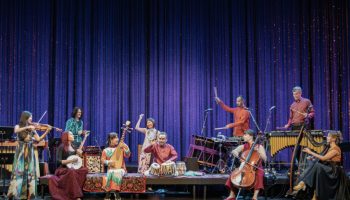
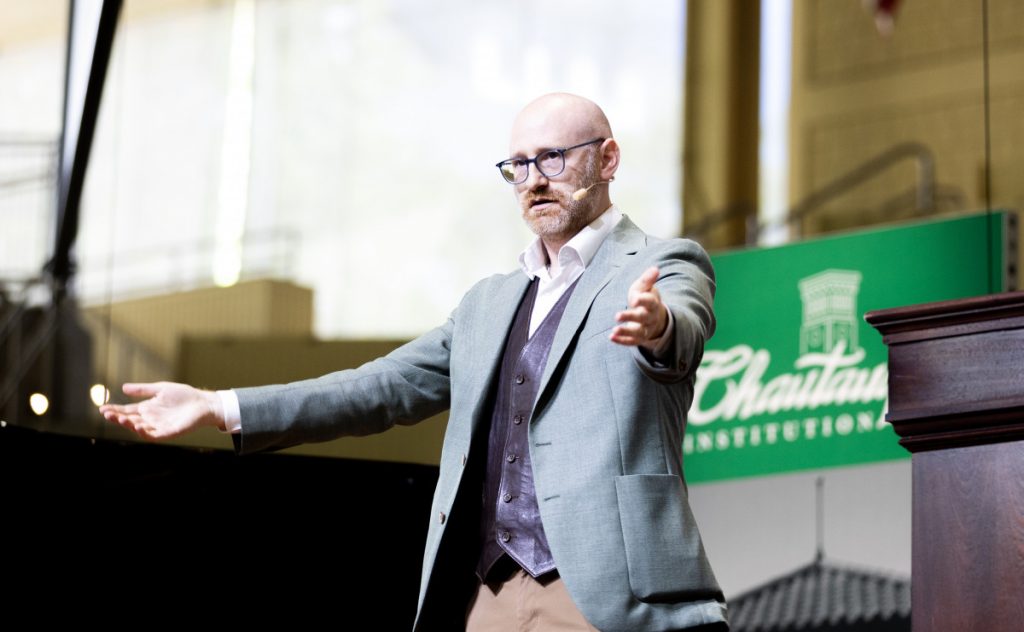
Micah Hendler, founder and artistic director of the Jerusalem Youth Chorus talks about creating dialogue through music Thursday in the Amphitheater.
ARIANNA NEVAREZ
Staff Writer
In most movements, Micah Hendler said dialogue and justice are often pitted against one another, but neither is sufficient on its own. He said both are necessary to create solutions to today’s problems. Throughout his life, he has faced a question of how to intertwine them to create something powerful.
“I’m still seeking the answer to that question, but I’m not doing so alone,” Hendler said. “I have fellow seekers in the group of Palestinian and Israeli young people in Jerusalem called the Jerusalem Youth Chorus, or JYC for short.”
At 10:45 a.m. Thursday in the Amphitheater, JYC founder and artistic director Hendler shared insights into his relationship with music, how the JYC has fostered a place for dialogue and shared his perspective on how to create change through conversation. He even turned the Amphitheater into a choir.
During Week Five’s “Art and Artists Against the Odds,” Hendler said the singers he works with fit the week perfectly. The singers in JYC are teenagers who come from East and West Jerusalem, but he said the route they travel “demands courage.” Hendler shared that an Israeli soldier stopped one of the choir’s Palestinian singers on his way to practice, and the officer forced the boy to sing in order to be released.
“When that is what it costs to show up to sing, you have to ask a serious question: What is singing for, and how can we defend it?” Hendler said.
In response to this situation, the JYC created a song called “Reason to Love,” which stems from the Jewish phrase “ahavat chinam,” which translates to “baseless love.”
Hendler recalled the first time he harmonized with others and how music became a constant throughout the rest of his life. He realized that music could be a tool to create a sense of “togetherness and trust.”
On a ninth-grade community service trip, Hendler said he heard about the Seeds of Peace camp, which brought children from conflict zones together and allowed for “structured conversations about challenging topics.” He ended up attending the camp and said listening to his Palestinian friends describe their lives of fear challenged his beliefs and made him think more critically.
“I listened to my new Palestinian friends describe their lives shaped by loss, by checkpoints, by fear of the same soldiers I had been raised to see only as protectors,” Hendler said. “I began to see the shadows cast by those I had looked up to only as idols. Being in dialogue challenged everything I thought I knew from growing up.”
Hendler said dialogue “reveals story by story what each of us cannot see on our own.” He said he also saw how music could create “a sense of shared identity” in a group of people who were taught they would not get along or have anything in common.
Hendler said in October 2000, Israeli police killed Asel Asleh, a 17-year-old Palestinian citizen of Israel, while he was peacefully protesting. This event that changed Hendler’s life without even knowing Asleh.
“Israel convened an official state commission of inquiry to investigate the protests in which Asel and 12 other Palestinians of Israel, citizens of Israel, were killed in October,” Hendler said. “The commission condemned the police’s use of lethal force, and still no one was ever indicted — not for the death of Asel.”
Hendler said the absence of accountability is “not the exception” and “is closer to the rule.” He also said this was “one of the most tragic pieces of the violence in Israel and Palestine” because he said the act committed was “agnostic to a victim’s own views, attitudes toward the other, or even actions toward a better future.”
“The Israeli policeman who shot Asel in 2000 didn’t bother to ask him first whether he believed in peace, and the Palestinian militants who killed Vivian Silver, a fellow peacebuilder of mine, on October 7 didn’t first stop to learn that she spent much of her time helping Palestinians from Gaza get to Israeli hospitals for medical treatment,” Hendler said. “They were too full of hate and fear and an assuredness that what they were doing was right to consider the human being in front of them.”
When Hendler visited the Seeds of Peace camp, he learned about Asleh’s death. Hendler then created “the most profound piece of music [he had] created in [his] whole almost 18 years of life until that moment,” which centered around Asleh’s favorite poem; he performed it for Asleh’s parents.
When Hendler turned to see their reaction, he received blank stares. They thanked him, but he continued to wonder about the experience and reflected on it through a question he wrote in his notebook: “Why did I assume that my music would be meaningful to them in the first place?”
“I was writing with musical stereotypes, and they did not like it,” Hendler said. “It was just another blind spot that I had. … That night, they gave me Asel’s room to sleep in. I lay awake in the bed of a boy who believed in this field, who was killed at the same age that I was when I lay there, and I asked myself a question that has driven me ever since: What is my responsibility? What am I going to do with the skills, passions and understandings that I have, and the opportunities that I have been given?”
As a student at Yale University, Hendler wrote his thesis about what he had experienced at Seeds of Peace, a place with controllable variables, and whether something like this could survive on the ground in Jerusalem, where he said there are multiple uncontrollable variables.
To test his thesis, Hendler moved to Jerusalem. At first, starting the JYC was difficult, but he said 80 students showed up to the first audition, most of whom were Palestinian. He said the organization was “tapping into something that these kids needed deeply — a space where they could be heard.”
In the JYC, Hendler said the “heart of the program” is when the singing stops and the dialogue starts. He said this is where participants “find their own voices offstage as they do onstage.” Singers may have different experiences and opinions, yet he said the JYC became a safe space to learn and grow.
In a broader conversation, Hendler said, “justice without reconciliation is simply vengeance,” and moves oppression from one side to the other.
“I believe to the core of my name that any possible future for Israelis or Palestinians must be a positive future for Israelis and Palestinians,” Hendler said. “We are not going to get to that shared future without partnership, and we will surely not get to that shared future if we can’t even imagine how it could be. In the ever-descending darkness of our time, peace and justice feel so very out of reach, and that is precisely where singing comes in.”
Following the attacks that took place Oct. 7, 2023, the Biden administration called the JYC to perform, but the chorus declined, saying they would “not provide the soundtrack while the administration was largely funding war.” Instead, the singers sat with National Security Council staff and presented policy proposals joined with personal narratives about their lived experiences, Hendler said.
Hendler said his singers have faced public shame and attacks, yet they have continued to speak up and sing. He said participants in the JYC don’t always share the same opinions, but they come together to sing and have hard conversations knowing that they all share the same future.
“No matter what the politicians say, we know that we do not have the power single-handedly to stop war,” Hendler said. “But we also know that the reason that war continues is because people think there isn’t a different way — we are the different way.”
To close, Hendler sang his song “What to Do” and spoke about the lyric “walk humbly with God.” He said whether one is a person of faith or not, everyone has a responsibility to create good with the abilities, understandings and tools they were given.
“Humanizing one another is not naive,” Hendler said. “It is the starting point for any positive, sustainable change. You cannot build a coalition, change a policy or heal a society with people you have stopped seeing as human beings.”