
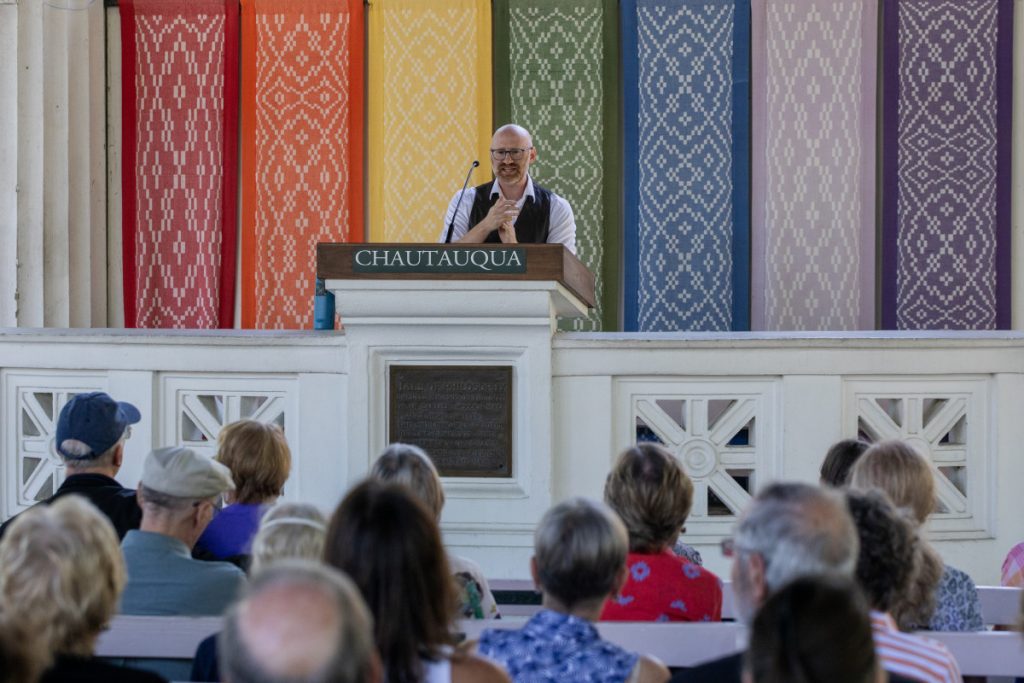
Micah Hendler leads Chautauquans in songs about community, religion and peace Thursday in the Hall of Philosophy.
LILY RESLINK
Staff Writer
In English, Hebrew, Xhosa and Arabic, Micah Hendler used his Interfaith Lecture as an opportunity to host a “community sing,” leading Chautauquans of all levels of experience in song.
At 2 p.m. Thursday at the Hall of Philosophy, audience members began as listeners — but only for mere moments. Hendler, founder and artistic director of the Jerusalem Youth Chorus, gave an introduction in under a minute and then began the participatory singing event.
“Repeat after me,” he began. For Hendler, — a frequent leader of community sings — it was essential to bring Chautauquans into the creative process as artists themselves.
As “the warm-up,” Hendler selected “One Foot/Lead With Love” by vocal activist Melanie DeMore, who wrote the song after the 2016 presidential election. He said DeMore sought to answer the question of “What is the way forward?”, and the pursuit of this answer resulted in the song’s lyrics: “Put one foot in front of the other, and lead with love.”
He said he sees the spirit of this lyrical answer as relevant across every moment.
After the first song ended, Hendler said three minutes prior, one might not have known anybody else in the Hall of Philosophy.
“And now here we are, and we’ve already experienced something together … that we co-created,” Hendler said. He said the act of co-creation can represent the power of singing together, which he described as singing’s “highest and best purpose.”
Hendler said he selected the five songs for the program based on Week Five’s Interfaith Lecture Series theme: “The Creative Spirit: Art, Resilience and the Soulful Work of Making.” He said the songs come from across different faiths and traditions.
Next, Hendler led the audience in the 1949 protest song “If I Had a Hammer” by Pete Seeger and Lee Hays. He spoke to the impact of folk music as a genre, explaining the unity that results from folk often being widely known and not complicated to sing.
Across contexts, he said, “The song has been used to move the needle of history in the direction it needs to go.” On this note, he prompted the audience to think about the areas where music can make a difference right now.
Acknowledging it as lesser-known but easy to learn, Hendler segued into the 2020 folk song “We Rise” by Batya Levine, a Jewish prayer leader and musician.
While emphasizing the word “rise,” Hendler prompted the audience to stomp and clap with the rhythm.
The next song, entirely in the Xhosa language, was “Akanamandla,” which he said means “we have the power.”
With the spiritual South African song, Hendler said he wanted “to move to a different context and different place where music and communal singing have changed history.” He said the song has served as a testament of how communal singing has changed a “system of injustice.”
Hendler noted the impact of not only the lyrics but also of the syncopated form. “Everything is right before the beat, which gives it so much more energy and life,” he said. This, he said, is a song he taught in the first rehearsal of the JYC.
In an impromptu moment, Hendler’s mother — who he said taught him to sing — joined him behind the podium to sing a countermelody of the song he translated into Hebrew.
Hendler introduced the fourth song, أدينُ (Adinu), by sharing the lyrics: “I believe in the religion of love, wherever love is found, for love is my religion and
my faith.”
“Those are the words we’ll be singing, but in Arabic,” he said.
Amid the communal singing session, he asked the crowd to hold a note while he shared “the parable of choir in terms of social change.” No individual can hold a note forever, but, he said, a choir can.
“As long as you breathe out a different time than your neighbor, the note does not stop. That is how it is also in social change and movements and grassroots action,” he said. “No one person can do everything, but together, maybe we can do everything.”
“Can we fill this temple with sound?” he sang.
He ended with “Give Us Power,” which he said he learned from singer and composer Ysaÿe Barnwell. For the “finale,” Hendler prompted the audience to rise to their feet.
To conclude, he thanked the audience for joining him on this “adventure” — both in singing in different languages for what may have been the first time and for “diving into this communal experience.”
“It’s really something that I don’t take for granted and something so rare in today’s world, to be able, together, with a group of strangers in a non-bounded context — not in the context of a particular religion or particular gathering, but just because we’re human beings,” Hendler said.