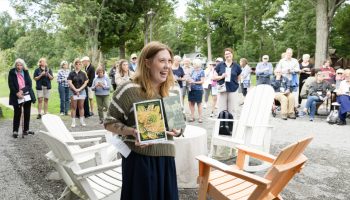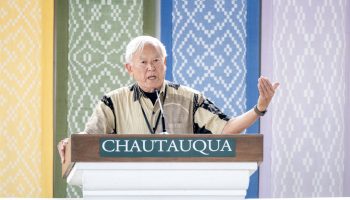

Chautauqua Literary and Scientific Circle Week Nine speaker Kelly Link reads a reimagined fairy tale from her book White Cat, Black Dog Friday in the Hall of Philosophy.
NORA SMITH
Staff Writer
At 2 p.m. Friday in the Hall of Philosophy, Chautauquans listened attentively as national bestselling author Kelly Link told ghost stories and fairy tales and encouraged others to do the same.
Link began her presentation by asking the audience to “take a moment and think of a fairy tale that you loved when you were a kid, one that a parent read to you or one you maybe read to a child.”
Chautauqua Literary and Scientific Circle Week Nine selection White Cat, Black Dog is a collection of seven short stories that Link said draw on “two still very lively streams of folklore and tradition: fairy tales and ghost stories.”
“I’m going to ask you, too, that you think of a true ghost story,” Link said.
Once audience members conjured up stories in their minds, Link introduced White Cat, Black Dog and said some stories are retellings of fairy tales while others are loosely connected to the source of inspiration by either imagery or characters.
“I know the theme of this week is community, and this is one of the things about fairy tales — like ghost stories, they are communal property,” Link said. “They’re meant to be told to an audience who is already familiar with some versions of them. They’re meant to be taken by that audience and mixed and remixed and made new.”
Link said when writing, she sought for White Cat, Black Dog to enter the bustling conversation between stories and narratives already in abundance.
Before reading from the collection’s first story, “The White Cat’s Divorce,” and speaking to the retelling’s inspiration, Link provided the audience with some context of the original fairy tale, The White Cat by Madame d’Aulnoy.
After garnering a collection of chuckles in reading an excerpt of the story, Link closed the book and spoke to the value of storytelling.
“For over 30 years now, I have had the extraordinary good fortune; I have spent most of my life reading, thinking about and making up stories, stories which could not possibly be true, though I hope they contain truth in them… ” Link said.
Link said she has reflected on why fairy tales are designed to entertain children before making what she referred to as “a large claim for the value of stories” based on author John Crowley’s essay, “Practicing the Arts of Peace.”
Link read from Crowley’s essay: “What we want is a world in which fantastical stories are possible and are valued, and (in) which there’s nothing so dreadful or urgent that it causes the writing of such things to stop or be stopped. … Worlds where the arts of peace can be practiced are wounded worlds, and that is why we have to go on practicing those arts so that our worlds don’t die.”
Link said Crowley defined these “arts” as those that don’t aim to convert, convince or instruct but instead follow their own aesthetic imperatives, inspired solely by the drive to see what one can create.
Just as she asked of Chautauquans at the beginning of the presentation, Link said she often has her students think of fairy tales and ghost stories they’ve heard when teaching creative writing workshops.
“I teach them to draw from these two types, because the ghost story and the fairy tale are designed to be told out loud, which is the origin of all storytelling,” Link said. She added that both story forms are designed to be told consistently and remembered: Fairy tales are about transformation, and ghost stories are about going beyond reality and facing issues that cultures often ignore.
Link shared some ghost stories and emphasized the importance of fairy tales and ghost stories today.
“We must practice Crowley’s arts of peace because they tell us change and transformation remain possible,” Link said.
Link concluded her presentation by encouraging audience members to tell family stories, ghost stories and of course, fairy tales to one another when gathering.
“We ought to be kind,” Link said. “We ought to be helpful. We ought to believe in the possibility of transformation and change. We ought to remember, too, that the arts of peace are communal. They are playful. They are a human practice. They don’t require special skills, and they don’t need to serve a serious purpose, but the purpose and real meaning may arise out of them.”