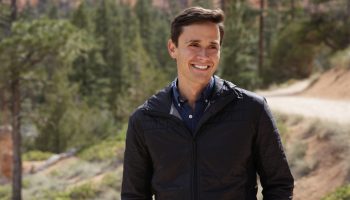
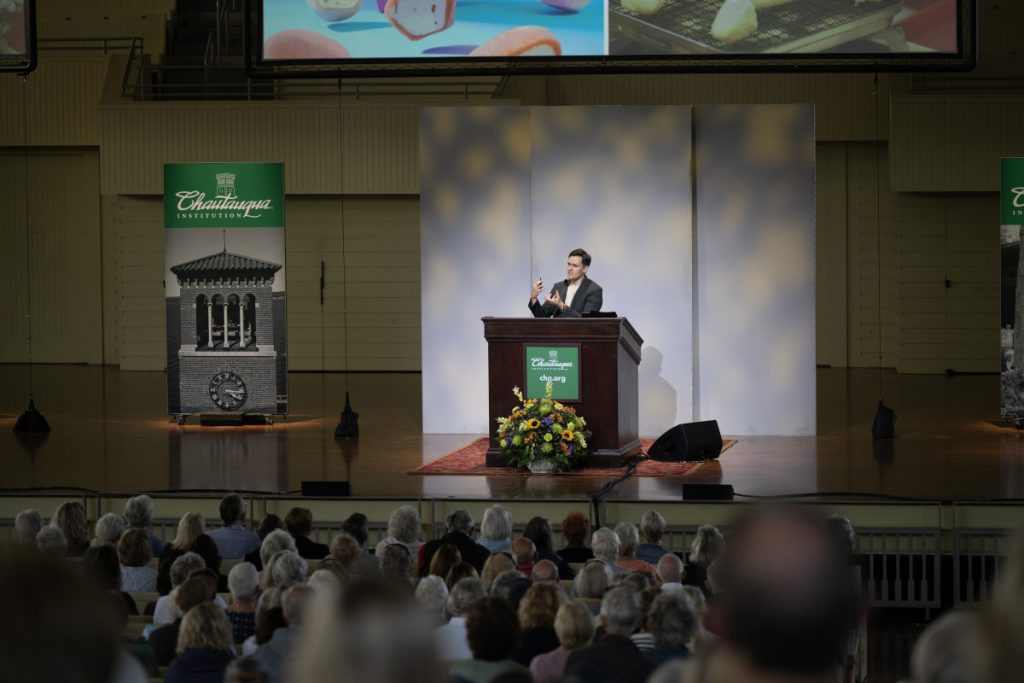
Conor Knighton tells stories of unconventional conventions Friday in the Amphitheater.
SOPHIA ROOKSBERRY
Staff Writer
Friday morning, on what Conor Knighton described as Chautauqua Institution’s “last day of school,” the “CBS Sunday Morning” correspondent made it his mission to entertain the audience with his unique bank of experiences. With a self-defined subspecialty in unconventional gatherings, Knighton brought riveting stories to the final lecture under this week’s theme, “The Importance of Gathering: A Collaboration with the Smithsonian Folklife Festival.”
“I’m happy to see so many of you here this morning, considering all of the other gatherings you could be attending,” Knighton said. “Today is the Pokémon World Championships in San Francisco. In Pittsburgh, the American Numismatic Association is hosting the World’s Fair of Money … It is Bigfoot Eve, the preview event for the Western North Carolina Bigfoot Fest. A Marriott in Houston is hosting StratosFur, which is a space-themed furry convention for people who enjoy dressing up in animal costumes. If any of you have to leave for that, I understand.”
Before Knighton landed in this subgenre of reporting, he embarked on a yearlong journey to visit every national park in honor of the National Park Service’s centennial.
“While that was such a solo year, I did throughout it feel constant connection,” Knighton said. “That’s because the parks are our literal common ground. I know I say hi to more people, more strangers, in just a day of walking on a trail than I might in a month of walking around the city, because when you see somebody on the trail, you feel like you have something in common with them, and you do. You have both chosen to spend your leisure time in this very specific way.”
After 365 days on the road, Knighton said he felt a pull to reintegrate into the “CBS Sunday Morning” family. Fortuitously, this decision came right around the time one of his producers offered him an assignment covering the National Pie Championships in Orlando, Florida.
“For a guy who spent the entire year eating beef jerky and trail mix, that sounded amazing,” Knighton said. “The National Pie Championships have hundreds of bakers, thousands of pies. People come from all over the country … There are blue ribbons and small prize money, but basically people do this for their camaraderie. [A participant] mentioned that the reason that she prioritizes this every year is to be around like-minded bakers, sharing recipes, sharing ideas.”
From a journalistic perspective, these stories are more compelling when they revolve around a niche interest, such as visiting all 251 towns in Vermont or summiting the highest peaks in all 50 states. Knighton met a group of the latter adventurers while attending a convention of the Highpointers Club.
“I’m surprised at how many people had actually completed the list and kept returning to this gathering, because I think that community was very important,” Knighton said. “Highpointing is a pursuit that’s often done solo, and so this gathering is proof that they still want more than that. They want to be around other people and share their stories, share their struggles, share their successes.”
Although not nearly the highest point in the country, Charles Mound in northern Illinois is the most difficult point to reach, Knighton said. At just over 1,000 feet above sea level, Charles Mound exists on private land and is only accessible four weekends a year, during one of which Knighton visited.
“People started streaming in, and these were people who were on highpointing vacations — they were trying to hit seven or eight on a single trip — and so before long, I talked to far more people we could actually broadcast,” Knighton said. “I had all of my interviews taken care of, so then I got to sit back and just watch these impromptu gatherings take place as these people were able to connect. Somewhere in between all those highs and lows, they found this middle ground.”
Knighton has also attended gatherings with significantly higher attendance numbers; the World Concrete Festival hosts approximately 50,000 people a year for demos, contests and seminars all revolving around the world of concrete.
“There’s something really cool about seeing these people celebrate the skill that so often goes unnoticed,” Knighton said. “These guys all have regular jobs. They work on construction crews. No one’s applauding for them on the job site, but here they’re cheered on and hyped up by their peers.”
Another typically thankless work Knighton highlighted for “CBS Sunday Morning” was the craft of worm grunting, a method of coaxing earthworms to the soil’s surface by creating vibrations in the ground. Knighton attended the Worm Gruntin’ Festival in Sopchoppy, Florida, which keeps the craft alive even in the age of artificial fish bait.
“The festival developed after the industry was already in decline, and that’s to honor that worm grunting heritage,” Knighton said. “They crown a worm grunting queen. There is a gummy worm-eating contest. There is a worm fun run that they have, and then they take kids out to the yard and they have a worm grunting demonstration, all the while knowing they are not training the next generation of worm grunters. This is really just an excuse to have a party, and you see that a lot.”
On some occasions, these parties fit within incredibly specific niches, like the International Jugglers’ Association Championships or the Lumberjack World Championships, both of which Knighton found himself in the audience for. Other occasions are broader and encapsulate a myriad of interests, like the Iowa State Fair.
“I think [state fairs] might be the most quintessential of all American gatherings, because at the World of Concrete, it’s not really a spectator sport,” Knighton said. “Nobody with a fear of heights goes to the high point convention, but at state fairs, people gather to appreciate the unique talents of other people who are not part of their culture. You walk around and you see so many subcultures on display … You walk around that fair, and you realize that in your own state there are worlds that you never knew existed.”
After making a career for himself out of attending these assemblages, Knighton left Chautauquans with a final reflection about the nature of his reporting specialty.
“On the surface, these are not stories that impact a large portion of the population,” Knighton said. “5 million people watch ‘CBS Sunday Morning.’ 500 people live in Sopchoppy, Florida, and a crapload of worms. These are not what you would consider ‘important gatherings,’ but they speak to the importance of gathering. Maybe … you can’t attend a juggling convention, but if you’re anything like me, you’re glad that somewhere out there are people who are into that. You don’t need to be a concrete freak to be glad that others have found a way to bond over concrete.”