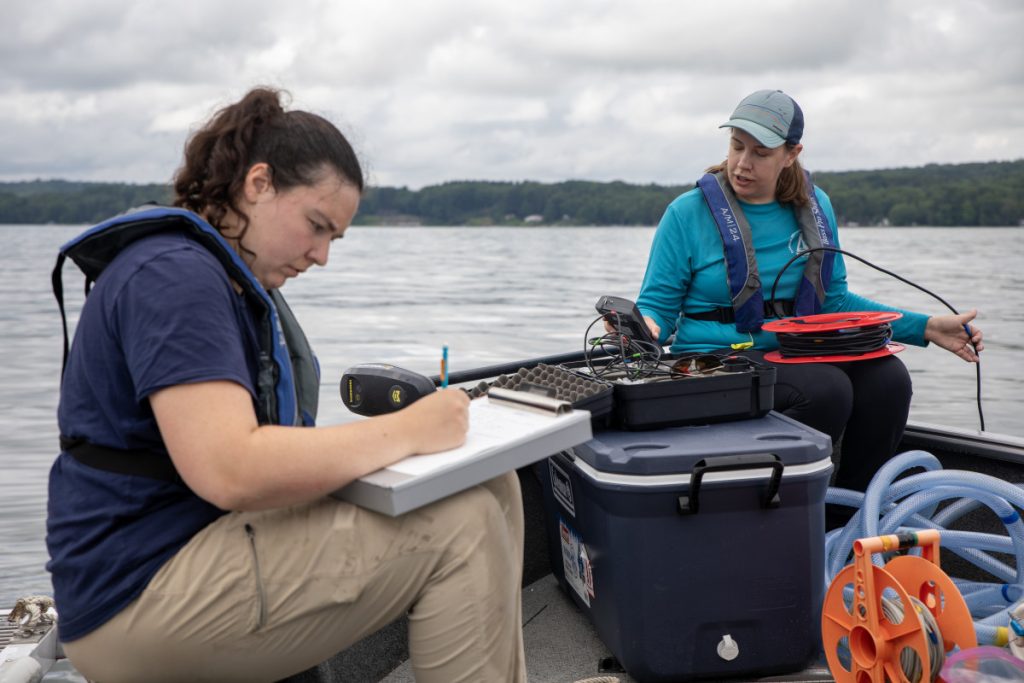
Kira Yerofeev, research specialist for the Darrin Freshwater Institute at Rensselaer Polytechnic Institute, left, takes notes on Chautauqua Lake’s water quality while fellow Research Specialist Allison Hrycik samples the water July 7.
JENNA OUTCALT
Staff Writer
Since 2020, research on Chautauqua Lake has expanded greatly as Rensselaer Polytechnic Institute has taken advantage of the lake’s algal blooms to investigate the phenomenon. However, the efforts to study it so intensively began with a research partnership at Lake George in the Adirondack Mountains nearly a decade earlier.
John Kelly, the father of IBM’s Watson supercomputer and a graduate of Rensselaer Polytechnic Institute, explained that the Lake George Association, Rensselaer Polytechnic Institute and IBM joined forces to study Lake George “like no other lake had ever been studied,” and The Jefferson Project was born.
“The goal was to instrument the lake, make it the ‘smartest lake in the world,’ which we did,” he said. “It’s by far the smartest lake in the world.”
Kelly said the project collected massive amounts of data and supported mitigation projects for the reduction of salt, nutrients, invasive species and more.
“I want that lake to be there for my grandkids and their grandkids,” Kelly said. “When we do this, we don’t think about it as just a ‘couple of years’ project. We think of it as multi-decade-long monitoring, measuring, understanding and action.”
When Lake George started having harmful algal blooms, the Rensselaer Polytechnic Institute and its lake research center, the Darrin Freshwater Institute, expanded its research to Chautauqua Lake to learn more about the phenomenon. Kevin Rose, the director of The Jefferson Project, said Chautauqua Lake received the most recent edition of the project’s vertical profilers, floating solar-powered structures that take measurements of the entire water column.
Rose explained that they first thought they could use a commercially available version of the profilers, but they soon realized that they would need more power and capacity for a higher frequency of samples.
“The commercially available ones were really overpriced toys, and they didn’t have the scientific capability that we really needed,” he said. “So we went back to the drawing board, and we basically reverse-engineered the good parts of what was there and added a lot more functionality onto it, and that’s the vertical profilers that you see today.”
Now, the sensors are taking four samples every second and profiling water all the way from the lakebed to the surface, where algal blooms used to sneak by sensors undetected.
Kelly explained that the frequency of sampling in a lake is extremely important. He said sampling a lake environment monthly is the equivalent of taking samples in a forest once every 1,000 years.
“Pushing the envelope, really sampling at really high frequencies, gives us a wealth of insight into the processes that lead to algal blooms, ecosystem degradation, water quality loss and water clarity loss, nutrient loads with severe storms, et cetera,” Kelly said. “And if we continue to sample it monthly, we would miss 99% of that.”
According to Rose, research by the Darrin Freshwater Institute on Chautauqua Lake is still in “the growth phase and the learning phase.” Researchers are currently trying to develop a nutrient “budget” for the lake, identifying when and where the biggest pulses of nutrients come into the lake.
“We can think about this tributary network as a circulation system, and there’s times when you’ve got a lot of major things flowing through that circulation system, and we want to be able to stop that,” Rose said. “We want to be able to put our pressure point right on that.”
Rose said with targeted mitigation efforts, change is possible.
“When you get the informed management and effective mitigation options on the table, we can improve things,” he said. However, he noted that the lake would see gradual improvements, not immediate health.
“You wouldn’t fix all water quality impairments because there’s been decades of previous input, and a lot of that is dissolved in the water or is in the lake sediments,” Rose said.
In the coming year, Rensselaer Polytechnic Institute is partnering with Everwild Land Trust to engineer a wetland along the Goose Creek tributary. The wetland will be designed to absorb nutrients like nitrogen and phosphorus that promote the overgrowth of algae and aquatic plants.
“(If) you reduce the nutrient loads, you will improve water quality over time, and that’s ultimately what our goal is,” Rose said.
According to Rose, the wetland system will also include a gate to divert water from tributaries to the wetland.
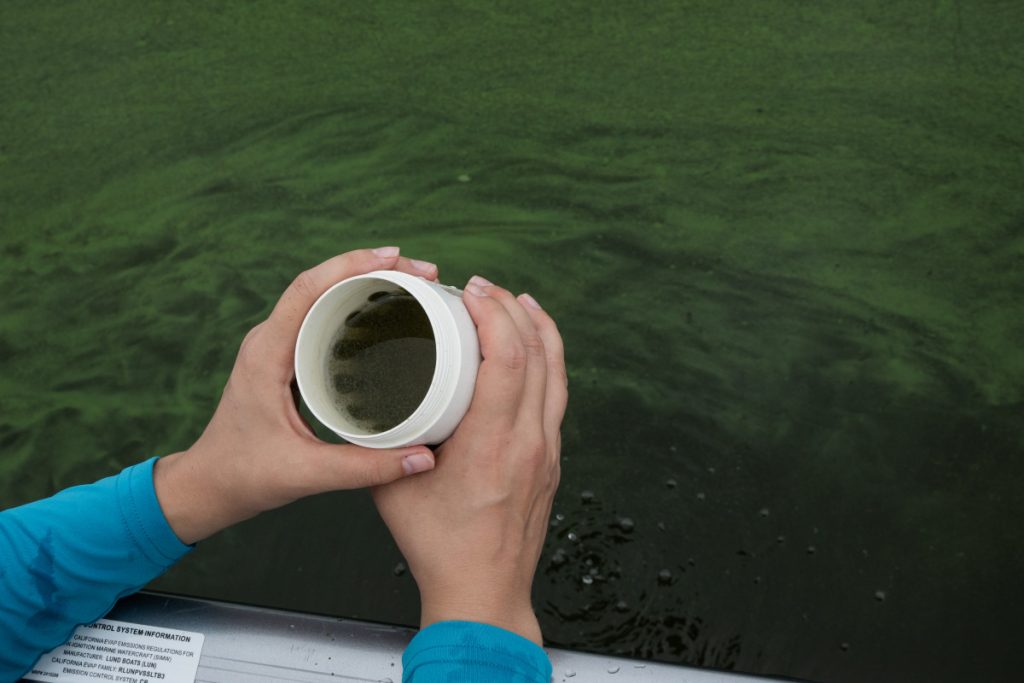
Hrycik lifts a sample cup from the water of Lake Chautauqua.
“When there’s a big storm event, the rising tide of that storm brings a lot of nutrients off the landscape, and that’s what we really want to capture,” he said.
The gate will operate based on sensors around the lake and tributaries that estimate nutrient levels through factors like temperature, water turbidity, flow rate and recent rainfall. Rose explained that an engineered wetland like the one they are planning can absorb the worst of the nutrient overload without cutting off stream flow into the lake.
“We know over time that in the region we’ve had an increase in severe storms…. Normally, that means that we would be flushing more nutrients into the lake. But what that really means is that we need more capacity in our engineered wetland,” he said. “By diverting the water for the severe storms but not for base flow, that means we can maintain a minimum flow in a stream and still capture all of the highest nutrients that we have.”
Rose said the wetland would be “over-engineered” to ensure longevity and effectiveness.
“We want to be building it out of corrosion-resistant materials and then over-engineering it so it can last for many decades to come,” he said. “And we want to keep it, engineering-wise, as simple as possible. The more moving parts you get, the more complex it gets, the more likely something is (to) break.”
Rose explained that the wetland is one part of a hierarchy of steps to reduce nutrient runoff in the lake.
“We want to first try to keep (nutrients) on the landscape, and we can do that through best practices of education, of training people,” he said.
Rose said this could include explaining where, when and how to apply fertilizers or educating people on when fertilizers are not necessary at all. However, if nutrients enter the soil, there are additional steps to prevent them from entering the water. The “first line of defense,” Rose said, is a strong riparian buffer zone. A riparian zone, the land directly next to water, can become a buffer when it has plants to absorb nutrients before it gets to the stream or lake.
“Our first line of defense is really strengthening those riparian buffer zones, improving education and outreach around best practices,” he said. “But what do we do once it gets into your water body, into your streams? That’s when we need some diversion, and that’s the next step. Down closer to the lake is where the engineered wetland plays a role.”
Twan Leenders, the director of conservation at Everwild Land Trust, said the trust has been acquiring lands along Chautauqua Lake and its tributaries, much of which used to be farmland, to create a healthier watershed for the lake.
Leenders said much of the land is taken over by the default vegetation that shows up after farmland is cleared, including invasive species. Rather than “waiting 50 years for that to turn into forest,” Leenders said, Everwild wants to engineer wetlands where they were historically located before farming took place.
“We’re trying to recreate an engineered version of a natural wetland that does what natural wetlands do already, like cleaning the water for us, dropping out sediments, absorbing nutrients and all that before it reaches the lake,” he said.
Leenders explained that the wetland is a solution that allows for close monitoring and experimenting, which means there are fewer risks to the lake. If the wetland works well, Leenders said he hopes to see more projects like it along the lake in years to come.
He also emphasized that the lake is dealing with years of nutrient input that still has not stopped, so the wetland will be important to actually slow nutrients rather than mitigating them once they are already in the lake.
“Any kind of interventions that we’re trying to do in the lake right now aren’t really terribly effective because we’re essentially mopping with the faucet still running,” he said. “This could be a first step towards actually greatly reducing, at the very least, the sentiment loading that’s coming in from the watershed.”
Leenders said Everwild Land Trust is hoping to get construction started in the winter, when the ground is frozen and equipment will do minimal damage to the environment.
“I’m hopeful that if we can do construction this winter, we will actually be adding all of the native plantings and everything that we’ve proposed in the springtime,” he said. “We’re also actually planning to build in a series of trails and interpretive signage as well, because we would love to make this a conceptual stormwater park.”
Leenders said he was excited to partner with Rensselaer Polytechnic Institute and the Darrin Freshwater Institute.
“It’s a great project to begin with, but I think this collaboration just makes it a really fascinating, interesting project, and it’s got some really great potential for Chautauqua Lake,” he said.
Rose emphasized that water quality problems are complex and have built up over the decades, so it is important to have healthy expectations about the time it will take to fix it.
“Just like it took many decades to create the problems that are there, it’s going to take many decades to fully recover for the lake. But I like the quote, ‘The best time to plant a tree is 20 years ago; the next best time is now,’” he said. “The best time to stop nutrient loads to lakes was 20 years ago, even 50 years ago, and the next best time is now.”