Mary Lee Talbot
Staff Writer
The Bible, according to the Rt. Rev. Mariann Edgar Budde, is mostly stories of men told by men: “When women get a word in edgewise, it is astonishing. And most of the memorable one-liners are by women.”
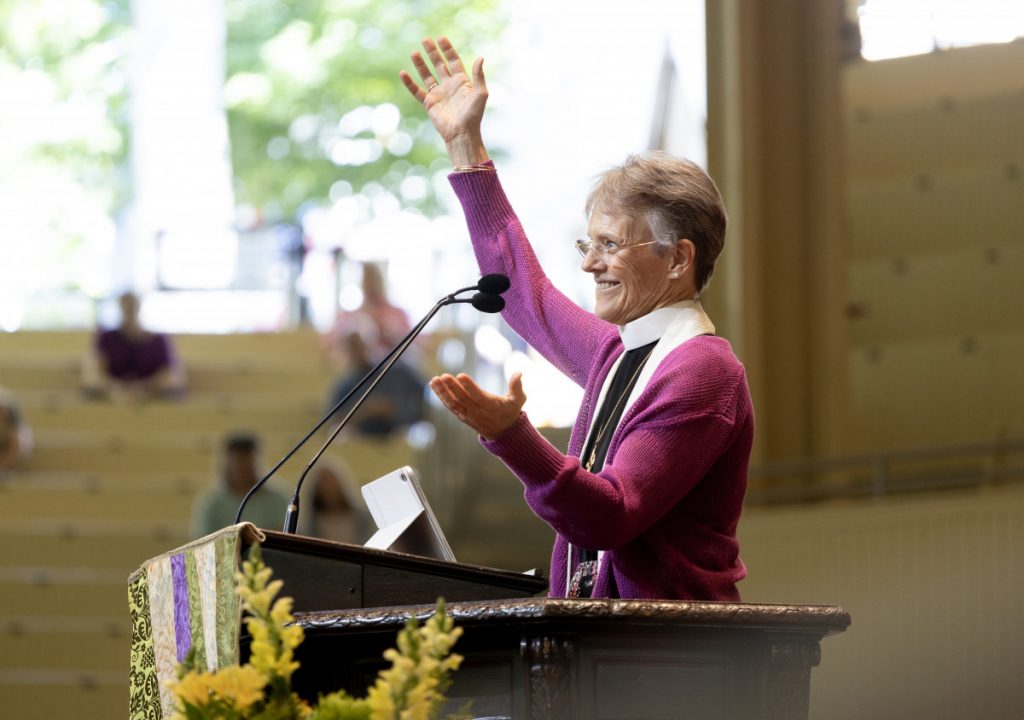
Budde preached at the 9:15 a.m. Monday Morning Worship Service in the Amphitheater. Her sermon title was “Where You Go I Will Go,” and the scripture reading was Ruth 1:1–18.
Ruth was a foreigner — a Moabite — when she decided to follow Naomi on Naomi’s return to Bethlehem in Judah. Ruth bound herself to Naomi with words of love. “Where you go, I will go; where you lodge, I will lodge; your people shall be my people, and your God my God. Where you die, I will die — there will I be buried. May the Lord do thus and so to me, and more as well, if even death parts me from you.”
These are words that are often used in weddings today, said Budde.
The Bible story is full of tribalism and rules to keep out foreigners. “Ruth teaches that love is where home is, where we belong. Naomi and Ruth went to great lengths to get Ruth accepted. Ruth marries Boaz, a relative of Naomi, to ensure that she has legitimacy in spite of laws to keep foreigners out; she was accepted into the lineage of King David,” Budde said.
There is a difference between institutional belonging and personal belonging. “Ruth is an icon because she knew she belonged long before the institution recognized her,” Budde noted.
In the 1980s and 1990s, Budde came into leadership in a small Episcopal church in Minneapolis, Minnesota. It was a time when the church was fighting about ordaining women and about the place of LGBTQ+ people. Her predecessor as priest at the church was a partially closeted gay man who built a community in the congregation. No one talked about inclusion; they just did it.
“When I came with two kids and a husband, sexuality was all people wanted to talk about,” said Budde. “The LGBTQ+ community wanted to know if they were included. The LGBTQ+ community knew they belonged, but did we know they belonged? There is a difference between personal belonging and institutional belonging.”
In his speech at the Lincoln Memorial in 1963, Martin Luther King, Jr. did not ask if Black people belonged to the United States as citizens; he already knew that they did. “King called the Declaration of Independence a promissory note. All people, even Black ones, were entitled to life, liberty and happiness. He knew he belonged before the institution did,” Budde said.
In another example, Budde noted that a Latino church in the Episcopal Diocese of Washington celebrated the help it had gotten from the other churches in the diocese with balloons and food. It was Latino heritage month, “and while members of the congregation were being detained and disappeared, and the leaders of this country rejected them, it did not change them. They knew they belonged, but did we know that they belonged?”
Budde cited theologian Pádraig Ó Tuama, who wrote that Ruth does not tell us how to vote or open borders. She is someone who arrived in a foreign country with love and honesty. She saw herself belonging, even if others didn’t.
“It was a woman’s love and courage that changed the law of the land,” Budde said about Ruth. “She refused to let love be defined by those laws. She refused to be left behind and recognized herself as one who already belonged.”
Budde continued, “This is about making room at the personal and institutional level because everyone needs both. We need this in this country. Who knew they belonged before they were welcomed?”
Robert Wilson-Black, director of the Department of Religion, served as liturgist. Beth Brockman Miller, one of the founders of Common Grounds, read the scripture. The prelude, played by Interim Director of Sacred Music Sonya Subbayya Sutton on the Massey Memorial Organ was “Improvisation,” by Nadia Boulanger. The Motet Choir sang “The Size of Your Heart,” with music by Eleanor Daley and words by Charles Miller. The choir sang a cappella under Sutton’s direction. Owen Reyda, organ scholar, played “Toccata on Kingsfold” by Mary Beth Bennett on the Massey Organ. Support for this week’s chaplaincy and preaching is provided by Week One Presenting Sponsor Erie Insurance and the Gladys R. Brasted and Adair Brasted Gould Memorial Chaplaincy.