
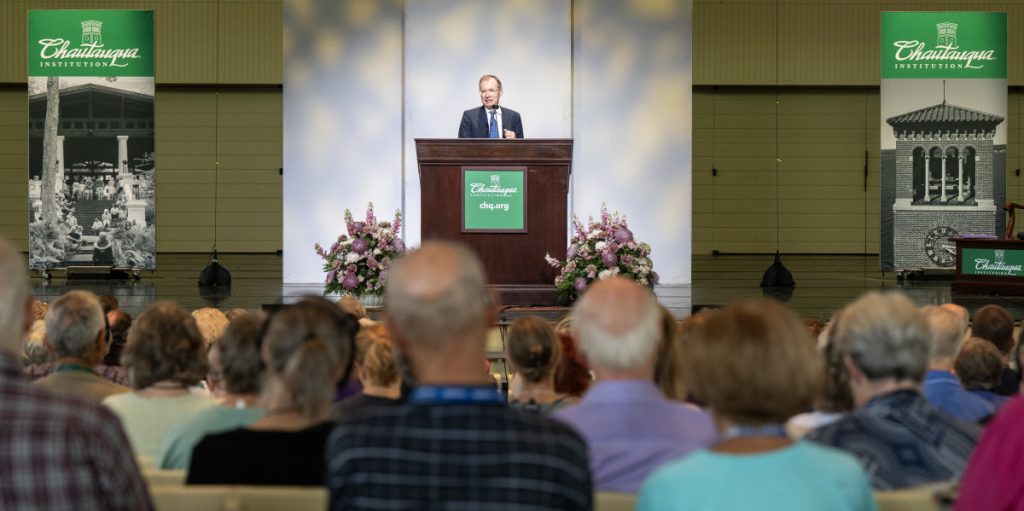
Robert Chatterton Dickson, former senior member of the British Diplomatic Service, shares his perspective on the current state of the international world order Wednesday in the Amphitheater.
ARIANNA NEVAREZ
Staff Writer
Though he grew up in the United Kingdom, Robert Chatterton Dickson spent his childhood admiring the United States; he watched the moon landing and President Richard Nixon’s resignation speech, which he said was a recognition of both the Watergate crisis and the resilience of U.S. institutions.
Dickson, an international affairs consultant and a former senior member of the British Diplomatic Service, said the United States shaped his life in a positive way. He began to better understand the country when he later served in the British Embassy in the late 1990s and saw the transatlantic partnership in day-to-day bureaucratic action.
At 10:45 a.m. Wednesday in the Amphitheater, Dickson shared his experiences working with the U.S., the impact of the country’s unpredictability on international affairs and Europe’s next moves in current contexts. During the lecture, he spoke in a strictly personal capacity.
While working in the British Embassy, Dickson said he observed “pretty good years” for both the U.S. and the U.K., characterized by a growing economy, the end of the Cold War and traditional bilateral defense and intelligence ties that remained strong.
Following that experience, Dickson served as consul general in Chicago, where he was responsible for representing the U.K. across 13 of the Western states. He described Chicago as vibrant, and as he traveled, he saw “pockets of optimism throughout the Midwest.” Though he saw this hope, Dickson also noticed more polarized politics compared to what he saw in the 1990s.
“There was a new sense … that traditional politics wasn’t really working, or people didn’t think it was working in delivering better lives for them,” Dickson said. “That was the subject of much anguished debate among the politicians, the governors, the congressmen, the newspaper editors who I met, and I have to say these experiences over many years have shaped our scenes in the United States, both personally and professionally.”
With 36 years of British diplomatic experience, Dickson shared three examples of how he now forms his view on the United States as a Briton.
The United States is “an indispensable nation” and has an “incredible effectiveness” on the international scale, Dickson said. When Bosnia descended into civil war, the U.S. initially stayed out of the conflict. In late 1995, Dickson said Washington, D.C. “lost patience,” so Richard Holbrooke and his colleagues “delivered at Dayton a masterclass in political persuasion backed by hard power.”
He said they resolved this conflict in a way no other country in the United Nations could.
“As a young diplomat, I could only admire the scale of the U.S. military resources, political resources and the discipline and care with which they are applied to well-defined and achievable objectives,” Dickson said. “That seemed to me to be a remarkable example of statecraft … in action.”
Dickson also said he has noticed “strong” U.S. power has been amplified by being grounded “in alliances, universal values and its own democratic traditions.” He said he saw this firsthand in North Macedonia. There, he worked with American and international colleagues to strengthen peace by offering the country a place in the international system while trying to promote free elections and curb the issue of killings by the police.
While experiencing extremism in the post 9/11 world, Dickson said U.S. power, statecraft and idealism have still had their limits. Following 9/11, the U.K. came to the U.S.’s aid and suffered casualties in Afghanistan. He said the lessons he learned lay in the political aftermath, when the “overwhelming military superiority did not translate automatically into a successful outcome.”
Despite the sacrifices made by American and British allies, Dickson said they were unable to create a sustainable government from the bottom up, and their ability to engage Afghans on the ground was increasingly halted by Taliban attacks and security restrictions.
Overall, Dickson said Afghanistan still faces a “reveling humanitarian disaster,” which has worsened due to cuts in international aid. He said the biggest lesson he learned in all of this was honesty.
“I think we were almost willfully blind to the realities that we weren’t winning,” Dickson said. “The Taliban were winning, we hadn’t brought the Afghan people with us and we were set on a course to failure. … The biggest single lesson for Afghanistan is the importance in confronting the world to deal with it as it is and not deal with it as we might want it to be.”
From the other side of the Atlantic, Dickson said that with the U.S.’s help, Europe rebuilt itself and is thriving following the world wars with great education options, healthcare and “an enduring social contract.” Yet, he said, the continent is feeling the weight of the climate crisis through worse-than-ever wildfires and a summer that is on course to be the hottest on record.
The U.K. has also had demographic issues, according to Dickson. He said they need more young people to work, but people aren’t having enough children to fill these gaps. He also brought up technology as a challenge that is intensifying international competition.
“These issues are too big for any one nation, even the United States, to solve on its own, but they’re hitting us at a time when the old U.N.-based mechanisms for solving common problems have, as Kevin Rudd said, almost flailed away as practical problem-solving methods,” Dickson said.
To add to the challenging times, Dickson said international affairs have also affected Europe. From Russia’s full-scale invasion of Ukraine in 2022 to China dominating the same exports Europe focuses on, he said there is “plenty for Europe to worry about.”
In Europe, the “shock” of the U.S.’s unpredictability is “profound,” according to Dickson. He said the U.S. is now approaching NATO in a transactional way and has threatened Greenland, a close ally. He said it has become an “incredibly uncomfortable position” where the bonds of trust have diminished.
“As Europeans, we know that we no longer live in a world where our security is underwritten by Article 5 of the Washington Treaty,” Dickson said.
With Europe and the U.S.’s relationship shifting, Dickson said the whole continent of Europe must revive its economy, equip itself in preparation for “a more dangerous world” and rebuild democratic self-confidence. Though they need to build on their own, Dickson said the complementary strengths of “America’s dynamism” and “Europe’s steadiness” can create something neither continent can do alone.
Even when things look difficult, there is still a possibility of renewal due to the free election process, Dickson said. In this process, diplomats are needed to create this new future and “lasting peace,” according to Dickson. Though the issues at the international scale seem daunting, he said the challenges won’t seem impossible if there are diplomats ready to step up.
“We’ve got hard work ahead, but it’s not hopeless. This doesn’t have to be a winner-take-all world. The advantage is strongest when both shores stand together, and when strength is underpinned by diplomacy,” Dickson said. “And I would argue that that is profoundly in our shared interest.”