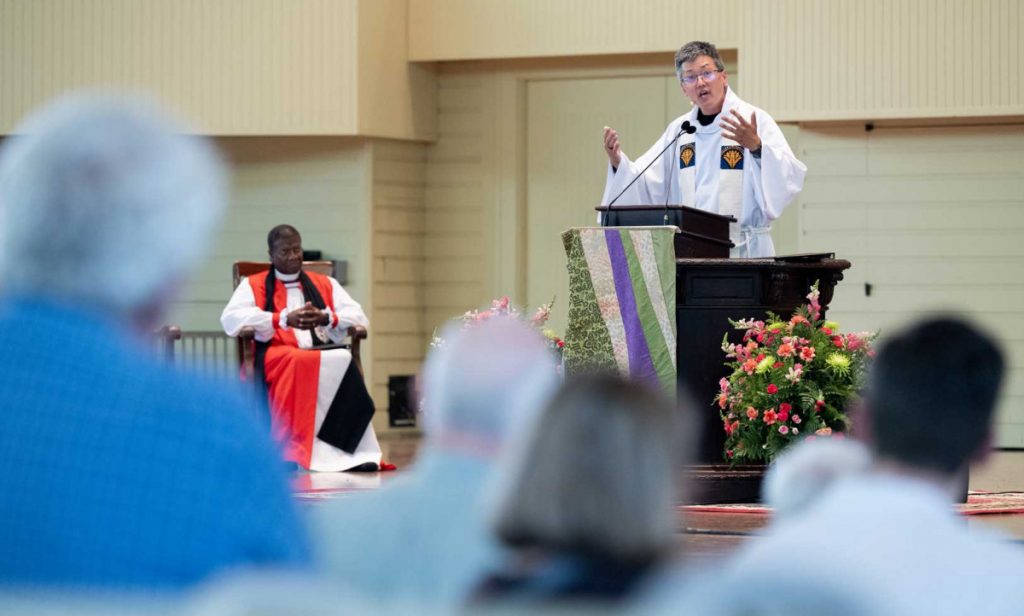
Michael Chan, executive director for faith and learning at Concordia College, delivers his sermon “Memory and the Flourishing of the World” during morning worship Sunday in the Amphitheater.
MARY LEE TALBOT
Staff Writer
“We are in a strange and dangerous age,” said Michael Chan, Ph.D. “It is an age of certainty, and we have two myths we have to choose from — triumph or transgression, glory or shame, a grand tree or a weed to be plucked out. We are told we have to pledge to one side or the other or this election will be a Flight 93 election — the plane will go down.”
Chan preached at the 9:15 a.m. Sunday morning worship service in the Amphitheater. His sermon title was “Memory and the Flourishing of the World.” The scripture reading was Deuteronomy 4: 9–14.
This week is Chan’s first time at Chautauqua Institution, and he had previously known about Chautauqua but wondered what it was. “Like the Israelites in Exodus 16 when they first see manna and ask ‘what is it?” my response to Chautauqua is that it is a place where manna is offered in the desert.”
He read Deuteronomy 4: 9 to the congregation. “But take care and watch yourselves closely, so as neither to forget the things that your eyes have seen nor to let them slip from your mind all the days of your life; make them known to your children and your children’s children … ”
A forgetful nation is a fragile nation, Chan told the congregation. He described the danger as “curated cultural amnesia.” If people only remember the triumph or the tragedy, they will pay a price. “The quality of the future depends on the quality of our memory,” he said.
The author of Deuteronomy urged the people to remember and retell the whole story. Chan said the author gave the people a megaphone to tell this intergenerational story. It is not a completely cheerful remembrance. “It is a book for children, but it is not childlike,” he said.
He continued, “It is for future generations. The story is filled with missteps and with highlights, but there are no elephants in the room because they are all on parade. To tell a truthful story, we have to look in the mirror and not through an Instagram filter.”
Despite the bald reality of the situation, Deuteronomy offers a theology of hope that “grows in the soil of remembrance” when we remember clearly, Chan told the congregation.
The founders of the United States cited the book of Deuteronomy frequently in their writings. The book spoke to their time, of people seeking deliverance from tyranny and on the edge of a new life, like the people of Israel. “The founders might have seen themselves as Moses with all the promise, peril and responsibility.”
Last week Chan was in the Black Hills of South Dakota at a youth conference. He took a break to work on this week’s sermons and went to a café at Mount Rushmore where one can get Thomas Jefferson’s original ice cream recipe. “I could see both Washington and Jefferson, but my gaze went toward Jefferson and I thought about the drafting of the Declaration of Independence and those famous words: ‘We hold these truths to be self-evident, that all men are created equal, that they are endowed by their Creator with certain unalienable Rights, that among these are Life, Liberty and the pursuit of Happiness.’”
Later, Chan was going toward Custer, South Dakota, and stopped at the memorial for Lakota Chief Crazy Horse. This memorial is also carved in rock, with Crazy Horse’s arm stretching over 263 feet and his face at 87 feet, six inches.
“The two stories exist alongside each other,” he said. “This is what true remembrance looks like: a story told with honesty, both the triumph and the transgression.”
Chan continued, “Moses said that remembrance precedes promise. We have our own Jordan to cross. We need to reconnect with all our history to see how we got here. There is so much to celebrate, to repair and to be done.”
He urged the congregation to face the entirety of our national history because there are reasons to grieve as well as celebrate; there are wounds that need to be repaired. To surrender to amnesia is to lose many memories of pain and of hope. “We need to join with Israel’s collective memory and future and our collective memory and future,” he said.
The Rt. Rev. Eugene Taylor Sutton presided. Deborah Sunya Moore, senior vice president and chief program officer of Chautauqua Institution, read the scripture. Sonya Subbayya Sutton, interim director of Sacred Music, and Sam Torres, guest musician and saxophonist, played “Fantasy on ‘Veni creator spiritus’” by Richard Proulx for the prelude. The anthem was “O Clap Your Hands,” music by John Rutter and text from Psalm 47. The Chautauqua Choir sang the anthem under the direction of Sutton with organ scholar Owen Reyda accompanying the choir on the Massey Memorial Organ. The offertory anthem was “The Dream Keeper,” music by Gary Davidson and text by poet Langston Hughes. Davidson was in the congregation and was introduced. The anthem was sung by the Chautauqua Choir under the direction of Sutton and accompanied by Reyda and Torres. Sutton played “Toccata, Symphony 5” by Charles-Marie Widor for the postlude. Support for this week’s chaplaincy and preaching is provided by The Edmond E. Robb-Walter C. Shaw Fund and The John William Tyrrell Endowment for Religion.