Mary Lee Talbot
Staff Writer
In the June 15, 1876 issue of the Chautauqua Daily Assembly Herald, the Rev. Theodore Flood wrote, “In our day of rapid transit, lines of telegraphy under the sea, daring business enterprises, and exploits in reform, the daily paper becomes a necessary medium for catching news on the wing, and holding it, until the ecclesiastical, scientific, political or whatever the nature of the movement is, shall be consummated, then the historian can gather his harvest of facts and garner them in stately volumes.”
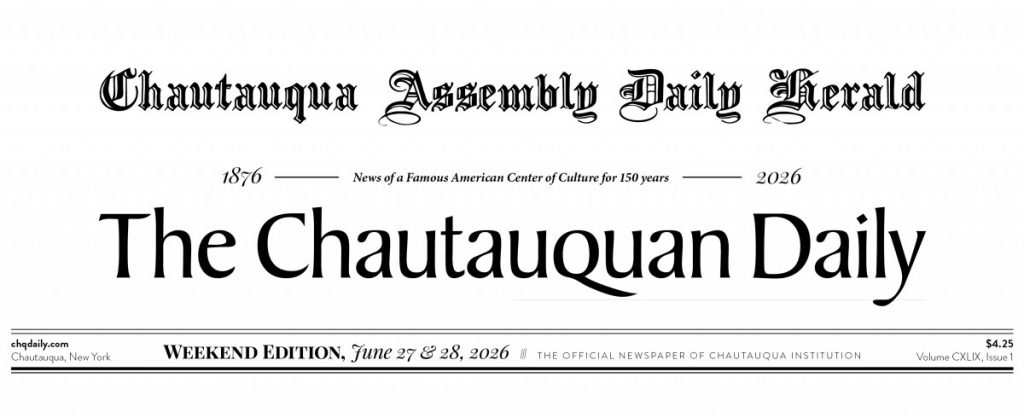
In our day of 24/7 news and opinions, the World Wide Web and self-driving cars, The Chautauquan Daily is still a necessary medium for catching the breadth of events of the Chautauqua Summer Season. When the Chautauqua administration suggested that the Daily become an online-only presence, Chautauquans said “no,” and agreed that they would pay more for
a subscription.
As a historian of Chautauqua, I have found the Daily to be the source for learning how Chautauquans have lived over the past 150 years, the kinds of speakers and entertainments they enjoyed (or hated) and the love and concern they expressed for the direction Chautauqua was going.
When Lewis Miller and John Heyl Vincent founded their city in the woods to give people education and relaxation, the Chautauqua Sunday School Assembly, they did not plan to have a newspaper. For the first two seasons, the programs of Chautauqua were reported in a variety of Protestant denominational newspapers.
Theodore Flood, the founding editor of the Daily and a Methodist Episcopal minister, tried to found a Sunday school assembly at Lake Winnipesaukee, New Hampshire, that did not survive. When Flood was transferred to Jamestown, New York, he approached Miller and Vincent about a newspaper for the Chautauqua Assembly, but they were not interested in investing. He got permission to shoulder the financial responsibility himself and with Milton Bailey of Jamestown, he began the Daily.
Flood said the purpose of the Daily was to be the official publication of the Chautauqua Assembly and its various conferences and to “make the Assembly Herald a necessity of every preacher and Sunday-school worker.”
When Flood was moved to the Methodist Church in Meadville, Pennsylvania, he formed a new partnership with E. A. Hempstead, a local printer, and they set up a printshop at Chautauqua in 1880. In 1881 he was allowed to keep his clergy status by the Erie Conference of the Methodist Church as a publisher and editor with no pastoral responsibility.
Flood tried a monthly Assembly Herald for about nine months. It did not work well, but it set the pattern for The Chautauquan, a magazine and prime reading source for the Chautauqua Literary and Scientific Circle. The paper, Flood boasted, “reached the 10th anniversary without costing the Chautauqua Assembly one cent…now putting more than $4000 per year into the treasury of the Chautauqua university … without these two publications (Chautauqua Assembly Herald and The Chautauquan) Chautauqua would not have been known in the world.”
In 1883, Flood bought the Meadville Tribune Publishing Company, and in 1886, he built the Chautauqua Building in Meadville. He established the Chautauqua Century Press in 1890 with George Vincent, Bishop Vincent’s son, who served as literary and book editor. Ned Arden Flood, Flood’s son, was the managing editor of the Herald in the 1890s and business manager of The Chautauquan. Flood and Vincent built the building now known as Hultquist Center as the Herald editorial staff headquarters.
After the death of Chautauqua co-founder Lewis Miller in 1899, an administrative reorganization of Chautauqua brought the publishing enterprises under auspices of the Institution, acquired all of Flood’s interests and ended publication in Meadville. At the time, Flood wrote about himself in the third person: “After paying all the bills and securing the copyrights of the magazine, he has paid as percentage into the treasury of Chautauqua in the last 13 years over $216,000 … During that time Chautauqua was not responsible for one dollar of liability whose net results contributed this large sum to the treasury. ” Over two-thirds came from the paper and the magazine and the rest from the books published by the Chautauqua Century Press.
Whether known as The Chautauqua Assembly Daily Herald, The Chautauqua Assembly Herald or The Chautauquan Daily, generations of Chautauquans have looked forward to seeing a new issue each morning. Generations have written for the Daily and delivered or sold Dailies. People placed classified ads to sell things or advertise rentals or placed Happy Ads to wish one another “Happy Birthday or Anniversary.”
Early issues of the paper were dense columns of reports of lectures taken down by stenographers. It would not be until the 1920s that headshots of speakers would be printed and not until the 1960s that feature photos were included. For most of its life, the Daily was only black and white; color pages are a recent innovation.
Along the way, reporters and editors started writing features about Chautauquans. Columns like “Walks and Talks” and “Arrivals” noted the comings and goings of Chautauquans. “Chautauquade” and “Chautauquans” celebrated births, weddings, swimming across the lake and other milestones. Maritza Morgan’s “Chipmunk Tales” include some of her drawings. Special sections of the paper were produced to celebrate Chautauqua’s 100th anniversary in 1974, the Daily’s 100th anniversary in 1976 and the CLSC 100th anniversary in 1978.
The Daily covered the tough times for Chautauqua, especially from 1934 to 1936 when Chautauqua was under receivership to pay off about $750,000 in debt. It covered the arrival of Amelia Earhart, the end of World War II and the moon landing in 1969.
The editorial offices of the Daily have always been on the Assembly grounds during the summer. The first office was at 5 Whitfield, the top of Bowman Avenue, Post Office Building (1910–1915), the “shack” in Post Office Park (about where the Brick Walk Cafe is) (1916–1930), Colonnade (1931–1972), Post Office Building (1972–2007), Kellogg Hall (2007–2010) and Logan Dormitory (2011–present).
The print shop location moved on and off the grounds over the last 150 years. From Meadville to the building on Bowman, the Post Office Building, The Westfield Republican and The Corry Journal, the physical printing of the Daily has followed the changing technology of printing. From staff leaving the grounds at noon with copy for the next day’s Daily to sending copy via computer and internet, the Daily has moved from just a physical presence to both a local edition here at Chautauqua and an international presence on the internet.
Physical copies of the Daily can be found at the Oliver Archives at Chautauqua and on the Archives section of the Chautauqua Institution web page. This archive includes issues up to 2006 and then there is a separate archive from the Daily itself that begins in 2011. Between 2006 and 2011, there appear to be a number of issues which have not yet been digitized.
On Aug. 4, as part of the Daily’s coverage of Old First Night, we will continue the celebration of 150 years of the Daily.
I am compiling a list of Daily staff for our Aug. 4 edition. Although we have mastheads with the names of writers, photographers and designers, we need some special information. We need the names of people who delivered and sold the Dailies. We would love some stories about families with more than one generation who worked for the Daily. Please send them to mltalbot33@gmail.com by July 31.