Lily Reslink
Staff Writer
In February, Robert Wilson-Black stepped into the director of religion position with vast Chautauquan connections already in-hand. These notably include a 2012 project under former Director of Religion Joan Brown Campbell that brought together attendees from the world of religion in pursuit of comprehensive multifaith inclusion at Chautauqua Institution.
Going back to the 90s, mentors, colleagues and his wife have put Chautauqua on Wilson-Black’s radar. In fact, he even took part in an off-season gathering held by former Department of Religion Director Maureen Rovegno and co-sponsored by the Fetzer Institute.
“I still have my notes from that,” he said.
With interfaith contributions to the community already under his belt, Wilson-Black enters his first Summer Season at the Institution leading interfaith programs and operations. As he looks to the forthcoming season, he continues to thoughtfully steward his new role and take his responsibility to Chautauqua seriously.
“Many of our faiths teach us to have no fear, but we’re humans, and so we have them,” Wilson-Black said. “My only fear would be not being able to deliver for Chautauqua, which I’ve had a relationship with (for) over a quarter of a century now.”
As a historian, Wilson-Black expressed excitement to serve Chautauqua while continuing to learn from its past and present. He recognized its distinctive, gradual journey toward interfaith inclusion.“There have certainly been some difficulties in the past year, given difficult topics, because at Chautauqua we don’t just get to live here for nine weeks in some kind of utopia,” Wilson-Black said. “I say we’re a utopia-in-training.”
“There have certainly been some difficulties in the past year, given difficult topics, because at Chautauqua we don’t just get to live here for nine weeks in some kind of utopia,” Wilson-Black said. “I say we’re a utopia-in-training.”
Wilson-Black said Chautauqua’s early religious directorship focused more on education. He said Chautauqua emerged from the Camp Meeting Movement and Lyceum Movement, which both created opportunities for adult education in settings that welcomed religious and secular conversation to casually overlap. Even now, diverse coexistence and dialogue are foundational to Chautauqua.
Wilson-Black described how the history of the religion director is indicative of the role’s visionary opportunity. Because of leadership, what began as a Methodist assembly shifted to be inclusive of all Protestants and eventually, all Abrahamic faiths under Director of Religion and Historian Emeritus Ross Mackenzie’s tenure starting 1989. As one of many influential directors, Wilson-Black noted Joan Brown Campbell’s influence in expanding focus from Abrahamic faiths to multifaith inclusion in her 14-year tenure starting 1999.
Throughout the Institution’s 150-year evolution, Wilson-Black said the director of religion is responsible for understanding Chautauqua’s identity and responding to needs across its Religion pillar.
“Chautauqua has really made some great strides, and then we still stumble. We stumble on very complicated, difficult issues across religious barriers and divides.” Wilson-Black said the question then becomes how to listen, take note and repair.
“If religious conversations are complicated and difficult and joyful, we’re right there along the way to stumble and to fall and to get back up and to help each other,” Wilson-Black said.
The director of religion takes a lead in the curation of the afternoon lecture docket, which means choosing the 36 speakers comprising the Interfaith Lecture Series. Wilson-Black said Chautauqua’s reputation leads most lecturers to accept invitations with enthusiasm.
“This year I’ve been able to devise and work with others to create a most incredible lineup,” Wilson-Black said.
Wilson-Black’s specific background has offered advantages of being well-connected to both Chautauqua and a network of religious scholars.
“Being the CEO of Sojourners for almost a decade, … that’s a real exciting thing and that gives you the kind of connectivity that you need,” Wilson-Black said.
From an Evangelical childhood to decades of religious scholarship, Wilson-Black’s experiences have familiarized him with becoming what he described as “a translator across religious divides.”
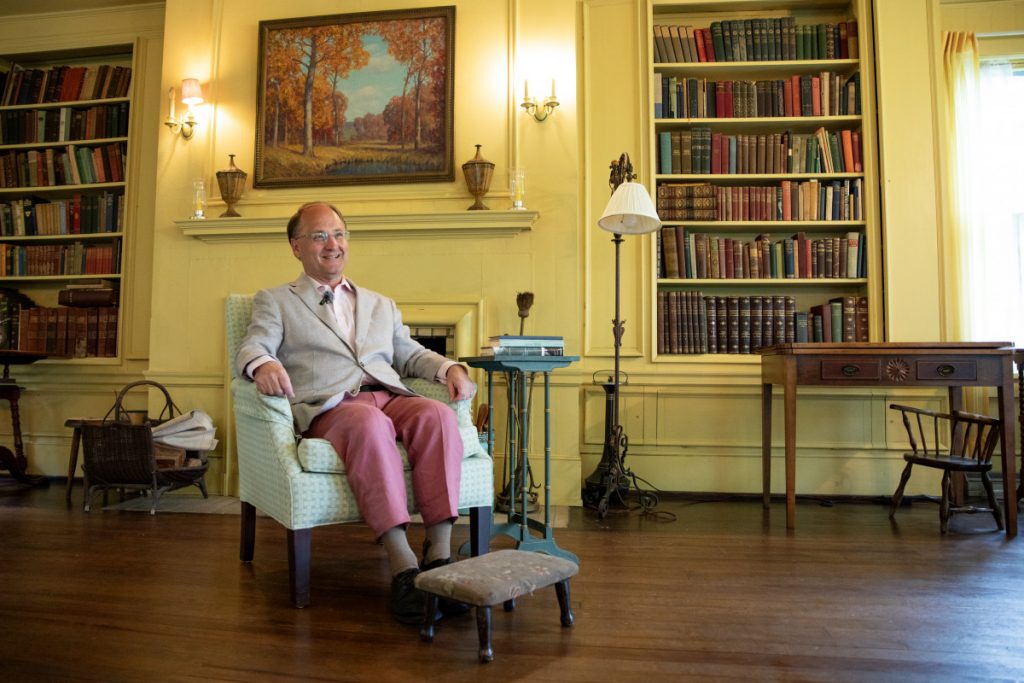
His background as a historian even extends to his understanding of his housing. To Wilson-Black, residence on the grounds elevates immersion both in Chautauqua’s history and present community.
“Living in the (Lewis Miller) Cottage is easily the most incredible gift that I was not expecting coming into Chautauqua,” Wilson-Black said.
The cottage has accommodated generations of historical families and figures. The living room where household names such as Thomas Edison and Henry Ford stood in the 1920s is now a venue for his own family to make memories, which Wilson-Black said recently included a sing-along to pop artist Olivia Rodrigo’s 2026 album you seem pretty sad for a girl so in love on Father’s Day.
Wilson-Black said preparing this designated National Historic Landmark as a place of residence for the season has taken a team of historical stewards and archival experts. Wilson-Black and Chautauqua Institution Archives staff sorted items into what should be removed, transferred to archives and kept there.
“We treat it very lovingly and carefully,” Wilson-Black said.
While he is working as director of religion, his family is on the grounds, too.
“My daughter works at the Presbyterian House; my son’s a lifeguard, so you see me at the Presbyterian House, and maybe on the beaches and out and about; you see me singing sacred songs; so, when you see me around, say ‘Hello.’ I love to learn,” Wilson-Black said.
Ultimately, Wilson-Black sees Religion at Chautauqua as something to be “enjoyed” and “appreciated,” but he also recognized that people don’t always ascribe to a particular religion or faith. He said he hopes every Chautauquan will enjoy the place in its entirety and “dip (their) toe in the water” when conversations are of interest to them.
Wilson-Black said it is important to consider the experience Chautauqua is meant to offer.
“It’s a place where you want to be delighted and intrigued and maybe moved a little bit,” Wilson-Black said.
“Chautauqua was never about, is never and will never be about compulsory religion,” Wilson-Black said. “It’s about religion as a resource, as a foundation, as a pillar and hopefully providing some sunlight along the way.”
Wilson-Black said Chautauqua’s unique qualities don’t make it immune to worldly conflicts and fractures. “We don’t get to pretend we are not a part of the rest of the world, because we are. What we try to be specialized at is listening,” Wilson-Black said.