
ARIANNA NEVAREZ
Staff Writer
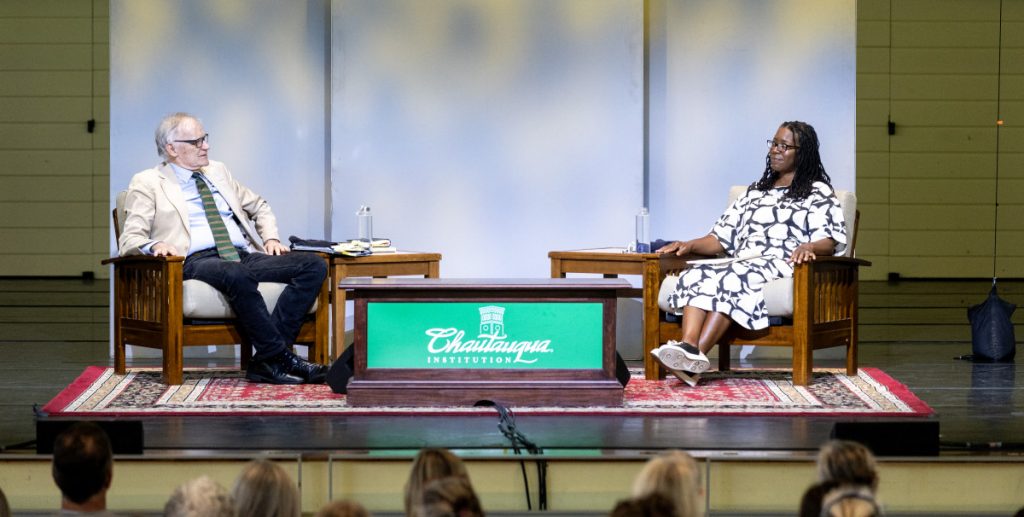
At 10:45 a.m. Wednesday in the Amphitheater, David Blight and Tiya Miles partook in a conversation about the U.S. founding documents and their complexities.
Blight is the Sterling professor of History and Black Studies and director of the Gilder Lehrman Center for the Study of Slavery, Resistance and Abolition at Yale University, and Miles is the Michael Garvey professor of History and Radcliffe alumnae professor at the Radcliffe Institute for Advanced Study at Harvard University.
In their discussion, Blight said the moral foundation of the Declaration of Independence is “virtue,” which he believes the founding fathers gathered from their deep reading of philosophical works and books of their time. Miles added a framework to the documents that she heard from her colleague, saying, “The declaration is the vision statement, and the Constitution is the operating manual.”
While Blight emphasized the importance of the founding documents, he also said it would be a mistake to pass by the declaration or Constitution without addressing social flaws and contradictions. Specifically, he highlighted the “moral failings” of the founders when it came to slavery.
“How could this generation of brilliant slaveholders create these documents?” Blight asked. “First, you have to just sit down and deal with human contradiction.”
Blight argued the founders were aware of how problematic slavery was, yet they mentioned principles of equality while actively owning slaves whom they did not view as people. He cited Frederick Douglass, who said America is made of contradictions, and Blight said “the most terrible aspects of human contradictions” can be found in the declaration.
Slavery had a deep-rooted economic interest, according to Blight. He also said, “The deep economic ties that the society had to this institution of labor is in [the founding fathers’] minds every day.” Blight acknowledged that Thomas Jefferson attempted to condemn slavery in the earlier drafts of the declaration and reflected that if there had been a condemnation of slavery at the nation’s founding, there would be “a different history.”
“It’s just that (it) could not happen at that moment,” Blight said. “History doesn’t give us what we want; it gives us what it gives us.”
The documents were “flawed” and “almost guaranteed future conflict,” Blight said; they are also “creedal documents.”
Miles then acknowledged that the founders of America were brilliant, but also were enslavers. She said people think they’re not allowed to acknowledge the accomplishments of the declaration because the founders knew the wrongdoing in slavery and ensured the practice still persisted.
The two talked specifically about the Declaration of Independence’s reach. Blight said no other text in U.S. history has traveled as widely and effectively as the declaration, citing examples of the text being reprinted in European countries and King George III giving a speech denouncing the document.
“What traveled first so well is the ending — that eloquent, beautiful ending where they declare they’re independent, where they declare that they are free and independent,” Blight said. “Because that is what astonished the world.”
According to Blight, the words from the Declaration of Independence also go back to natural rights. He said natural rights are based on the idea, which goes back to the philosophies of Roman statesman Cicero, that every person is born with certain things, ideas, rights, liberties and capacities.
“I thought about it this morning, sitting there on the deck of these beautiful houses and watching [the CLSC graduates] walk down that path and the sunrise on that lake,” Blight said. “I thought, ‘My God, natural rights are like that — like that blue sky, like that lake, like the sun, like this air we all breathe, like this freedom we feel right now in teaching these ideas.’ That’s natural, if you believe it.”
Miles acknowledged, though the document was created by a group, there were still people excluded from the drafting of the Declaration of Independence who may have had grievances. To supplement her point, Blight mentioned Benjamin Quarles’ essay about how Black abolitionists “appropriate the literature” and said, “No group of Americans ever refused to allow the American Revolution to be revolutionized as much as Black Americans.”
Blight provided an example of how people used the words from the declaration to protest and show that the words on the paper didn’t include them. He cited the National Association for the Advancement of Colored People and several Black churches in New York City for organizing a march of 10,000 Black people in 1917.
The women were all dressed in white, the men all dressed in black, and they all held hundreds of banners and flags, according to Blight. But at the front, a banner was displayed with words from the declaration.
“The very front of this parade, this march, held by children was a banner: ‘We hold these truths to be self-evident’ — to give the country a lesson about mob murders and people,” Blight said. “… We sometimes use them when we need to point out someone else’s deficit. ‘You are not living up to this. You are not living up to this.’ And may we all stop and wonder, ‘Have I lived up to those principles?’”
Blight said he believes the declaration is both “sacred and secular” because it mentions God, yet he said one doesn’t need religion to believe in the Declaration of Independence.
Blight then shared his opinions about how American history is being used in current contexts. To close, he gave examples of how history is being used in contemporary issues. He said Justice Ketanji Brown Jackson’s concurring opinion “schooled the court on the historical context and the developing meaning of birthright citizenship.”
On the other hand, Blight noted attacks on historians and said they are “the minority.” He recently testified before two House of Representatives committees in defense of the Smithsonian Institution. He said the staff minority invited him to observe up close just how politically polarized the country is over who is allowed to research and understand American history.
He called this “both illuminating and deeply depressing,” but emphasized his role as a curator and researcher.
“[Curators] surely do not create for the domestic policy committee of the White House, which has no historians,” Blight said. “The profession of the practice of history as trained people who have all kinds of rules and all sorts of ethics, some of them ancient ethics that we abide by — even though we disagree all the time, and disagreeing is good for business — but this idea that somehow the government can choose the history for you is as antithetical to American history and American tradition as anything I can think of.”