

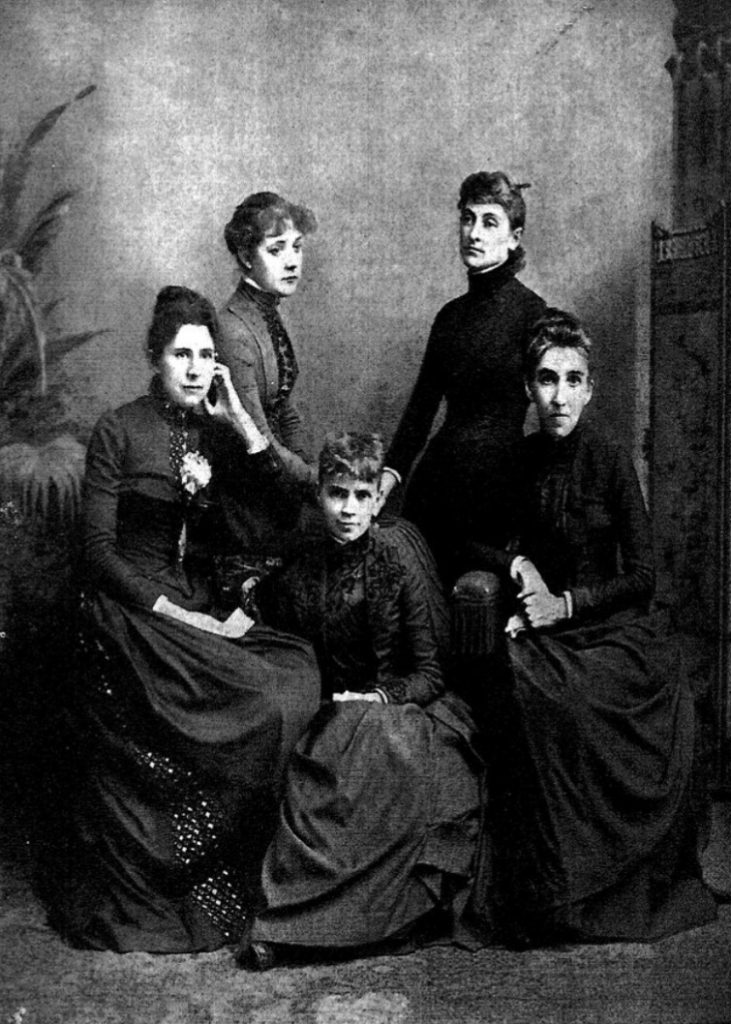
John Warren
Contributing Writer
The early days of the Chautauqua Assembly are not lost. Far from it: They were meticulously chronicled. Arguably the greatest source of that history is The Chautauquan Daily’s predecessors, the Chautauqua Daily Assembly Herald and the Chautauqua Assembly Herald.
The newspaper celebrates its 150th anniversary this year, two years after the 150th of the first Chautauqua Assembly. The Daily will mark the anniversary with this newspaper column about Chautauqua’s newspaper columns, telling the stories of the people who told Chautauqua’s stories.
For its first two years, the Chautauqua movement relied on outside newspaper writers. John Heyl Vincent and Lewis Miller felt these writers didn’t get the Chautauqua movement’s vibe, and by 1876 established the Daily Assembly Herald as the official organ to more accurately record the assembly’s objectives and daily events.
They chose as first editor a man characterized in the Daily Assembly Herald as “nationally celebrated”: Theodore Flood. But as Flood was John Heyl Vincent’s personal secretary, perhaps the esteem was held more locally. Flood and his first newspaper staff worked from a cottage on Whitfield Avenue that featured a sign marked “Editorial Rooms — Assembly Herald.”
In its early days, the newspaper was published six days a week during the summer season — like today. It had eight to 10 pages, contained daily schedules, Institution news, and printed lectures and sermons. The paper at its advent also promised it would “from time to time give a description of the domestic customs and social habits of the Chautauquans, written in a racy style by an enterprising correspondent.”
With no spirited beverage, no dancing and no card playing, there would have been little racy to chronicle, not by a conventional assessment. Racy, in the 19th century, meant “having a quality of vigor,” not having yet fully acquired its current definition of “risqué.”
Among the early scribes on the pages of the Daily’s predecessor was Ida Tarbell, who was to become one of the great journalists in American history, and who is the subject of an original opera this season, Ida By Lamplight, in celebration of the Daily’s 150th.
From 1880 to 1891, Tarbell wrote for the Daily Assembly Herald and the monthly magazine The Chautauquan, which published remotely in the off-season.
Of her work, she wrote: “The Chautauquan interested itself in all of this turbulent and confused life. Indeed, it rapidly became my particular editorial concern. We noted and discussed practically every item of the social program which has been so steadily developing in the last fifty years.”
She honed her muckraking instincts in magazine articles, advocating for progressive reforms including the eight-hour workday, safer working conditions, higher wages and temperance — though not prohibition. To her, abstinence was a matter of practicality and not morality.
In an article entitled “The Arts and Industries of Cincinnati,” she wrote: “Morally, Cincinnati has much to learn. Its foreign population has made it a beer drinker and Sabbath breaker. The number of beer gardens and saloons scattered about the streets is appalling. Work in the factories and shops stops on Sunday, but to all appearances it is only to give time to frolic.”
A Chautauquan dared suggest women would never be good inventors. That tweaked Tarbell sufficiently to visit the U.S. Patent Office in Washington, D.C., where she delved into a precursor of the investigative journalism that would define her career. She discovered many times more patents by women than had been previously reported and produced the article “Women as Inventors.”
Tarbell carried a heavy workload, writing two to three editorial columns a day on public or political matters. Her editor, Flood, originally assigned Tarbell the task of answering his reader correspondence using generic, pre-written templates. She thought this approach lacked a personal touch, and decided to lean into these reader responses, signing Flood’s name.
So affecting was her writing that one reader traveled to thank Flood in person for his compassionate letter, and so a bewildered Flood came to understand that his proxy had strayed from his uninspired templates.
There were other tensions between Flood and Tarbell, including Flood’s decision to place his son’s name above Tarbell’s on the magazine masthead. Of his management and editorial style, Tarbell wrote: “Dr. Flood has little interest in detail. The magazine was made up in a casual, and to my mind a disorderly, fashion. I couldn’t keep my fingers off (it).”
In the estimation of Richard Heitzenrater, a Duke University professor emeritus who has studied Flood, he was more PR man than journalist. “He was always hyping things up,” Heitzenrater said in a 2018 Daily article. “The speakers were all the absolute best. The singers were all the best.”
By 1891, Tarbell decided to leave to pursue a freelance writing career in Paris. Years elbow-deep in the arts and letters, the words she had once heard from an old Presbyterian minister rang ever louder: “You’re dying of respectability.” At 33, she felt it was time to shun safety.
Flood’s words on her parting: “I hope you won’t mind starving because you are not a writer.”
Remarkably, reflecting in her autobiography years later, she agreed with him; she felt she was “a student, wanting to understand things regardless of how I could use that understanding if I reached it.” It might well have been the king of all motivations.
Flood left Chautauqua within a few years, but lived plenty long enough to witness Ida Tarbell’s comeuppance.
By 1904, she was acclaimed the world over for her seminal, historic takedown, “The History of the Standard Oil Company.” She published numerous books and became a sought-after lecturer at Chautauquas and Chautauqua wannabes in all of the then-48 states. President Theodore Roosevelt bestowed upon her an unflattering moniker, “muckraker,” that she wore like a badge.
Postscripts, acknowledgements, and a call for feedback
Ida by Lamplight, with a score by Jeremy Gill and a libretto by Jerre Dye, is a chamber opera set in 1886 inside the office of The Chautauquan, and features actors portraying Ida Tarbell and early CLSC leader Kate Kimball. It premieres on July 22.
In her autobiographical chapter devoted to her time at Chautauqua, Ida Tarbell writes of the preponderance of four-poster beds on the grounds that had been cleverly converted into benches. She notes people learned that shortening the side rails and adding some cushions to castaway beds made for a lovely bench. Readers, do you know if any of these benches survive on the grounds?
Special thanks to Scott Ekstrom at the Smith Memorial Library for providing the digitized text of Ida Tarbell’s “All in the Day’s Work.” Any telling of the Institution’s history is indebted to longtime archivist Jon Schmitz, who oversaw during his tenure the digitization of a significant portion of 150 years of Chautauqua publications.
“Historiographical,” loosely defined, pertains to a history of a history. But it’s really just a cousin of a real word, “historiography.” So if anyone takes issue with this definition, remember it’s barely a word at all, and it feels fortunate to get the ink.


