
Column by Mary Lee Talbot
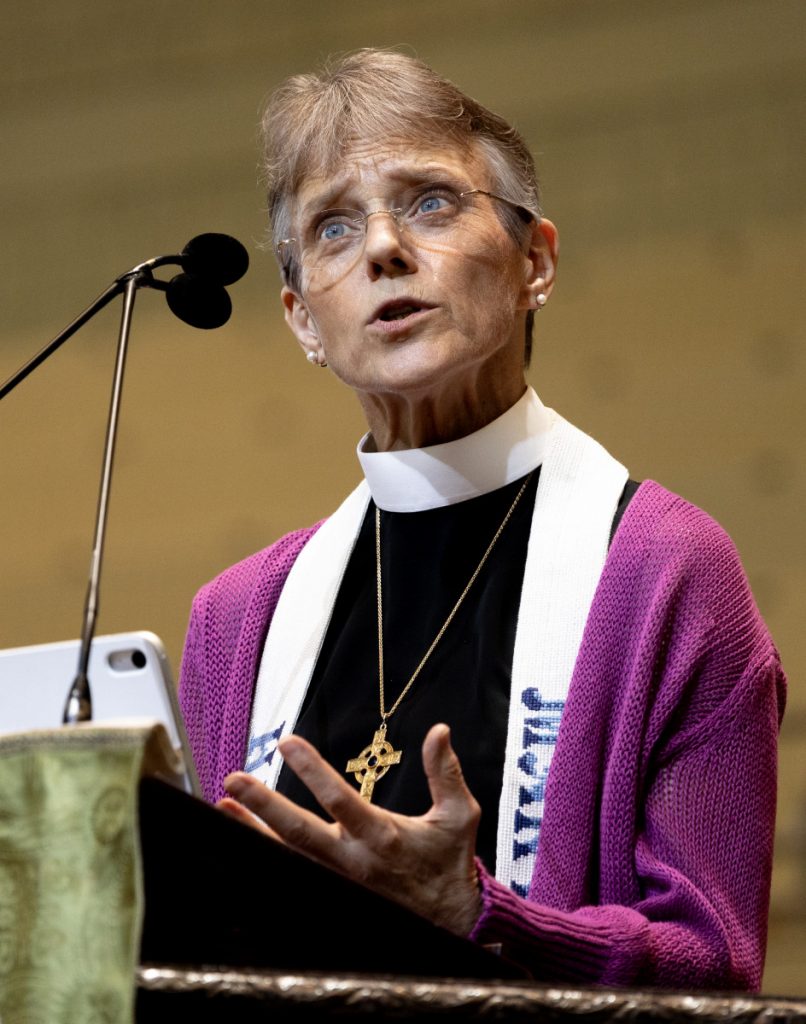
The Week One theme for the Chautauqua Lecture Series is “Icons and Instigators: Women Who Change the World,” and the Interfaith Lecture Series theme is “Women of Spirit.” The contribution of the Rt. Rev. Mariann Edgar Budde to this discussion is to talk about four “iconic, agitating, spirited women” from the Bible.
Budde preached at the 10:45 a.m. Sunday Morning Worship service in the Amphitheater. Her sermon title was “For a Time Such as This,” and the scripture reading was Esther 4:10–17.
She began with an exploration of the words “icon” and “iconic.” The word comes from Greek and refers to a stylized religious image painted on wood, used as a visual anchor for prayer, commonly in the Eastern Orthodox Christian tradition. “This inspired image can become a conduit of grace, as it draws us closer and as God draws closer,” Budde told the congregation.
To think of a woman as a living icon is high praise; someone in her humanity can reveal something to us of God’s grace and love.
“We might assume that such women are so holy as to be set apart from the rest of us. But that’s not how we experience them. What’s astonishing about such women and men is that we come away from their presence, not overwhelmed by who they are, but affirmed and prized for who we are,” Budde said.
These iconic people have the power to change the world. Budde recalled going to seminary at age 24 on fire for social justice, but she also carried a lot of pain. Ann Belford Ulanov, professor of religion and psychiatry at Union Theological Seminary in New York City, came to give a series of lectures at Budde’s seminary.
“Her presence was electrifying. She was an icon of inner strength and spiritual wisdom that pierced me. I had never been in the presence of a woman so courageous and so kind, so true to herself and yet fully present to us,” Budde said. Ulanov’s words helped Budde face her pain and be able to hold it without being overwhelmed by it.
Ulanov gave Budde guidance for living: It did not matter what noble cause Budde chose to work for, if she did not tend to her own wounds, she would contribute to the problem she was trying to solve.
Budde said, “You are an icon to someone else, who will experience something of God in you.”
The word instigator is almost always thought of as a negative characteristic. “We can cause waves, stir things up for good. Remember John Lewis — good trouble,” she said. People who make waves, who challenge what is, are fiercely resisted at first, “but they reveal God’s justice and move us toward it.”
The story of Esther is not a fairy tale. She was swept up by the king’s servants in a nationwide search for a new queen. The king chose her to be his queen, but they did not know she was a Jew.
Her story began with state-sanctioned human trafficking and moved toward genocide when Mordecai, Esther’s relative, refused to bow to Haman, an official of the king. Haman got the king to issue an edict of death to all Jews in the kingdom. Mordecai asked Esther to intervene, but she said she was vulnerable and couldn’t act.
Budde said, “Revealing herself could mean immediate execution. But Mordecai challenges Esther with those words that reverberate across time and space. ‘Who knows? Perhaps you have come to royal dignity for a time such as this.’”
Esther rose to the challenge but first fasted and prayed and asked Mordecai and all the Jews in the city of Susa to do the same. She used the strategy of prayer, said Budde, before she leaped into action. Esther claimed her vocation and said she would go, even if she died. She went and persuaded the king to punish Haman and lift the edict. This deliverance is celebrated in the Jewish festival of Purim.
Esther’s example for all of this is one of stepping up. “This means we are as we are and where we are for a particular task that is ours and ours alone,” Budde said. “Esther reminds us that there will be times, perhaps most times, when we know we must respond, but we feel ill-equipped and inadequate.”
Budde cited the young Queen Elizabeth II in “The Crown.” She was a young woman, suddenly thrust on the throne through the death of her father, surrounded by men who wanted to tell her what to do. At one point she acknowledged that they might be better leaders than she, but “for better or worse, the crown has landed on my head.”
Courage is not always seen in big actions or from people of large personality. More often, Budde told the congregation, it is a private act. “Courage is love not letting fear have the final word, it is love tested by everyday life. So how do we begin?”
Budde cited Biblical scholar Judy Fentress-Williams, who teaches at Virginia Seminary, to answer that question. Fentress-Williams wrote that when Esther remembered who she was, a Jew, she knew how to act. “The answer to what we should do can be found in our own stories. What places have we come from? What places have we come from that are in need of help? Start there. What gifts and skills do we have to share? Start there. What information do we have that could liberate others? Start with that.”
Fentress-Williams also brings up an element of Esther’s story for those of us who live in relative safety, protected by sufficient means and distance from the harsher realities of this world. Our privilege will not always protect us; equally as important, it comes with responsibilities.
Budde noted that Fentress-Williams reminds us that we are not as far apart from those realities as we might imagine. When we tell the truth about ourselves, we remember that when we occupy places of relative privilege, we do so not because of our own strength, but because God placed us here for times such as this.
Esther was an icon and an agitator. Budde told the congregation, “Remember, dear Chautauquans, there is a crown on your head, too. Remember who you are and where you are. Trust that God is already present and at work there and that you are who you are and where you are for a time such as this.”
The Rt. Rev. Eugene Taylor Sutton presided. Laurie Branch, chair of the Chautauqua Institution Board of Trustees, read the scripture. Sonya Subbayya Sutton, interim director of Sacred Music, played “Prelude and Fugue, BWV 541” by Johann Sebastian Bach. For the anthem, the Chautauqua Choir, directed by Sutton, sang a capella “Wait on the Lord” by Rosephanye Powell. Michael Wilkinson played “Taps” during the Chautauqua Family Milestones. Written by David Butterfield during the Civil War, Oliver Wilcox Norton of Sherman, New York, was the first to play it. Norton Memorial Hall on our grounds was a gift from Oliver’s wife, Lucy Coit Fanning Norton, in honor of her husband and their daughter Ruth. The offertory anthem, sung by the Chautauqua Choir under the direction of Sutton and accompanied on the Massey Memorial Organ by organ scholar Owen Reyda, was “O Come Let Us Sing unto the Lord” by Emma Lou Diemer. The postlude was “Toccata, Symphony No. 5” by Charles-Marie Widor, played on the Massey Organ by Sutton. Support for this week’s chaplaincy and preaching is provided by Week One Presenting Sponsor Erie Insurance and the Gladys R. Brasted and Adair Brasted Gould Memorial Chaplaincy.