
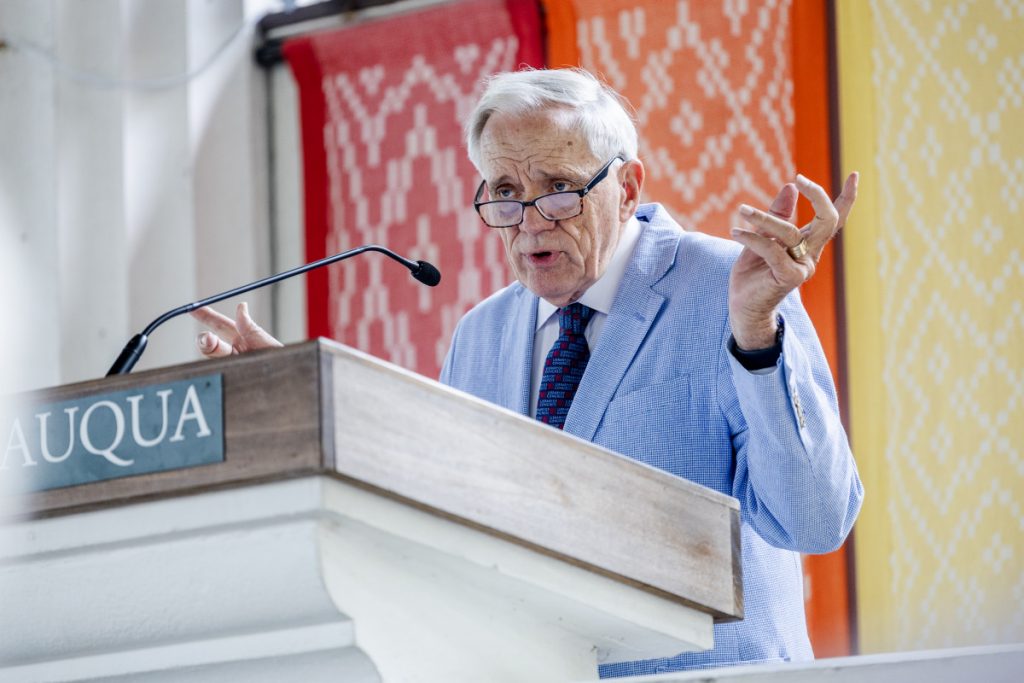
Former General Secretary of the Reformed Church in America and Contributing Editor to Sojourners Wes Granberg-Michaelson speaks about applying faith-based morals in addressing global crises during his Interfaith Lecture Thursday in the Hall of Philosophy.
LILY RESLINK
Staff Writer
At 2 p.m. Thursday in the Hall of Philosophy, Wes Granberg-Michaelson, general secretary of the Reformed Church in America and contributing editor to Sojourners, began his Interfaith Lecture with an anecdote from U.S. politics. He talked about the U.S. Department of State’s prior resistance to establishing an office of faith-based partnerships and initiatives.
He said reluctance “to give attention and credence to the impact of religious forces on the formulation of foreign policy in shaping the international global order” highlights the challenges of addressing Week Seven’s theme: “Religion, Power and the Moral Stakes of a Changing Global Order.”
Granberg-Michaelson said four topics guided his lecture: religion’s contribution to morally guiding changes to global order, religion’s benefits and detriments in evolving global politics, places where religion’s impact on global developments might manifest in the future and contributions from religious communities to cultivate moral foundations of changing global order.
He named three compelling convictions he thinks religion offers to international engagement: centering all engagement on peacemaking, undermining exclusionary nationalistic ideologies as driving forces of nation-states and affirming the intrinsic value of human life as the moral reference for judging actions.
He said applying these values to a present world “gripped by violence” and “flagrant empirical denial of the equal worth of every person” requires consideration of one’s starting point.
“From what perspective do we view the realities of war and peace? How do we judge the moral framework of our global order? From above, or from below?” Granberg-Michaelson asked.
He said the teaching of Christian tradition “begins from below in concrete human experiences” as its ideas of incarnation “expresses this solidarity with suffering and hope.”
He said many problems are rooted in detachment. “Policymakers, political leaders and opinion influencers often view the global order and interactions of nations from above,” Granberg-Michaelson explained. In his perspective, one of the most important callings of faith traditions today is to bridge the gap between those in power and “those who are bearing the consequences of their actions.”
He said, “The power of compassion must break the logic of vengeance.” According to Granberg-Michaelson, the word compassion means to “suffer with” and therefore, views of problems from above prevent one’s ability to practice compassion.
Granberg-Michaelson’s lecture outlined what he sees as the obstacles to religion functioning as a moral guide in global order, including various forms of “autocratic ideological religious nationalisms.”
He said, “Any living faith tradition grounded in an understanding of divine reality which ultimately embraces all people and all creation will undermine the power and hold of any autocratic, morally-superior, exclusionary nationalism.”
He expressed that “the truth of religion” positions it as effective resistance to “every attempt at exclusionary nationalistic power claiming divine sanction.” To illustrate how this looks in practice, he pointed to interfaith examples of nonviolent movements for peacemaking justice.
The U.S. Institute of Peace — which he said was begun through efforts from his former colleague Sen. Mark Hatfield and is mostly dismantled under the current administration — studied the effects of the grassroots movements often inspired by moral and religious vision to incite change.
Granberg-Michaelson spoke about climate justice and what he called the “threatening chronology of climate disaster.” He said, “Today, the catastrophe of a warming climate burns our hearts and eyes with hell and high water.”
He said interfaith movements have mobilized for climate justice. Suggesting that one should not underestimate “the pressures from below” on religion’s potential to impact global events, he named three examples: Pope Leo’s encyclical on artificial intelligence, prayers for unity of North and South Korea and emerging spiritual movements in China.
“We are living at a time when the most dominant forces, practices and actors shaping the global order have tried to banish moral stakes from having any claims; it’s all about power, leverage, vengeance … and transactional deals when they can be done,” Granberg-Michaelson said.
Religious voices and movements, he said, are indispensable to hopes of reshaping the global order norms. He said his three moral claims — imperatives of peace, primacy of shared humanity and inherent sacred worth of every person — must “penetrate the prevailing forces shaping the global order.”
For people across faith traditions who ground themselves deeply in their inward spiritual belief, he outlined eight convictions to turn this belief into action. The first conviction, he said, is “This world belongs to God,” and all life permeates from God’s presence. He said action can begin with humans “knowing beyond knowledge” that they live in the midst of limitless love.
Secondly, “Our engagement with the world has a spiritual foundation.” To apply this conviction, he said, “it is crucial to recognize that the movements for social change desperately needed for a liberating future include a radical transformation of values,” which he said requires spiritual power.
Third, he said, “We act on the basis of calling.” Granberg-Michaelson said using spirituality as a guide to decide what to address offers “clarity and renewable energy” to continue making an impact.
Fourth, he said, “Our action is steadfast and is committed to the long-term.” In practice, he emphasized the role of both urgency and patience in the pursuit of long-term results with “holy significance.”
The fifth conviction, he said, is, “We will display resilience,” describing this as the most valuable gift one can offer to movements. As setbacks are inevitable, he said resilience — “detachment from the fruit of your actions” — allows people to prevail.
Sixth, he said is “detachment from ego,” which he said means not emphasizing the role that one played above the mission itself.
Seventh is “Do not demonize our opponents,” he said. Granberg-Michaelson said the “eye for an eye” mentality leads to death, and “radical transforming change” comes only from breaking this cycle.
Finally, eighth, he said, is, “We are rooted and grounded in love.” To Granberg-Michaelson, it is important to understand, “This love not only transforms our inner being; it also transforms the world.”
He underlied these by saying the spiritual power of religious traditions are essential to the ability for moral claims to make an impact on global order.
To conclude, Granberg-Michaelson said, “This impact will only be possible only through those … who learn how to internalize the spiritual core of these convictions and then work and witness for them the indefatigable commitment of one’s heart and soul.”