

NORA SMITH
Staff Writer
Rebecca Nagle, award-winning journalist, author and citizen of Cherokee Nation, said she sobbed when the Supreme Court sided with Muscogee (Creek) Nation in 2020, confirming that the Muscogee reservation remains intact.
“Most tribal citizens I talked to had the same kind of overwhelmed emotional experience,” Nagle said. “It was this overwhelming sense of joy, but it was also this joy that cut really deep because we knew how many sacrifices had been made to arrive at this moment where we could still have a reservation.”
Nagle said what originally began as a man’s conviction of murder in a small Oklahoma town eventually led to “the largest restoration of tribal land in U.S. history” when the defendant’s lawyers began to argue that the reservation of the defendant’s tribe, the Muscogee (Creek) Nation, was never disestablished.
Eventually it was the later McGirt v. Oklahoma case, which argued that the Muscogee (Creek) Nation was never disestablished, that led to the restoration of tribal land. Nagle said it was understood that the court’s decision would apply to other tribes in Oklahoma because of the similarities in their histories. So, when the court sided with Muscogee (Creek) Nation, it also meant Nagle’s tribe had a reservation.
In the Chautauqua Literary and Scientific Circle Week Seven selection, By the Fire We Carry: The Generations-Long Fight for Justice on Native Land, Nagle alternates between the history of her ancestors’ tribe’s removal from their homeland and the modern murder case. In this, she said she hopes non-Native readers will understand the weight of the Supreme Court decision and the long history of this fight for justice.
“[The book tells] a sweeping story about tribal jurisdiction, tribal land and the intergenerational fight for justice,” Nagle said.
Nagle said generally most people “don’t think of Indigenous nations as sovereign nations,” and they don’t understand the history of tribes’ relationship with the U.S.
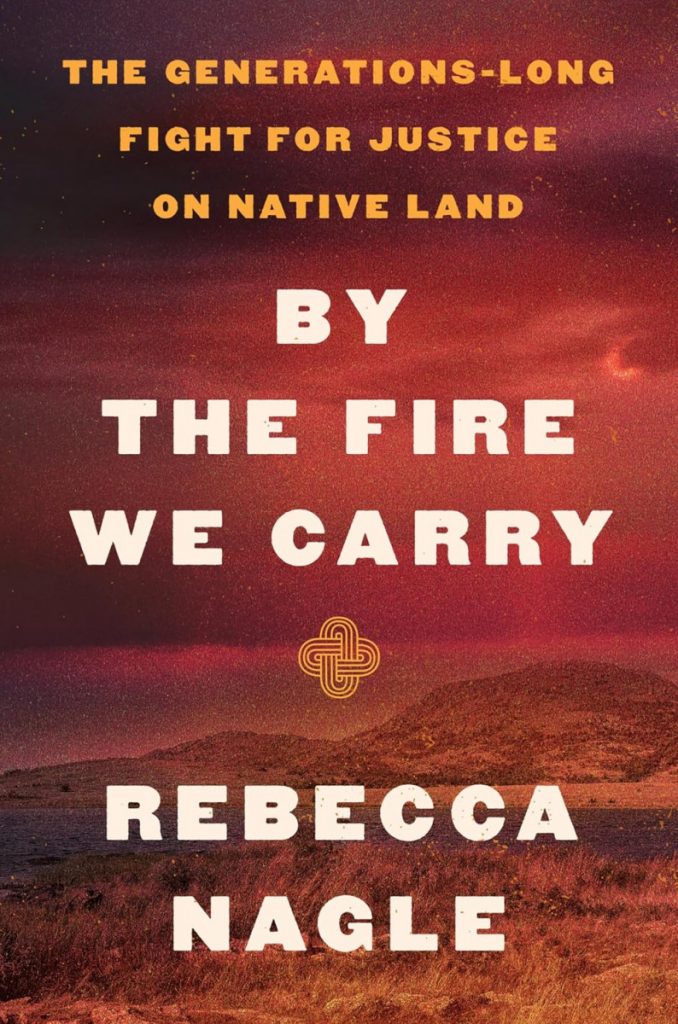
“I think that the book helps people understand the relationship between tribes and the U.S. and the harm that the U.S. has done, but also the ways that tribes have fought to preserve our sovereignty and our ways of life and our land within that system,” Nagle said.
Further, Nagle said she hopes readers and audience members attending her presentation at 2 p.m. today in the Hall of Philosophy come to realize how history repeats itself.
“[I hope] for people to see those patterns not just as ‘It’s so unfortunate that that happened to Native people, isn’t that sad, that’s bad’ … but actually seeing it as weaknesses in their government and a problem that we all in the U.S. need to take seriously,” Nagle said.
When working on the book, Nagle said she interviewed more than 100 people, including the forensic criminal investigator, the county sheriff who arrested the defendant, historians, tribal citizens, district attorneys who were opposed to tribal jurisdiction and even the pastor who baptized the defendant while he was in jail.
While working on the book, Nagle said her understanding of her ancestry expanded.
“My ancestors signed the treaty for Cherokee Nation that led to our removal and led to the Trail of Tears,” Nagle said. “They signed that treaty because they thought that Cherokees, as a distinct people and as a nation, wouldn’t survive if we stayed in our ancestral homelands because of the intensity and the violence of white encroachment at that time.”
Nagle said her ancestors thought the best chance of survival was to leave, but most people disagreed, and as a result, her ancestors were killed.
“Obviously, a lot of people died as a result of the Trail of Tears too, and so part of the book in the history is grappling with that legacy,” Nagle said.
Growing up, Nagle said she knew a different version of her ancestors’ decision, one in which her ancestors were heroes, and it wasn’t until she was older that she realized most Cherokees disagreed. In researching the book as an adult, Nagle immersed herself in primary sources such as documents, letters and speeches her ancestors had written about what they did and why they made that decision. Now, Nagle said she’s been able to “sit with the complexity and nuance of their decision” and has gained a different understanding than she once had.
“I felt a lot of the weight of it,” Nagle said. “The absolute grief and horror they must have felt. Today, when we talk about social justice or even just political decisions in general, what struck me about my ancestors’ lives is that they were having to make a decision based on survival, and not necessarily what was right and what was wrong, but, ‘How are we as a people going to survive?’”