

NORA SMITH
Staff Writer
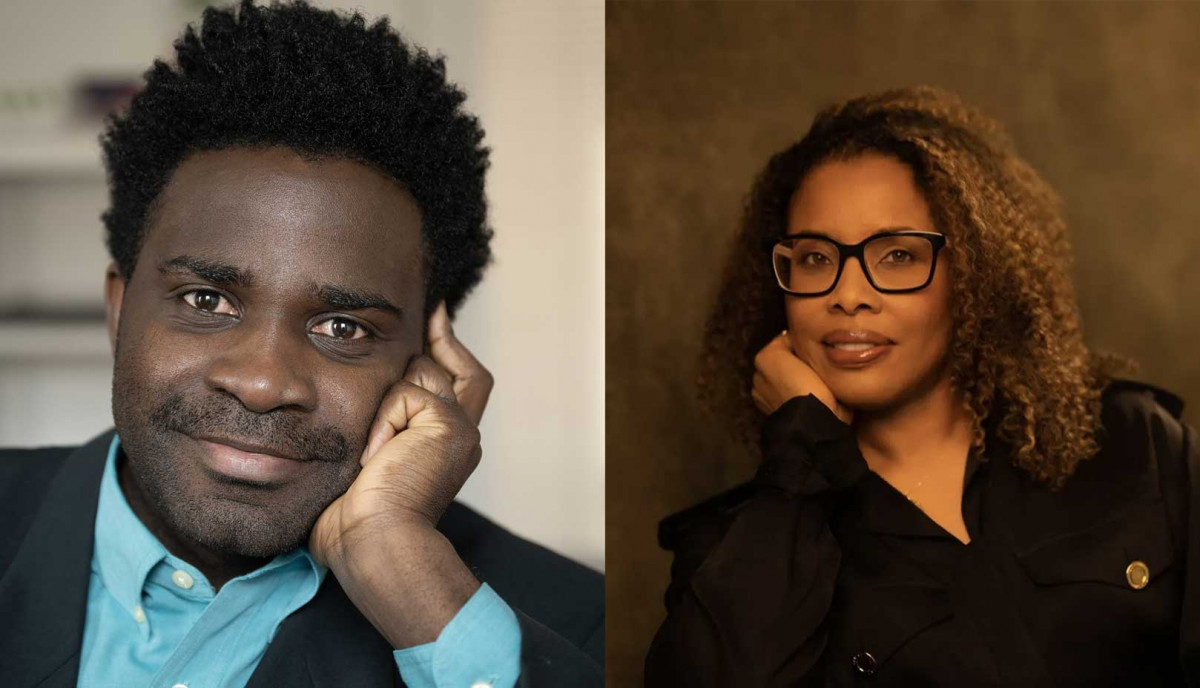
Sony Ton-Aime and Lauren Francis-Sharma will transport readers back to historical events in order to provide hope for how to handle today’s perils during Week Three’s “The 2026 Election: What’s at Stake? A Week in Partnership with American Enterprise Institute and Brookings Institution.”
“The question of what’s at stake is, I think, what both of these authors address really beautifully in their work and in varying ways, in lyrical poetry and prose,” Interim Michael I. Rudell Director of Literary Arts Stephine Hunt said.
She added that she is thrilled to welcome Haitian poet and author Ton-Aime, who is the former Michael I. Rudell Director of Literary Arts, and Francis-Sharma, author of the critically acclaimed novels ’Til the Well Runs Dry, Book of the Little Axe and Casualties of Truth, back to Chautauqua.
Ton-Aime and Francis-Sharma will transport audience members into historically significant settings and experiences during their shared free faculty reading at 3:30 p.m. Sunday in the Hall of Philosophy.
“I think from the conversation, [Chautauquans will] see the wide breadth of conversation and stories that can lend itself to this conversation of what’s at stake,” Hunt said. “I hope from the reading [Chautauquans] get that sense of the way these authors and works are speaking to each other.”
Ton-Aime positions his readers in Haiti during the 1776 Haitian Revolution in his debut poetry collection Konbit. As he relays the history of this strong community’s fight for freedom, Ton-Aime aims to grant readers some hope in grappling with climate change.
The title, Konbit, is a Haitian Creole term for a system of communal labor and mutual aid. This concept is at the heart of what Ton-Aime conveys throughout the book: The telling of a story from centuries ago can motivate communal work in the future by examining how it worked in the past.
“What we are facing when it comes to climate change, when it comes to societal collapse, we — the individual — cannot fix that,” Ton-Aime said. “We will need all of us to do it. And so, that’s why I was thinking, ‘Oh I definitely need to tell that story to see how some folks in the past came together and they defeated people that were more technologically advanced than them.’”
Ton-Aime hopes that when people read about the Haitian Revolution, they will realize that if the Haitians could overcome their battle by coming together, then the same strategy can be utilized for climate change.
“They dared to imagine a future where they will be free, where they will be independent,” Ton-Aime said. “And that, they also knew there were a lot of things they were going to have to let go — one of them, their lives. Luckily for us, we don’t need to lose our lives, we don’t need to put our lives in danger; we just need to kind of scale down.”
Not only did the Haitians defeat Napoleon’s army, but they did so with a weaker source of weaponry, which Ton-Aime compared to the use of social media today, arguing that working together surpasses all obstacles.
“I wanted to bring that back to see the value of coming together, the value of community, the value of working together and in the face of a society that is addicted to technology when it comes to the conquests that are being made,” Ton-Aime said.
In her book Casualties of Truth, Francis-Sharma takes readers to South Africa in the year 1996. Here, readers see what it was like for people to live under apartheid, a very right-wing national party.
“I think the most important thing for me with writing this book was that I didn’t feel like it was a story that people understood, that the 50 years of apartheid sort of ended with Mandela being freed and people not really understanding what it looked like for 50 years under this regime,” Francis-Sharma said.
While Francis-Sharma was pursuing her undergraduate law degree, she had the opportunity to enter South Africa just after Nelson Mandela had been freed and became South Africa’s first democratically elected president. During her time in South Africa, she had the chance to attend Truth and Reconciliation Commission hearings, where she learned what the country and people had endured those past 50 years prior to the release of Mandela.
“I ended up sitting at the hearings, and it completely changed my life and changed the entire way that I thought about the world,” Francis-Sharma said. “It changed my perspectives on nation building, national identity and what countries and heads of state were willing to do to citizens to maintain power.”
Now, Francis-Sharma keeps those citizens’ stories alive in her writing and hopes that readers can also learn from the past as she did.
Ton-Aime, who took on the ambitious feat of relaying the history of the Haitian Revolution while not being a historian, reflected on how poetry was the best vessel to work with because of its accessibility and exploration of the future.
“I did not want to dwell on the history that much,” Ton-Aime said. “My interest was really in what is happening right now and what might happen in the future, and I think that poetry allows for that because poetry is always creating new things. It’s by using language to build new things, to say things differently. That’s why we read poetry.”
For the faculty reading, Ton-Aime hopes that audience members will open themselves up to something new and in terms of the Haitian Revolution, something they might have never heard of.
“It’s going to be a moment for folks to open themselves, it’s like ‘This is something new, this is something that I do not know anything about and I’m going to listen,’” Ton-Aime said. “‘Sometimes the language might not fully make sense, but I’m going to open myself to listen, to get to know someone in the past better.’”
Ton-Aime also hopes to bring out empathy and connectivity in the participants throughout his workshop “Characters and Voices: Write the Other.” The generative workshop will run from 8:30 to 10:30 a.m. July 13, 15 and 17 in the poetry room at Alumni Hall with a maximum of 15 participants and an entry fee of $145 per person.
During the workshop, Ton-Aime hopes that listeners and participants will go as far as seeing themselves in the events of the Haitian Revolution and those who fought for freedom, as he does.
“I can see myself in the yearning for freedom, the yearning for community, the yearning for dignity,” Ton-Aime said. “I can see that, and I can put myself in their places for one moment — in their shoes for one moment — the reason is because I took the time to listen to their voices.”
Francis-Sharma also aims to keep the stories alive of those who fought for freedom and who won, no matter the challenges they faced. In a way, she wants readers to experience a sense of hope that there’s always an intention to heal a country after a dark time.
“I just really wanted to make sure that these people’s stories were heard, that they weren’t forgotten,” Francis-Sharma said. “I know that they’re in the records, but how do we continue not to forget the sacrifices people made so that freedom movements around the world would actually be able to look to them and be reminded that you can win?”
When Francis-Sharma first began writing Casualties of Truth, she said she hadn’t realized the United States would be in such a difficult political place as it is now. She had first begun the book during President Donald Trump’s first term in 2016 and then the book was published in 2024 during his second term in office.
“There’s a very clear playbook for how authoritarianism begins and is done,” Francis-Sharma said.
For Francis-Sharma, resistance is a large part of vocabulary that seems to be forgotten, so she emphasized the importance of being in the street and taking a visible stand.
“In this country and around the world, it’s usually the people of color who’ve sort of led the charge in these ways …” Francis Sharma said. “This time, right now, it’s not just about rights for people of color. It’s not just about marginalized people. It is about the direction of a country that all of us hold dear.”
This resistance is an aspect she hopes audience members and participants will walk away with after her reading and workshop.
Her flexible workshop “Old Land, New Eyes: The Necessity of Worldbuilding in Historical Fiction” will run from 3:15 to 5:15 p.m. July 13, 15 and 17 in the prose room at Alumni Hall with a maximum of 15 participants and an enrollment fee of $145 per person.
Here, Fracis-Sharma will focus on world building in historical fiction and specifically the questions that go into building a world in the past and the process of deciding whose story to tell and how to tell it.
“If I can do anything it would be to talk about these small moments of resistance, whether it be through the page and how you’re writing your story and who you’re focusing the story on or whether it be sort of through hopefully my reading and what we’ll be talking about [during the workshop],” Francis-Sharma said.


