
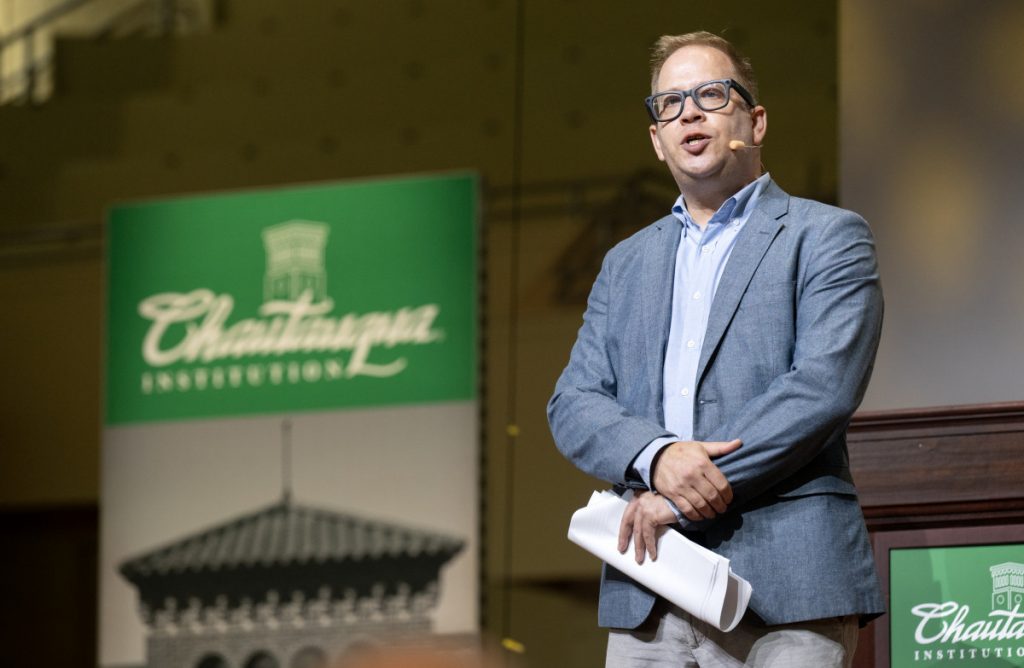
FTW Ventures founder Brian Frank speaks about new technologies impacting food systems Wednesday in the Amphitheater.
ARIANNA NEVAREZ
Staff Writer
As he was driving to Chautauqua, Brian Frank said he noticed a Welch’s factory and learned that Westfield, New York, is the “grape juice capital of the world.” He said his favorite grape juice product is wine, and he enjoys that it has become an “incredibly scientifically controlled process.”
Frank said the history of the beverage is a storied one; he shared wine’s history with the audience as a way of understanding how science and technology play a part in food. In the 1800s, a bug called phylloxera began eating grapevines’ rootstock, decimating the French wine industry.
A Missouri entomologist “came to the French’s rescue,” he explained, and discovered that if the French vines were grafted on top of American rootstock, which was resistant to phylloxera, they would survive.
“That’s just one indication of how science and technology has helped us overcome major issues within a specific product that we wanted to grow,” Frank said. “I’m here with sad news: We’re in another cataclysmic event.”
Frank spoke about how climate change impacts food, how technology can be used to expedite plant adaptation and how to expand the ingredient market at 10:45 a.m. Wednesday in the Amphitheater. Frank is the founder and general partner of FTW Ventures, an investment firm that cultivates technology that aims to reshape the global food and agriculture industries.
The “cataclysmic event” Frank was referring to is climate change, which he said has created harder and drier climates for crops to grow in, causing prices to rise for consumers. Another problem the agricultural world faces is higher prices for products like fertilizer, due to conflicts such as the Iran war, according to Frank.
“We have to find a way to grow more using less expensive resources and find new ways to build our food system that relies on innovation that has come to every other major industry,” Frank said.
Frank said the average age of farmers is 58, and they are either dying or retiring, with children who don’t want to take up farming in the same way their parents did. Instead, the children are studying engineering, chemistry or biology to bring the knowledge back to the farm. He said he has visited farms where the younger generation has built non-chemical intervention technologies, which is what FTW seeks to invest in.
In looking at new technologies, Frank emphasized crop genetics, specifically in the context of climate change. Because crops can’t transfer themselves to a more growable climate, people must fix the plants in their place when they experience a warmer climate or find new regions where they can thrive.
Frank cited Heritable Agriculture, a company that collects genetic data from crops from different climates using advanced artificial intelligence algorithms and produces recipes for farmers on how to adapt to changing environments. The company also focuses on trait adoption, which analyzes plants’ native characteristics to identify specific gene sequences that need improvement to enhance crop growth.
To do this, Frank said Heritable Agriculture’s basis is traditional crossbreeding, but that normally takes about 15 to 20 years for that trait to be adopted; Frank said this method would take up time the current food system does not have. Instead, the company uses speed breeding and genetic engineering to develop traits that endure, increasing access to effective crops in less than three years.
The downside to this technology is the lack of policy around it in the U.S., according to Frank, but in June, the EU Parliament signed its first regulatory pathway for genetically engineered crops.
“Remember our good friends in the French wine region that we saved from phylloxera? They’re now screaming for CRISPR and genetic engineering technology to save their grapes again from the dry, hot climates that they’re being affected by,” Frank said. “The most conservative people in the world, the French, are asking for these new technologies.”
The next issue Frank addressed was the need for better ingredients, specifically the lack of protein options and the need for people to eat more plants. Frank said RuBisCO is a protein and an enzyme that fixes carbon in photosynthesis, but it has not been cultivated on a large scale because there is not enough of the enzyme in plants to be extracted efficiently.
Now, a company called Plantible is developing RuBisCO at scale, Frank said. He said the two Dutch immigrants who started the company studied commodity markets and realized the world can’t produce protein fast enough to feed the growing population. They searched for a plant containing high levels of RuBisCO that is sustainable; this led them to Lemna, or duckweed.
“The amazing thing about duckweed is it doubles in volume every one to two days,” Frank said. “It’s incredibly prolific at expanding itself. It also has between 20 and 40 percent protein by volume, and can be amped up if we find the right strains and help them produce more protein.”
When figuring out how to market this product, the creators blended RuBisCO and removed the color, odor and flavor. When Frank met them to see the product, it was a white powder in a vial, yet when added to water, the drink was still clear. They created protein-enhanced water.
“By the end of the year, early next year, we should start to see products go up to the store shelf with what they’ve branded as plantable ‘Rubi Protein,’ and it will be one of the most transformative things that we will see in the new ingredient category,” Frank said.
Frank addressed the health crisis in the U.S. He said two-thirds to nearly three-quarters of the population is obese or overweight and said, “Food is literally killing us.” He said a “scary” new drug has entered the market that alters natural eating habits, referring to weight loss drugs, including GLP-1 medications. He said the third generation of this drug is currently being created, and many are calling this “the first trillion-dollar drug.”
If companies want clearance from the U.S. Food and Drug Administration or want to ensure their product has a label claiming a product is good for one’s body, Frank said they will run trials at major universities and spend millions of dollars to conduct them.
“Something that had only been accessible at millions of dollars to the largest corporations is now easily accessible at any new supplement, nutraceutical or food product company,” Frank said.
Now, the money that would have gone to food companies is instead moving to drug companies, according to Frank. He said tests are still being conducted on products even though they have already been put out to market to see how they interact with other treatments. For example, independent researchers are testing how probiotic sodas mitigate some of the effects of weight loss medications.
“It’s my hope here that what you’re learning is science is not necessarily to be feared within the food and agriculture and human health sector,” Frank said. “It’s meant to be a break, but with a responsible and societal good angle that also aligns the interests of the industry to create profits and put good food and natural food on every person’s plate.”