LILY RESLINK
Staff Writer
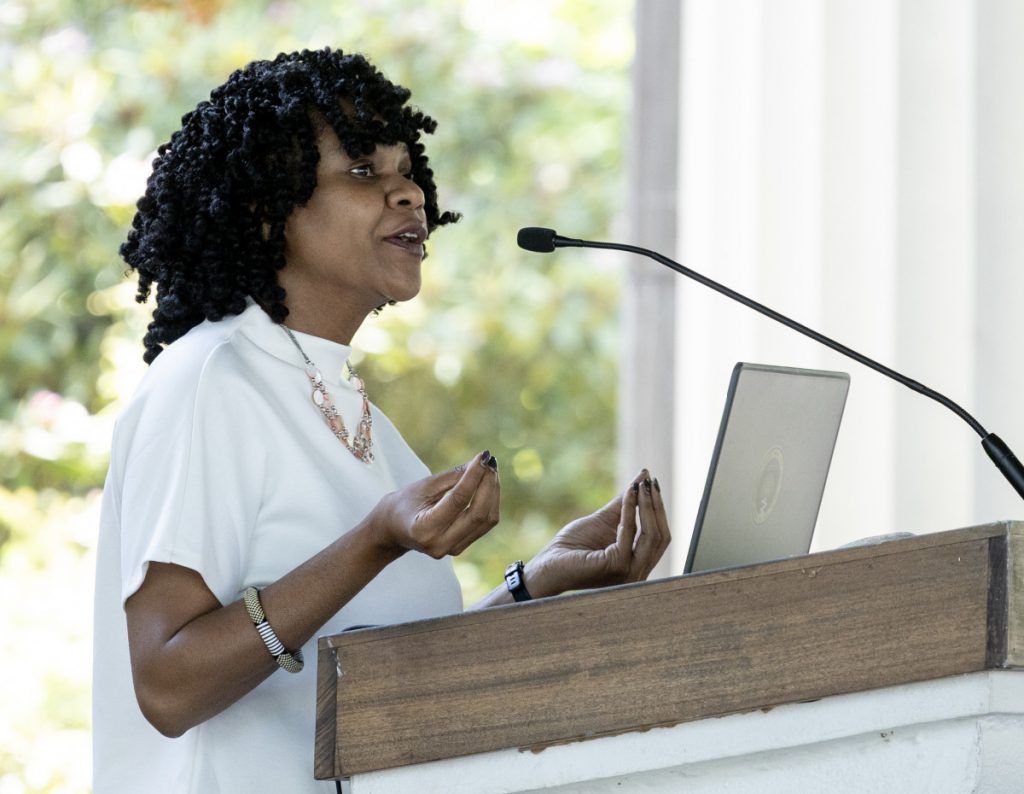
In her 2 p.m. lecture Thursday in the Amphitheater, Christian womanist theologian Yolanda Pierce spoke from her understanding of how storytellers shape history. Pierce said “living memory” reminds us of the history that is still being shaped.
Pierce, in light of her scholarly expertise and Week One’s “Women of Spirit” theme, embodied her lecture’s topic, recounting stories about spiritual women: women who told stories and women whose stories shaped a new understanding of history.
“It has been the sacred power of women’s stories that have sustained and will continue to sustain the ordinary and extraordinary work of faith,” Pierce said.
Pierce, “in true preacher fashion,” delivered her lecture with “three points and one hoop.” The three points were prophetic retrieval, source material and sacred in the ordinary, and the “hoop,” or positive ending, shared that in Christian theology, women carried the word.
Pierce said women storytellers are the reason that knowledge of Jesus continued. For those still living, she also said there is much more storytelling to be done. Within her scholarship, she is drawn to the term “living memory” and to how shared knowledge shapes group identity.
“This concept of living memory is closely related to cultural and collective memory: the shared knowledge and beliefs of a group, what they hold about their past,” Pierce said.
What dictates if a memory is preserved in history, Pierce said, is storytelling and archiving.
“There’s no such thing as spontaneous memory. We have to deliberately create an archive,” Pierce said. “We have to maintain the anniversaries. We have to organize the celebrations. We have to commemorate those moments.”
She said including the women who don’t get named or credited is essential for creating a “living memory” that recognizes women’s work in faith communities.
Pierce noted several factors that have complicated storytelling. She posed questions of whose memories and stories matter, and why some are remembered and others forgotten.
Pierce said she feels an obligation and a calling to teach and share stories. “As a Christian theologian, I am actually commanded to remember,” she said.
Pierce cited scholars who described intentional erasure and its impact. “We are in a sustained period of cultural and spiritual amnesia,” she said.
She said women’s stories and faith tradition is about prophetic retrieval. Pierce described this using the imagery of “Sankofa,” a symbolic bird whose head is turned backward but holds the egg for the future in its beak. This manifests in examples of maintaining traditions that heal people and tend to their future.
Pierce emphasized that sacredness is found in the ordinary. “Sacremental theology reminds us that women’s work in the most ordinary ways is sacred and holy.”
She also said the impact of Christian theology is large and disruptive to the construct of empire.
“It is hard for us even today to grapple with the subversive nature of the gospel, its embedded belief in a Messiah who came to turn the world upside down, a savior who came to dismantle systems and powers and principalities,” Pierce said.
Pierce noted the distinction of a “dangerous” story. “The modern-day church has lost sight of the danger of memory because it is a counterintuitive example to state-sanctioned power,” she said.
Pierce, an accomplished higher education professional, assigned the audience homework of recognizing the women in their “spiritual genealogy” — a Sunday school teacher, a grandma who taught one to pray, an aunt who took one to church — naming them, writing their stories and including them in their history.
She said this is an action that anyone can take as a response to the moment that centers Pierce’s faith “…that at some point, someone told the story of the risen savior,” and because of that, Pierce said, there is hope for a better future.