
ARIANNA NEVAREZ
Staff Writer
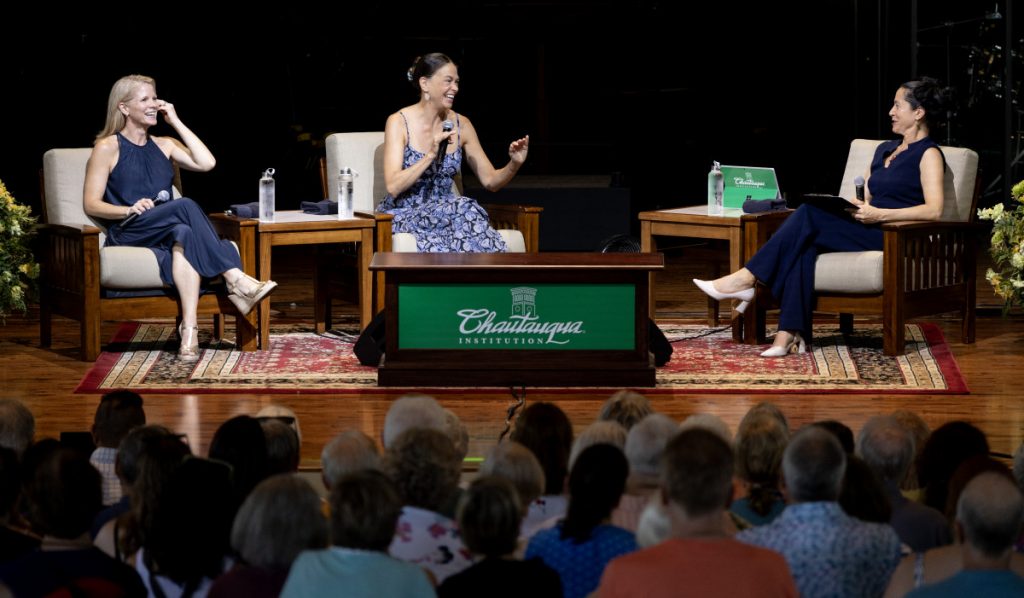
Acclaimed actresses Sutton Foster and Kelli O’Hara took the Amphitheater stage for the morning lecture at 10:45 a.m. Thursday in the Amp. The pair reflected on how their trajectories took them from admiring stars on TV to becoming stars themselves and sharing spaces with their inspirations.
“Suddenly, I was like, “Well, who are the leading ladies now? It’s us,’” Foster said. “We’re the people now that are in the middle, and we’ve got the ones that have come before, and now the ones that are coming up. And so it’s that’s also a big reason why we put together this show. We’re in our prime.”
From Broadway to their own show, Foster and O’Hara discussed strong role models, their careers and the future of theater.
The conversation opened with a discussion of titles around women in the theater community, such as “leading lady” and “diva.” Foster initially found it hard to be in the lead role because she felt a sudden loneliness compared to the community she felt in an ensemble. She also spoke about how the entertainment industry made her feel there is only room for one “leading lady.” Instead of being stuck in isolation, she found support from other powerful women such as O’Hara and saw an opportunity to join forces and create something new.
“In many industries, it feels like there’s only room for one, but that’s not the case; there’s room for many, and you don’t have to feel so lonely. You can actually find support and camaraderie with each other,” Foster said. “So this has been amazing to be able to join forces with [O’Hara] and to create the show … now we’re two powerful leading ladies.”
The two talked about the women who have inspired them and have set the stage for them, including some who were characterized and had a reputation as “divas.” Foster said she can see the negative connotation of “diva behavior,” but she acknowledged the need for balancing not apologizing for who you are while being kind.
O’Hara said she feels the characteristics come from a place of insecurity and wanting to be in control. Instead of judging these actions, she wants to approach with care and try to understand where nerves may play into behaviors.
O’Hara recounted a story in which she met Renée Fleming and had preconceived notions due to the “operatic divas” O’Hara had worked with before. After working with Fleming, O’Hara realized she was wrong about Fleming and should have approached her with curiosity and admiration instead of fear.
“This is something that we put on women sometimes that doesn’t sometimes exist,” O’Hara said.
Both O’Hara and Foster have developed characters in revivals or period pieces where they are challenged with a balance between interpreting and paying homage. Foster said she develops a character as if it has never been played before to find her own way into the role. On the other hand, O’Hara dives into the script to find something she can identify with to understand who she is playing. She looks into history while also looking into contemporary life to fully curate her version of a character.
“I find doing both of these things is where that [process] is diverse; it’s also very much the same,” O’Hara said. “It’s about finding humanity in all of that, and I find it all very beautiful. I often say that we’re the lucky ones because we get to study human nature and find out about other stories that we haven’t lived and try to understand those.”
Diving into the process and evolution of the “One Night Only: An Evening with Sutton Foster and Kelli O’Hara,” O’Hara said they aimed to pay homage to Julie Andrews and Carol Burnett but wanted to celebrate what they’ve done over their own careers. Three years after the show’s debut, they started to break the show open, let old ideas go and bring new ones in.
“It’s this beautiful, vulnerable, creative experience. Even tonight is going to teach us a lot, because we’re listening to the things that we love, the things that we don’t want to let go of, the things that we are willing to let go of … it’s exciting,” Foster said. “Not only are we the performers in it, but we’re the creators, so we’re just constantly working. The work never stops, and that’s a motto for life, too — to be willing to constantly crack open yourself and evaluate from within.”
The two talked about being instigators, particularly for the next generation. Foster said she was an instigator by going forward without fear and finding a path for herself.
O’Hara said that to persevere in this challenging industry, one needs to do it for the love of acting, not the awards. She said she was open at her Broadway shows about what she needed to excel, challenging the idea that she shouldn’t speak up or be vulnerable.
In talking about the changes in the industry, O’Hara highlighted how the “era of indifference” has created a desire to look tough, which has created a loss of vulnerability and fear of making mistakes.
“I think that the more we can encourage young people to go ahead and just be dumb and silly and broken and weird and messy, the more we might have that humility in our lives, and we can then reach out to each other and say, ‘I was wrong.’ Or ‘You hurt me.’ Or ‘Let me apologize for that.’ But not ‘I’m sorry for existing,’” O’Hara said. “… So that’s what we need to help with the younger people. It’s using your voices in ways that are honest and truthful, and not a facade.”
On the topic of balancing the life of performance, Foster talked about her conscious breaks from Broadway. She also talked about having to balance motherhood and decide if something is worth missing the important moments in her daughter’s life.
O’Hara pointed out how often women get asked this question. She also talked about a recent offer she declined, though it could have moved her career forward, because the schedule would have been hard on her kids. She was advised to instead say the contract wasn’t good.
“I remember thinking in that moment, ‘We can’t do this, we can’t continue to do this to put prioritizing family and motherhood in a place where it’s embarrassing or taboo,’” O’Hara said.
The two have played dozens of roles combined. They highlighted how different roles have shaped them and have specifically given them a different outlook on themselves. Foster, who described herself as passive, brought up a role she had as a dominatrix that challenged her to have a “stronger ownership of self.”
O’Hara mentioned how playing her role in The King & I was a time when she found out how to find purpose in a role and got to play a stronger character. She said the character taught her to stop trying to please everyone.
“It taught me about who I was, and it was a stronger woman than I had known,… In that moment, it changed who I was and how I thought of myself at the time,” O’Hara said.
The conversation closed by talking about the importance of the arts in schools. O’Hara said the arts are a way of exploring, learning deeply about the people around you and understanding differences. Foster emphasized the arts as a way of growing.
“It’s all about creativity, imagination, exploration,” Foster said. “It has nothing to do with screens … but it’s all about imagination. So, if you can dream it, you can live it, you can create it, and it’s about community, coming together and telling a story.”