Column by John Warren
You may have heard of the Thomas Edison-Nikola Tesla/George Westinghouse AC-DC “War of the Currents.” But a lesser-known, similarly white-hot electric rivalry played out on Chautauqua Institution’s grounds in the 1880s, with a Cleveland inventor who courted the electrification intentions of the Institution’s co-founder.
Edison’s earlier rivalry with Clevelander Charles Brush started in 1878, when the Franklin Institute in Philadelphia conducted scientific tests of competing technologies. The Institute emerged fawning over Brush’s “open-coil dynamo,” calling it “vastly superior,” and crowning Brush “King of Light.” Edison skulked away from the skirmish, determined to make Brush’s raw technology obsolete with his burgeoning brainchild, the incandescent bulb.
The Brush Electric Company and the Edison Electric Light Company spent the following years duking it out over contracts and in courthouses. Brush won in the small city of Wabash, Indiana, mounting four of his arc lamps on top of the courthouse clock tower. You could read the newspaper from miles away, a newspaper reporter gushed. By late 1880, Brush was lighting Broadway in New York City.
Brush demonstrated his “Dynamo Electric” generator in 1877 at Chautauqua. When the original, circa-1879 open-air Amphitheater was electrified in 1880, Chautauqua co-founder Lewis Miller picked Brush’s proposal for a massive arc-light system, in which circuits of powerful lamps would be linked in a single, continuous line.
The blinding-bright blue-white electric lights turned night into day, The Chautauqua Assembly Herald proclaimed; it “vied with the moon and the stars.” The arc lights also arced, flickering constantly. They smelled of sulfur. They hissed; they threw sparks. The thrill! What performer could compete?
(Snap, crackle, pop. Pleasant to hear in your cereal bowl; not so much in your performing arts venue.)
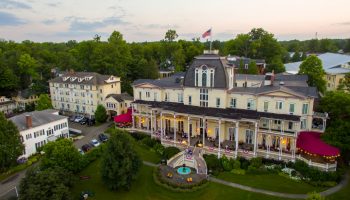
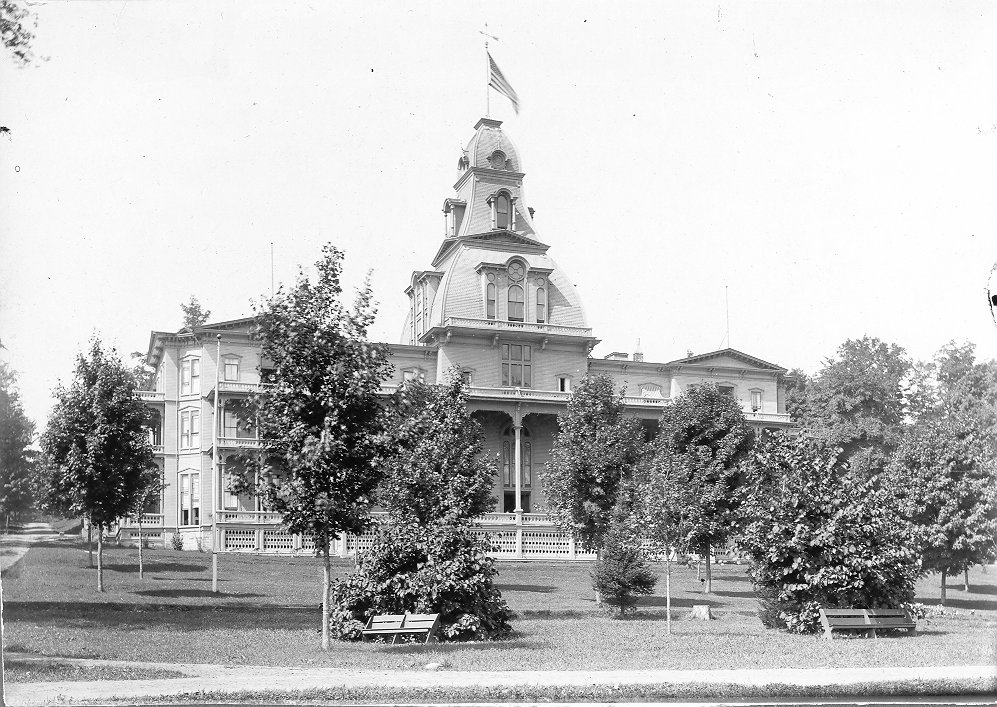
Soon after, Miller moved on to his next major construction project. Miller realized something more than platform tents and cottages was needed to accommodate the fast-accumulating masses. In 1881, he commissioned architect W.W. Carlin — not W.W. Calvin, who built the Amp — to build the Athenaeum Hotel, “The Grand Dame” that would be a showplace for modern luxury and an iconic anchor on Chautauqua Lake.
With Miller’s desire to bypass the Gilded Age gas-lighting era entirely, it was thought those Brush sparks would not be good companions with the Athenaeum’s custom-woven carpets imported from France. Edison seized the opportunity with his family friend, Miller, to successfully pitch his newly patented incandescent bulbs, which used carbon filament inside a vacuum and emitted a soft, warm, silent, safe light.
The Athenaeum, built by 90 men in 90 days for $125,000, featured a dedicated coal-fired steam dynamo plant to generate the electricity required to power the lights, making it a marvel of engineering.
The Chautauqua Assembly Herald shied away from portraying the Edison-Brush rivalry as it was (heated), preferring to frame it as a healthy competition, with both men key players in building the modern electric grid.
Shied away, that is, until 1886, when Edison married the co-founder’s daughter, Mina Miller, to whom he had been introduced the previous year. He had stayed at the Athenaeum for the summer of 1885 to (aggressively) court Mina.
In 1886, newly nepo Edison one-upped Brush outdoors, installing incandescent lighting at Miller Park. The Chautauqua Assembly Herald painted a romantic scene of platform tents bathed in soft electric light, taking care to contrast it with the noisy Brush lights at the Amp.
In the pages of the newspaper, it should be noted, Miller was not “Thomas Edison’s father-in-law.” Rather, Edison was “Lewis Miller’s son-in-law.”
Edison would continue to favor the Athenaeum as his Chautauqua home for the next 45 years, preferring its accommodations to the crowded Miller cottage.
He ate at the same corner table in the hotel, at a spot yet known as “The Edison Table.” The table was positioned next to one of the dining room’s floor-to-ceiling windows. Never a fan of attention, when he saw admirers assembling, he would slide open the window and leap onto the porch, making his escape.
As for Edison’s fierce competition with Brush, their rivalry culminated not in a courtroom nor with dueling pistols, but with a Wall Street deal brokered by J.P. Morgan. Brush Electric and Edison General Electric became part of the 1892 merger that formed General Electric.
John Warren is a columnist for the Daily writing about historical topics, events and happenings at Chautauqua Institution. You can reach him with feedback, suggestions or future story ideas at johndavidwarren1@gmail.com.