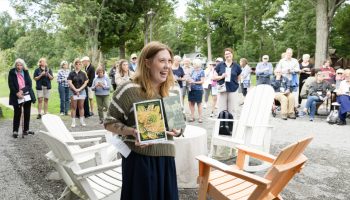
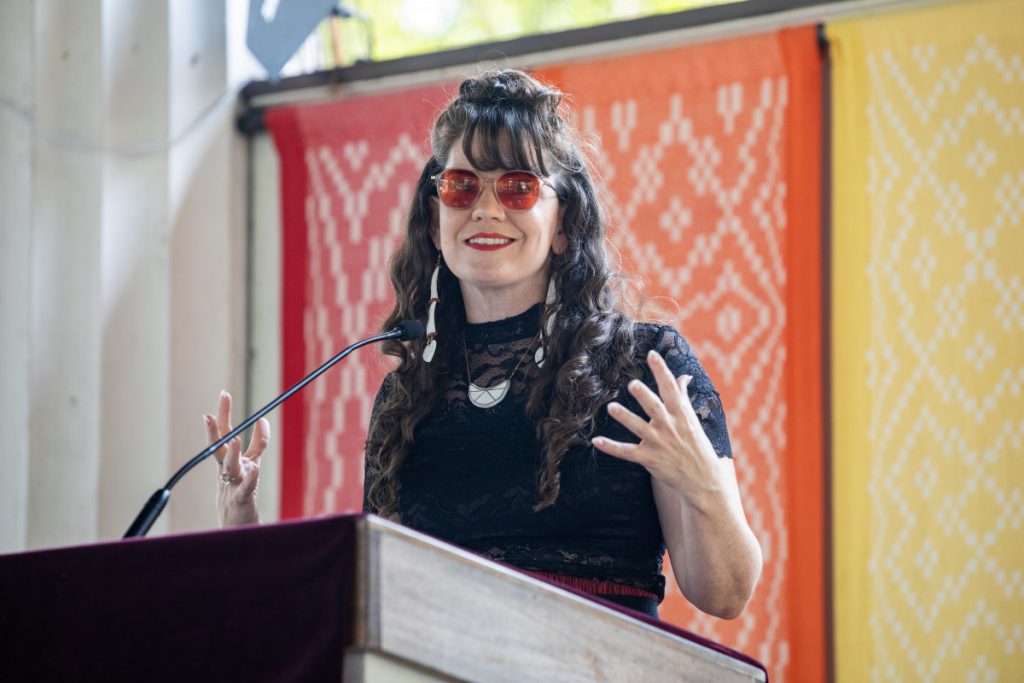
Rebecca Nagle, author of By the Fire We Carry: The Generations-Long Fight for Justice on Native Land, reads excerpts from her book Friday in the Hall of Philosophy.
NORA SMITH
Staff Writer
Before she officially introduced Rebecca Nagle, award-winning journalist, author and citizen of Cherokee Nation, Michael I. Rudell Director of Literary Arts Stephine Hunt acknowledged that “the land on which Chautauqua Institution operates is the land of Indigenous people.”
Then, Hunt introduced Nagle and shared how her work seeks to correct the journalistic standards for Indigenous communities, who she said deserve the same standards as the rest of the country.
Nagle read excerpts from Chautauqua Literary and Scientific Circle Week Seven selection, By the Fire We Carry: The Generations-Long Fight for Justice on Native Land, while giving a behind-the-scenes look at her thought process.
Then, Nagle discussed her podcast, titled “First America,” coinciding with the 250th anniversary of the signing of the Declaration of Independence. She said the podcast will be translated into a book in the coming years, focusing on the Revolutionary War and the founding of the U.S. from the Declaration of Independence to the writing of the Constitution.
“… Together with a group of Indigenous scholars, we really wanted to rewrite that origin story because most often, when I hear it, Native people are missing, right?” Nagle said. “We are just completely left out, and with that, that story is actually wrong. We’re actually missing how the U.S. began.”
Nagle said the podcast examines one of the biggest myths, that the founders of the U.S. created a democracy while rejecting tyranny and monarchy, because in reality, democracy is actually half the story; she said while building a democracy, the founders were also building an empire.
“You don’t conquer and take other people’s lands through democracy, you do that through force often and through extreme violence, and so today, as we’re living through this political moment as Americans and we’re asking ourselves, ‘Where could authoritarianism come from? How could this be happening in our country?’ I would just argue that the roots of that are actually quite old and start at the beginning,” Nagle said.
Nagle read from the prologue of By the Fire We Carry before speaking to its initial inspiration: a Muscogee (Creek) Nation legal scholar, who posted about a court decision that came from the 10th Circuit Court of Appeals in which “her tribe, even though it had not been recognized by the U.S. government or by the state in over 100 years, still had a reservation.”
Nagle then presented historical background on the case and the land before reading about the many moments of chance that led to “the largest restoration of tribal land in U.S. history.” Then, she shared her experience interviewing and reporting, and why it was important to her to write the story.
Nagle said as a tribal citizen, she followed the case in its entirety. From first learning about it to when the decision was made, it was a very emotional experience because she knew the sacrifices and the number of generations that fought for their land.
“I wanted readers who are maybe not part of my community, who don’t have that same kind of history to feel that, to feel the weight of it, that we’re not just talking about real estate, we’re not just talking about a symbolic victory, but this is something that, as tribal people, we carry this history in a deeply personal way,” Nagle said.
Nagle spoke about her ancestry, the Indian Removal Act and the reality of how many Indigenous people died. She then read the section of the book that focuses on the court’s decision.
“In one of the darkest chapters of American history, this land was promised to us for as long as the grass grew and waters ran,” Nagle read. “In Eastern Oklahoma, the grass is still growing, the water is still running, and our nations are still here, and despite the grave injustice of history, our legal right to our land never ended.”
During the Q-and-A following the presentation, Nagle went into greater depth on the Supreme Court’s decision, its effects on both tribal and non-tribal citizens and tribal and civil jurisdiction on Indigenous land. Nagle also spoke about the ties in her work to Week Seven’s theme, “Global Power and Our Evolving International Order.”
“What I think we can learn from Indigenous history is that the U.S. is an empire, and it’s a colonial empire, and it’s a colonial power. It’s always been like that, and I think we don’t think of ourselves that way,” Nagle said.
Nagle said people living in the U.S. think of it as “a beacon of democracy,” but in actuality, “there has always been part of our government that has colonized lands and lives of people who didn’t have access to those constitutional rights, who didn’t have access to that democracy.”
Further, Nagle said it is important that U.S. citizens broaden their views of the U.S. government on a foundational level because there has always been a part of the government that operates differently when there are no elections and no accountability. Nagle said an example is how Indigenous people are governed.
“I often say that what our government did to Indigenous people is the fault lines in American democracy, and the moment that we’re living through right now is the earthquake,” Nagle said.
Nagle said understanding these roots of American authoritarianism is important because the roots don’t just start at one election or one leader, and that “if we actually want to root authoritarianism out of the U.S., we have to get down to where it started, and it started at the beginning.”