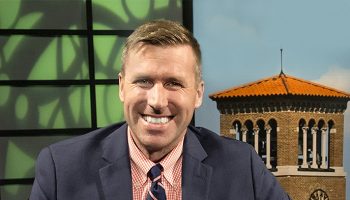

Incoming Chautauqua Institution President Mark Coolidge Johnson speaks with Daily Administration Reporter Cody Englander during an interview Thursday in the Colonnade.
CODY ENGLANDER
Staff Writer
As incoming President Mark Coolidge Johnson prepares to step into his new role following the 2026 Summer Season, he reflected on his time thus far at the Institution, his priorities in the role and Chautauqua’s imprint on how he approaches his career.
“I always tell my kids, ABC — always be curious — and how do you then apply that to what we now see, is my next role in Chautauqua,” Johnson said. “It’s a natural extension, you know, from always trying to learn about anything to now applying that to an institution; that is one of its main purposes, helping people be curious and learning.”
Johnson will begin his tenure following the conclusion of the 2026 Season. He was announced as the incoming president prior to the beginning of the season and has spent nearly two weeks on the grounds this summer.
The attorney and former Deputy Chief of Mission in the U.S. Embassy in Mexico City recently directed the completion of a $943 million embassy, which opened in November 2025. During his time on this project, he oversaw more than 3,000 employees.
Johnson said his strengths and experience lie in planning and executing large-scale projects.
“My strengths, my experience is with the setting of an agenda through creating with these other stakeholders, a strategic plan, and then making sure we have the team on board, and then building that out, and then executing, [making] sure that you’re holding people accountable for whatever the goals and objectives are.” Johnson said. “… You need to bring that all together, and that’s something I’ve done throughout my career.”
Johnson said he believes his experience working in the U.S. government translates to the role of incoming president at Chautauqua Institution.
“I’ve sold American values, and I’m going to be selling Chautauqua values,” he said.
Johnson, who will be Chautauqua’s 19th president, is a Jamestown, New York, native. By his recollection, has been coming to the Institution since 1970 with his late father Joe Johnson, who served 20 years as vice president of Finance at Chautauqua Institution. He is a third-generation Chautauquan.
He recalled visiting Chautauqua in his childhood, including visiting on Sundays and during the off-season to cross-country ski and sled, in addition to attending in-season programming.
“When I was 14 or 15 or so, my dad started working here, and I got to experience it from the inside, living on the grounds and having constant access to various programs,” he said. “ … There’s no other place that provides all of that in such an incredible setting. I learned how to sail on the southern part of Chautauqua Lake. I really learned how to water ski, which I can’t do anymore, on the northern part of the lake. I went to Camp Onyahsa across the lake. I spent a lot of time in Bemus Point as a college kid. The grounds are magical, but this whole area is part of who I am and what makes me who I am, and so I’m super excited to be back on the grounds and back in the Jamestown and Chautauqua County region. It’s just an incredibly special place.”
To Johnson, the Institution has evolved since he first set foot on the grounds, offering a larger selection of music and live performance he hadn’t been accustomed to seeing.
He said he recently attended Bandits on the Run’s performance at Roe Green Theater Center, which, from his perspective, marked an increase in and diversification of programming. He said, “They never had that when I was growing up here.”
Johnson recalled leaving the grounds to see live music at venues elsewhere in Chautauqua County.
“… To have that right here on the grounds is fascinating. And the band was fantastic, and that keeps it fresh, right? That brings more people in, as well.”
Having access to Chautauqua’s programming allowed Johnson to set a groundwork for his curiosity, and his love for the grounds and community was ultimately one of the reasons for his return, he said. Johnson said he will focus on community needs and construct a larger plan through understanding the needs of smaller groups between the conclusion of the 2026 Season and the beginning of the 2027 Season.
“ … You have all kinds of different groups that have a stake in what Chautauqua does, and being able to include them in that conversation and bring them along — get them on the bus, so to speak, having them shape where we’re going, frankly — is hugely important.”
Johnson said the basis for the Institution’s strategic plan will include, “trying to identify what individuals or their teams’ needs are, what drives them, where they see the holes and gaps, where they see the opportunities and working with them and with others, the donor community and other folks around the county, to try to make sure that we’re preparing the best — not only season for 2027, but laying the groundwork for several years.”
To Johnson, looking at the big picture is what will reinforce the ideas and goals he plans to carry into his term.
“I don’t think [I] can focus on one thing,” Johnson said. “… I can’t say it’s going to be growth or it’s going to be [budget] cuts or it’s going to be this or that. It’s going to be listening to everybody, which I’ve started [doing] already. But you need weeks and months of that to be able to say, ‘OK, this makes sense here. This doesn’t make sense here.’ But what I will be doing will be very intentional in working with the team to try to identify where the strengths and weaknesses are at this moment. What do we need to do to push things forward? How do we close gaps?”
As of September 2025, the Institution has seen $5.7 million in budget cuts and a 20% staff reduction. Johnson will inherit a different financial landscape than previous presidents, which he noted as a large-scale, multi-year issue he and the Board of Trustees will need to address.
“What I hope to do with the staff, with the board, is take a look at those changes, find out what worked, what maybe didn’t, where tweaks need to happen and where the next step has to be,” Johnson explained. “Chautauqua still has some financial difficulties, so I don’t think people should expect one year of adjustments to solve everything …”
He said he plans to work with the board to determine how best to use the budget and allocate it for continued success beyond the 2027 Season.
“I try to be purposeful,” he said. “I try to make sure that anything I do is strategic, and to understand why we’re going to do it, why the team will be spending time, resources, money, energy, emotion, on any type of thing.”
Chautauqua’s foundational pillars — the Arts, Education, Religion and Recreation — are important to Johnson. He said he does “not have a specific background in every piece of Chautauqua’s pillars,” but he brings experience in running large organizations, working across stakeholder grounds and stewarding a “mission-driven agenda.”
During his tenure, he said he plans to uphold Chautauqua’s defining features to ensure the grounds remain a place for shared ideas and appreciation of the arts.
“Chautauqua has always been a place of renewal and revival. It has allowed for those passionate conversations between very opposing ideas, and the culture that allows us to think differently, to expand our minds, or sometimes just to relax and to process some of those things while you’re watching a ballet or listening to the symphony,” Johnson said.
Building community and listening to their voices, to Johnson, is incredibly important. For the incoming president, creating and sustaining a community within the gates of Chautauqua, which he described as a “place of trying to be smarter, better (and) learn more,” sets the groundwork for the change Chautauquans can make outside the grounds.
He said Chautauqua provides an opportunity for people to experience new ideas and renewal, then take what they’ve learned back to their home communities, “and become community leaders or maintain our roles as community leaders with these new ideas, with this freshness of purpose.”
Johnson said he plans to live on the grounds year-round as both the president of the Institution and a member of the community. He said he hopes his tenure as president will be one of positive changes while continuing storied Chautauqua traditions.
“I [want to be remembered as] a good steward of Chautauqua, and I was able to preserve all the good traditions of Chautauqua, while also helping to move it forward on both a practical basis, giving it the financial footing it needs, and a philanthropic architecture that goes forward, that I was somebody that was accessible to all Chautauquans, and just continued in what all the other 18 [presidents] and … others have done over the years,” Johnson said.
Ensuring every Chautauquan has a voice in the community is important to Johnson, as he hopes to have open, healthy conversations.
“Let’s do this together,” Johnson said. “Get to know me. Let me know your thoughts. Tell me how we can do better, and then help do it. It’s one thing to have an idea or a complaint; it’s another thing to say, ‘I’m going to roll up my sleeves a little bit. This is where I’m going to jump in on a volunteer or financial basis, or lend somebody’s expertise to the board, or to specific members of the staff, to continue to make both Chautauqua better, and then by extension to make our country better and our world better.’ So, let’s do this together. I could have done other things in my life and career, and I came here because I really believe in the mission of what Chautauqua is and the purposefulness, and I believe it’s an extreme power for good.”