NORA SMITH
Staff Writer
For the average person, bumping into the word “choogle” while reading Dwight Garner’s New York Times book review is likely an insignificant event, one that requires only passing curiosity. Yet, for Stefan Fatsis, who has come to see the underbelly of words and their definitions, “choogle” has a history to be unearthed.
“My first thought is, ‘How did he end up using this word and why?’” Fatsis said. “And ‘Is it something that’s current slang?’”
Seeking answers, Fatsis played the keys on his laptop and hit the search bar, unearthing the identity of “choogle”: “a propulsive, laid-back, and repetitive musical groove or boogie, but can also simply mean having a good time, partying or keeping the vibe alive.”
Despite Fatsis having quickly learned the mysterious word’s definition, he inevitably ran into the dictionary world’s biggest threat today: Google’s artificial intelligence.
“The good thing about it is that, look, I get something that points me to where the word came from, and it gives me some places I can click on to find examples of it being used,” Fatsis said. “The bad thing is that it’s keeping me from scrolling down the page.”
Merriam-Webster, a private business that relies on funds to operate, becomes harder to reach because of Google’s stop sign at the top of the page. Although an easy find for the user, Google’s AI lacks the historically preserved process of how words are added to the dictionary.
If a lexicographer at Merriam-Webster came across “choogle,” they likely would’ve had the same instinct as Fatsis and instantly begun researching. Then, they’d have gone further to take a citation and add it to the database. Finally, they’d likely search for other examples of usage to try and determine everything there is to know about “choogle” and how people use it.
This is a process every word endures before it can even get close to entering the dictionary.
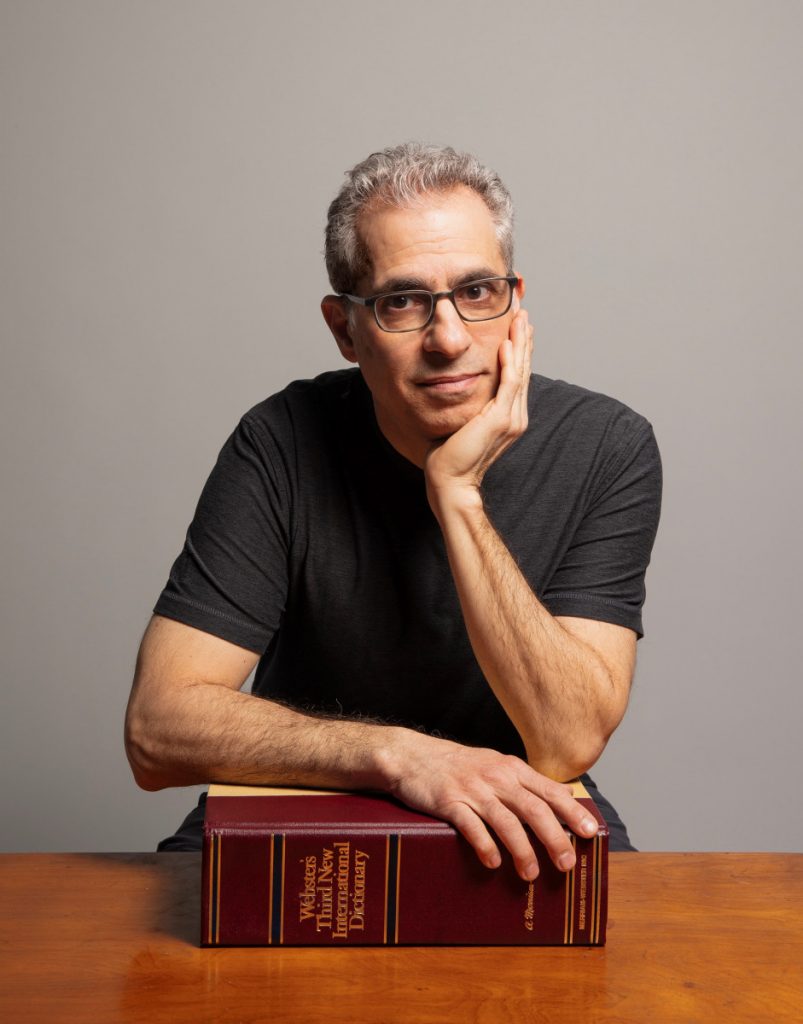
From expert Scrabble player to kicker in the National Football League, author and journalist Fatsis has walked in a variety of shoes, most recently that of the dictionary’s lexicographer. Fatsis only felt initially inclined to chase down “choogle” and its history because he had previously immersed himself into this world of lexicographers at Merriam-Webster.
“I wanted to experience it firsthand,” Fatsis said. “I wanted to understand what the people that define words for a living go through. ‘What’s the real process? What does it feel like to do this?’”

Dipping his toes into the world of dictionaries wasn’t just out of personal interest, though. Fatsis aimed to grant readers with this immersion he had experienced throughout his newest book Unabridged: The Thrill of (and Threat to) the Modern Dictionary by translating to readers not only what these words and the people that define them go through on a day-to-day basis, but also how difficult a task is that most people don’t give a second thought about.
“So, the struggle to learn to do something — whether it’s kick a football or learn 10,000 seven-letter words, or, in this case, learn how to define a word for the dictionary — you want to struggle so that the reader can sort of struggle along and empathize with you,” Fatsis said.
A dictionary’s tribulations aren’t limited to Google’s AI and the daily tasks that workers endure; dictionaries also face the same problems newspapers across the world do. This is something Fatsis took time researching for the book.
“To understand better how this centuries-old tradition’s craft was facing these headwinds that were similar to what newspapers are facing and what other media are facing — that’s the connection here,” Fatsis said. “It’s appreciating that something that looks like it’s this little substratum media actually has the same challenges that more familiar, daily institutions are facing right now.”
With language forever changing especially in today’s age of social media and the internet, Fatsis said it is more important than ever before to document these changes.
“The role of the dictionary in documenting that rapid change, I think, is essential to culture,” Fatsis said. “And because we need to have a repository of words because language is what we are as human beings, and for the historical record alone, we need to be documenting year in and year out, day in and day out.”
To Fatsis, examining how languages change, what forces propel those changes and how much they are adopted into mainstream culture is an essential part of documenting human history. This momentary acknowledgment and recording of how humans talk to one another is what drew Fatsis to immerse himself into this world in the first place.
“To me, that’s just fascinating,” Fatsis said. “That’s part of the reason I wanted to write Unabridged: just to be inside the room where this all happens, like trying to figure out what’s being used, what’s been overlooked, how do we document it, determining whether something is worthy of enshrining, basically, in the online dictionary.”
Acknowledging that the internet is a better delivery system than physical dictionaries, Fatsis still believes that it is necessary to have the authority of Merriam-Webster or the Oxford Dictionary.
“They are the people that do this for a living, and there are fewer and fewer of them making these critical decisions about what’s important to define,” Fatsis said. “We need to have it recorded somewhere in a systematic way, so that people can look and find and understand the way that we were speaking, writing, communicating at any given time.”
Fatsis has immersed himself in the world of Scrabble for his book Word Freak, the NFL for his book A Few Seconds of Panic: A Sportswriter Plays in the NFL and now dictionaries at Merriam-Webster. After writing, these experiences aren’t forgotten but instead become a part of him, so much now that words like “choogle” aren’t just words any more, but measures of history and culture.
“That, to me, is what’s so fun about language,” Fatsis said. “You never know where you’re going to see something that makes you go, ‘Huh,’ and makes you want to get a substantive explanation for the history of it.”
At 2 p.m. today in the Hall of Philosophy, Fatsis will present on Unabridged: The Thrill (and Threat to) the Modern Dictionary, a Chautauqua Literary and Scientific Circle selection. Here, Fatsis will speak to the value of the dictionary, its history, its employees and the importance of language in today’s world.