JENNA OUTCALT
Staff Writer
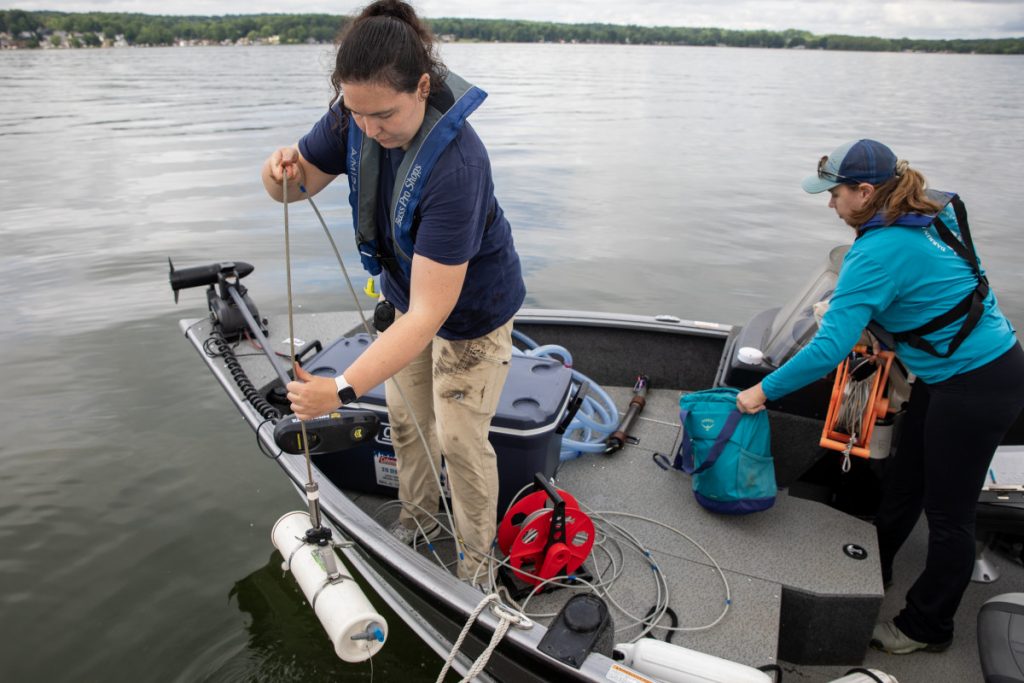
The best part of Allison Hrycik’s and Kira Yerofeev’s job is being outdoors. The two scientists go out on Chautauqua Lake every other week in a boat brimming with scientific instruments as part of The Jefferson Project, a research endeavor entering its sixth year on Chautauqua Lake. Their equipment ranges from tools that scientists have relied on for over a century to cutting-edge sensors that take samples of lake water.
Hrycik, who has been on the project for three years, is a research scientist focusing on algae ecology for the Darrin Fresh Water Institute at Rensselaer Polytechnic Institute. She and Yerofeev, a research specialist from Rensselaer Polytechnic Institute in her second year on the project, take samples from the lake year-round, even when they have to go through ice in the winter. They are collecting massive amounts of information on the ecology of the lake, much of it focusing on when and where harmful algae blooms occur.
Why is Chautauqua Lake the right place for this research?
“A lot of algae,” Hrycik said simply.
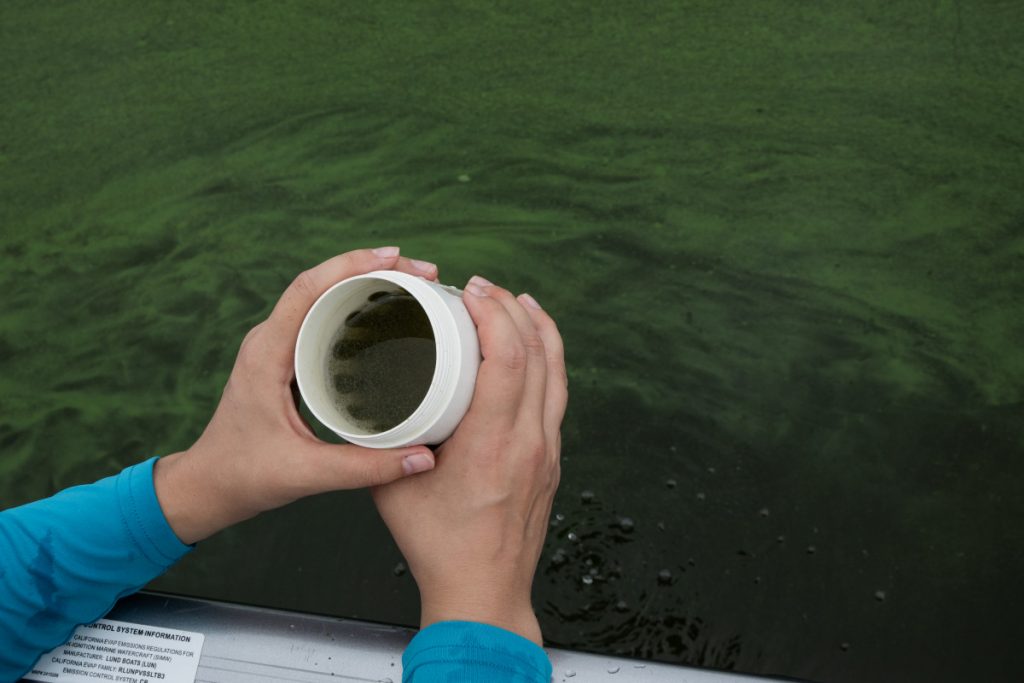
Boaters and swimmers may have already noticed bright green areas in the lake. That color comes from the cyanobacteria that make up algae blooms, some of which can be toxic to humans and animals. These blooms become more common when nutrients like phosphorus and nitrogen run off into the lake.
The Jefferson Project and State University of New York at Fredonia are conducting research on the lake, investigating what encourages algae and plant growth. On July 1, Hrycik and SUNY Fredonia professor Courtney Wigdahl-Perry gave an update on the information they gathered throughout last year.
Wigdahl-Perry explained during the research update that cyanobacteria are naturally found in the lake.
“They’re supposed to be here. But when the system gets out of balance, we could create more opportunities for the cyanobacteria to really grow and proliferate,” she said, “And most of the time, those causes are due to human activity.”
Nutrient runoff can come from agricultural or residential fertilizers, decomposing plant matter at the bottom of the lake and stormwater that picks up nutrients from surrounding land and deposits it in the lake. Impervious surfaces such as pavement allow more nutrients to continue into the water, where grass or wetlands could have absorbed them. The Jefferson Project is monitoring six tributaries that deposit into the lake to see where the most nutrients are coming from so it can guide mitigation efforts in the future.
However, other factors can play into algae growth in the lake as well. Algae, like plants, grows faster with more warmth and sunlight. This makes it more present in shallower parts of the lake, such as the south basin, where the average depth is only 11 feet compared to the north basin’s average depth of 26 feet.
Warmth and sunlight also encourage the growth of aquatic weeds in the lake. Chautauquans who visited in 2025 might have noticed an excess of weeds; the lake failed to freeze over in the 2024–2025 winter, allowing the plants to proliferate in the spring and summer. The freeze this winter indicates less severe overgrowth during this season.
SUNY Fredonia student Mayc Kelley spent last year investigating differences in algae growth based on vertical position in the lake. During the research update, Wigdahl-Perry said Kelley’s research confirmed that algae communities differed by depth. Some of the variation is due to temperature, but Wigdahl-Perry said they are looking forward to more research to determine other factors, such as the amount of light and nutrients at different depths.
Emma Steffenhagen, another SUNY Fredonia student, studied the relationship between algae and different types of aquatic plants to see if their relationship was mutually beneficial or competitive. Her research showed that there is no major difference between algae growth around native versus invasive plants, allowing future studies and mitigation efforts to look at the physical structure that plants provide for algae growth rather than focusing on species.
Wigdahl-Perry said the goal of the research was not to “purify” the lake, but rather to encourage its natural ecology to thrive and mitigate imbalance from human activities.
“We’re here to understand how the natural system works and to work within what we can do to get us back to a more natural state, where there are checks and balances biologically,” she said.
Hrycik presented on the Jefferson Project’s progress. Last year was the project’s biggest year for funding and sampling, with 14 survey sites on the lake. This year, there are only five survey sites on the lake, but there will be a greater focus on the tributary monitoring stations, where nutrients are entering the lake.

Two of the five stations have vertical profilers, floating stations that reach downward into the lake and take up to four measurements per second through the whole water column. The Jefferson Project is also in the process of adding two weather monitoring stations to their system, according to Hrycik during the research update. The project can then use computer modeling to marry data from the lake, watersheds and weather.
“This can help us build a more complete picture of lake processes and then help us forecast what’s going on if something changes over time,” Hrycik said in the update.
At the lake survey stations, Hrycik and Yerofeev test for visibility, zooplankton content, temperature and more. The information helps them study where algae blooms occur most often and where they might occur next. According to the research update, The Jefferson Project will make all of its 2025 data public. This year, the funding for the project is coming from the state of New York rather than fundraising, so data will have to go through a more arduous review process by the state before it’s published.
Hrycik explained that The Jefferson Project was mainly focused on research, not local action plans. For mitigation plans, the project has to utilize local partners such as Everwild Land Trust, the organization spearheading an upcoming engineered wetland project.
The Jefferson Project’s research discovered that more nutrients flow into the lake at the very beginning of a storm than any other time. The project is helping Everwild Land Trust engineer a way to ensure the wetland can absorb the influx of runoff at the start of storms.
Wigdahl-Perry and Hrycik also mentioned smaller mitigation projects around the Institution during the research update, such as pervious pavement that allows nutrients to seep into the ground rather than continue into the lake and support for natural plants that can absorb extra nutrients.
Hrycik explained that people often want a silver bullet to “cure” the lake, but in reality, the pace of recovery is a little slower. However, researchers working with the lake, as well as the community around it, are committed to helping Chautauqua Lake recover to its natural state.
“There’s a lot of things we can do, but it’s going to be little things that add up over time,” Hrycik said.