
NORA SMITH
Staff Writer
Week Eight’s theme, “The Future of Food: Climate, Technology and the Next Agricultural Revolution,” will satiate not only Chautauqua Institution’s appetite for food, but new concepts as well. Aimee Nezhukumatathil, essayist, poet and New York Times bestselling author, will combine these two flavors as she serves up the importance of food history and connectivity.
“I hope to showcase the importance of sharing food histories with one another because as the poet Joy Harjo once wrote, ‘The world begins at a kitchen table,’” Nezhukumatathil said when looking forward to her presentation at 2 p.m. today in the Hall of Philosophy on Bite By Bite: Nourishments and Jamborees, Chautauqua Literary and Scientific Circle’s Week Eight selection.
“I adore the Chautauquan audience because the majority of them already have a hunger for knowledge and a curiosity about the world,” Nezhukumatathil said. She said she hopes readers come to realize that Bite By Bite, among her other works, “seeks to find connections that mimics how a curious person experiences the world.”
Nezhukumatathil said finding these connections can lead to an understanding of the natural history of food by drawing on botany, lived experiences and observations. She said these observations and human ability to take in the world are irreplaceable.
According to Bite By Bite’s description, Nezhukumatathil “explores the way food and drink evoke our associations and remembrances — a subtext or layering, a flavor tinged with joy, shame, exuberance, grief, desire, or nostalgia,” in a collection of essays accompanied by Fumi Nakamura’s illustrations.
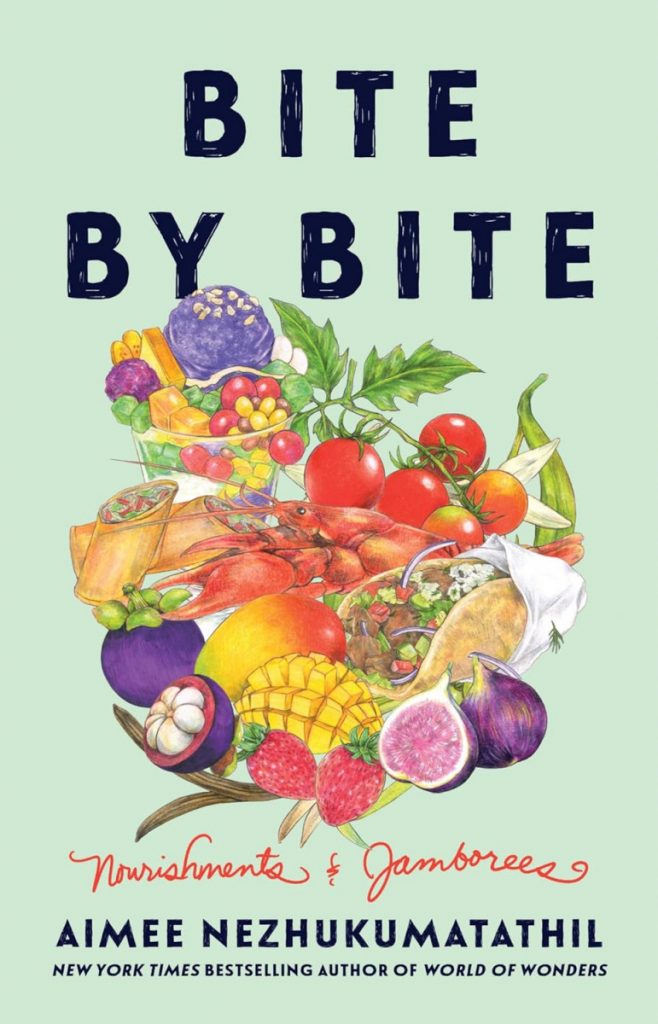
The essays span in their focus from a range of food and food traditions, with each essay following a colorful illustration depicting the food. According to the book’s description, Nezhukumatathil “offers a rich and textured kaleidoscope of vignettes and visions into the world of food and nature, drawn together by intimate and humorous personal reflections.”
“I hope readers leave Bite by Bite hungry — not only for another meal, but for the stories, people, places and memories contained in every meal,” Nezhukumatathil said. “Food is one of the ways we remember where we’ve been, discover where we belong and practice paying attention to the world right in front of us.”
In an interview with CNN, Nezhukumatathil said the book’s inspiration came from writing it after the COVID-19 pandemic.
“I think after a time of being so separate and having leaders who want to divide us so much, I wanted to focus on what nourishes us and also what can bring us back together,” Nezhukumatathil said in the interview with CNN. “And for me, that was food.”
In the same interview, Nezhukumatathil said Bite By Bite is a search for the homes that can result from food. In writing the book, she explored how certain experiences made her feel and then backtracked to pinpoint which foods encompassed those experiences. Further, Nezhukumatathil said in connecting these experiences with food, she hopes readers will grow in their own curiosity and make their own connections.
“What I wanted was to make you slow down and think about, ‘What are the stories that connect?’ and I think that learning that way of thinking about your own life becomes contagious,” Nezhukumatathil said in the interview with CNN. “Like, ‘Hey, I thought I knew apples, but did you know this? Or did you make this connection?’ and maybe my story of eating a gyro sandwich might make you think of a time when you missed one of your parents or guardians, things like that.”
During an interview with Wisconsin Public Radio, Nezhukumatathil spoke on growing up with a combined influence from two different food cultures, with her father being from India and her mother from the Philippines. She spoke further about her relationship with food growing up, how people’s senses of smell and taste contribute to their lives and how she feels in writing about food.
“That’s what I love about food writing, what I love about sharing food stories,” Nezhukumatathil said in the interview with WPR. “No matter where you are, if you are descriptive enough and specific enough, you can bring along a friend for the whole journey and never lose them. You establish this trust and it becomes reciprocal and interactive. It’s not me lecturing you as a professor; it’s me taking your hand or nudging you and saying, ‘Come with me. Come with me.’ ”