
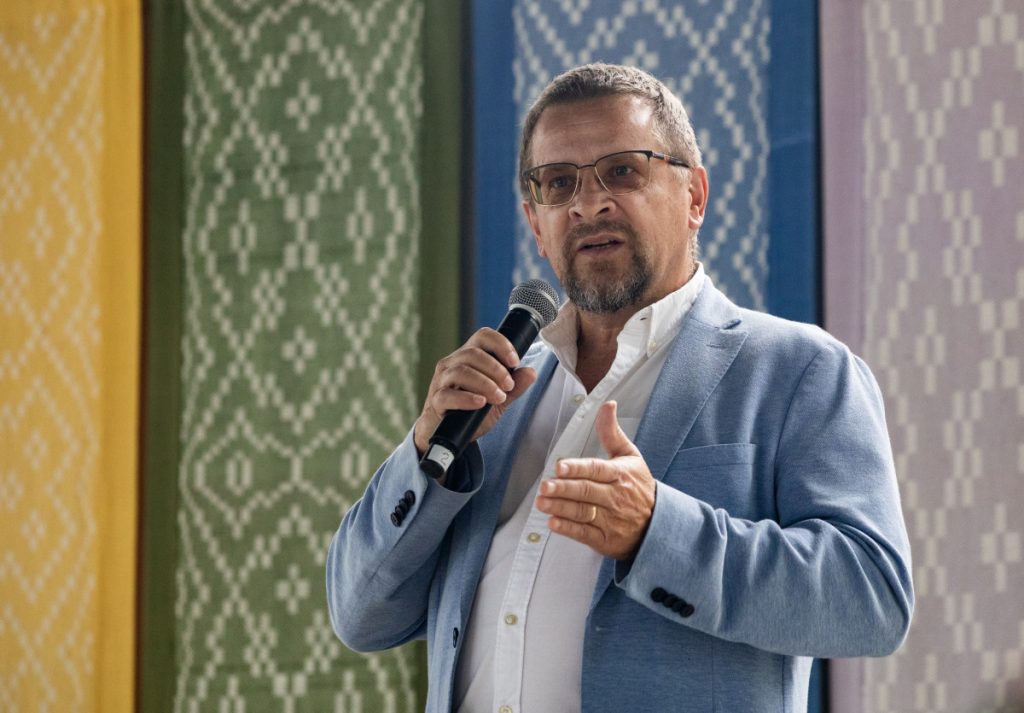
Gilbert T. Rowe Distinguished Professor of Christian Theology at Duke University Norman Wirzba speaks on the commodification of food and the spirituality of eating Thursday in the Hall of Philosophy.
LILY RESLINK
Staff Writer
Norman Wirzba, theology professor and senior fellow at the Kenan Institute for Ethics at Duke University, delivered a lecture on the spirituality of eating at 2 p.m. Thursday in the Hall of Philosophy, during which he suggested that “all of living is a conjugation of the verb ‘to eat.’”
He began his Interfaith Lecture with a distinction: “Eating is not simply what we do in life; eating is the means of life and death.”
In Wirzba’s perspective, the fact that eating necessitates death can be depressing yet profound.
As opposed to the farming, hunting and foraging that have sustained humans for millennia, he said, “We are living in a most unusual time because food is registered as a commodity.”
Wirzba said he grew up on a farm with a family that cared a lot about food. As refugees in World War II, he said the starvation his parents once experienced influenced their household’s huge pantry and readiness to feed guests or those who stopped by.
Wirzba left his family’s farm to become an academic; in college, he said he was struck by the fact that there was never a farmer on a single syllabus despite how fundamental their work was to sustaining life.
“How we eat, what we eat (and) how we grow what we eat is going to tell us a tremendous amount about what we think life itself is and what we think life is for.” These, he said, are huge questions.
Wirzba asked how unhappiness persists despite today’s “unimaginable” standard of living; he said this might suggest a lost ability “to think about life in meaningful, satisfying ways,” and the way humans think about food and eat it may play a role in modern culture.
He spoke on what he called the “logic of
commodification.”
Transformations in the food industry following WWII shaped the current view of food as a commodity, he said, adding that priorities lie in how cheaply and conveniently one can acquire it. He said this begs the question of whether people also see life as cheap and convenient.
He connected the topic of commodification back to the spirituality of eating, asking, “What is a fast
food spirituality?”
“The fast food drive-through is a beautiful window into how we think our lives should run,” which Wirzba said is quick, cheap and flavorful — albeit artificial.
He said technology in pursuit of a “friction-free life” is sold to humans. This advancement, he explained, presents dangers to the world’s ecological, social, political and economic health, as well as to the human body.
“Food is a gift,” he said, calling for a shift in mindset. He said he likes to say that food is “the creator’s love made delicious and nutritious.”
Culturally, he said people use food to punctuate important moments in life and show care. He suggested that humans think of food as an expression of love for each other, their bodies, soil, plants and animals. He theorized that activating this love to its fullest potential would yield a world that is “unrecognizable.”
Wirzba said mindless and thoughtless eating has created problems for families, neighborhoods, communities and economies.
He named factors that influence how religious approaches to food that emphasize relationships may address polarization, individualism and division. These include dietary laws, communal eating, hospitality, fasting, feasting and rest. He said, “Relationships are at the heart of faith traditions.”
In speaking about how cultural shifts toward eating alone are harmful to division, he said, “Faith traditions are constantly talking about, ‘How are we going to eat with each other? What rules are we going to be putting in place that govern well-functioning community?’ ”
Hospitality, he said, is another part of faith traditions across the board. “Showing kindness and generosity by inviting [people] into your home to eat is one of the most profound and practical articulations of faith.”
In religious tradition, he spoke about fasting “not because food is bad” but — referencing Adam and Eve — to acknowledge limits.
“When we develop a gluttonous relationship to the world, we will respect no limits.” He said not observing limits is indicative of much more of the world’s current state.
Religious feast days, he said, are important to many faith traditions as a “celebration of shared life.”
Within religious teachings, he emphasized not forgetting the purpose of day seven: rest.
“The opposite of rest is not activity, it’s restlessness,” which Wirzba said is fueled by feelings of inadequacy.
“It’s the feeling you do not have enough, do enough and are not enough yourself,” Wirzba said. He attributed this to a culture that prioritizes marketing and advertising to consumers.
”Our culture is anti-Sabbath because it wants us to be restless, because when you are restless, you are easy prey for marketers.”
He said the reason “the grass is always greener” is “because they’re watering it. And you’re not, because you’re too busy doing
other stuff!”
He said “enough” comes from appreciating relationships and seeing the world’s beauty, and offered suggestions to reimagine spirituality through gardening, cooking and sharing.
Contrary to the cultural pursuit of convenience, Wirzba said, “Try to grow something. It’s an education, because first you’ll learn how easy it is to kill a plant.” He said it is important to experience this difficulty.
He said “cooking spirituality” is a way to think about the ingredients one is using and open people up to “endless possibilities.”
Wirzba said sharing is a way to address today’s loneliness problem. “The most pleasurable way for us to share life with each other is to grow food together, to cook together and then to share the food.”
Eating around a table together, he said, helps people become more human.
He ended by saying when there is one slice of pie left, and two people waiting for a slice, one who happily relinquishes this slice to the other represents humanity at its best and “a spirituality worth looking for.”