

NORA SMITH
Staff Writer
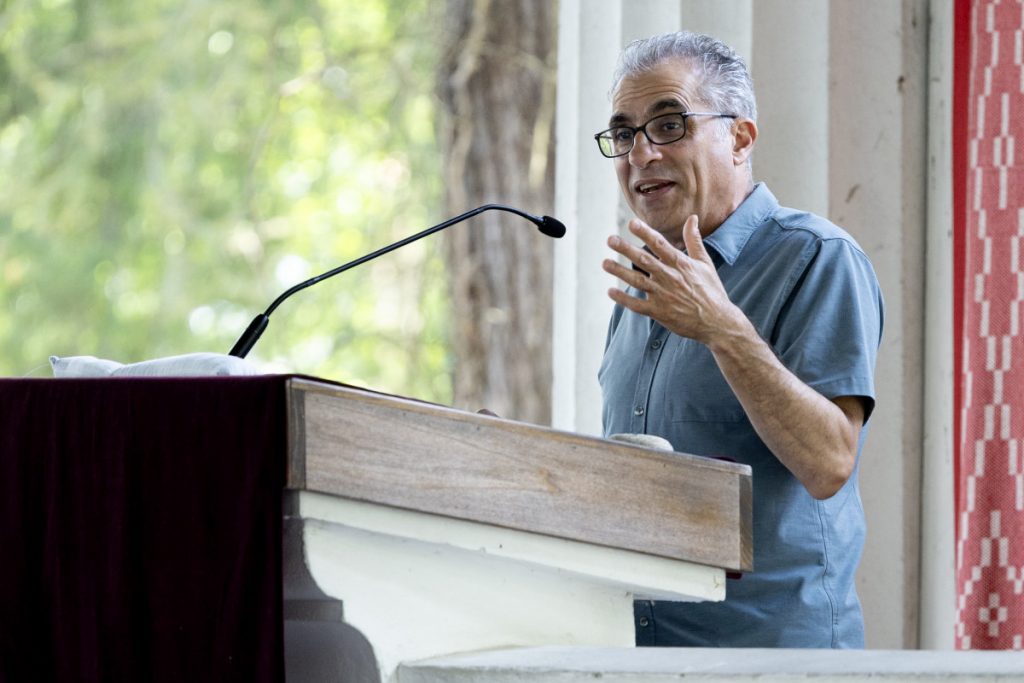
At 2 p.m. Friday in the Hall of Philosophy, journalist and author Stefan Fatsis began his presentation of Week Two’s Chautauqua Literary and Scientific Circle selection, Unabridged: The Thrill of (and Threat to) the Modern Dictionary with a question to audience members: Do you own a physical dictionary?
At first, a sea of hands raced into the air, but as Fatsis reframed the question by adding “If you’re under the age of 60,” hands began to slink down and continued to do so as Fatsis went down in age: under 40, then 30 until there was just a singular hand raised.
Despite the decrease in both physical and online dictionary users due to the current media landscape and growth of artificial intelligence, Fatsis expressed his optimism on the future of dictionaries.
“Like Noah Webster, I think the preservation and chronicling of our language is enormously important to our country,” Fatsis said after detailing his own relationship with dictionaries, Merriam-Webster’s history and his own involvement as a lexicographer-in-training at Merriam-Webster.
Fatsis revealed that while at Merriam-Webster, he drafted definitions of more than 90 words and as of today, 21 have made it into the dictionary. For him, humans doing this work is essential, especially during the age of AI, as he relayed to audience members.
“We don’t think of the insane amount of human work that you can trace back centuries from book to book, to website, from generation to generation, all of it supplemented and reconsidered and updated and improved along the way,” Fatsis said. “Language is who we are and how we live. We shouldn’t farm out its preservation to bots.”
Fatsis concluded his presentation by asking the audience to do two things: First, when looking up a word, don’t settle for AI; instead, scroll down to an actual dictionary that is deeply in need of your traffic. Second, maybe even go buy a physical dictionary.
“If you’re feeling crazy, find a dictionary or buy a dictionary, pull it off the shelf and then spend a few minutes letting your eyes dance along the pages,” Fatsis said. “That sense of discovery, that feeling of joy in spotting something that you knew nothing about — that is irreplaceable, and you don’t get that online.”


