
ARIANNA NEVAREZ
Staff Writer
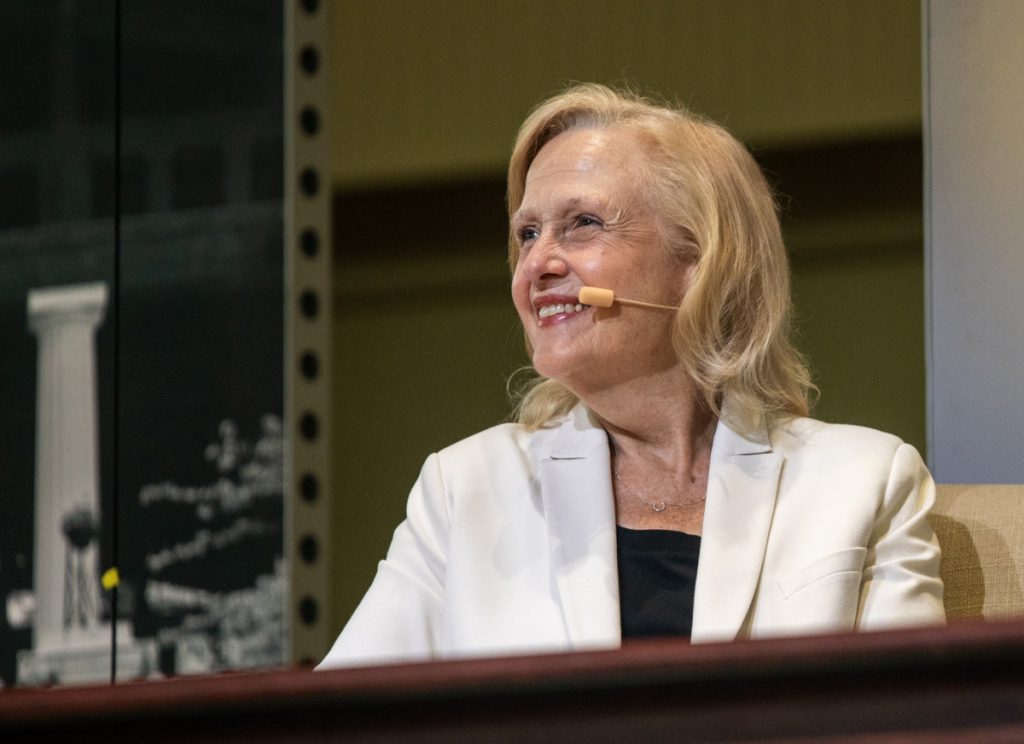
As the longest serving president and CEO in PBS history, Paula Kerger has been with the organization through a time of change, including the pulling of its government funding and a loss of its young audience to social media.
“We’ve had many moments over the years; people weren’t happy,” Kerger said. “We did Watergate hearings. It was an effort to potentially pull our money away at the different moments over the years. But we just keep persevering. I’m here today to tell you that even after this unbelievably difficult year, we are still here.”
At 10:45 a.m. Thursday in the Amphitheater, Kerger spoke about PBS’ journey during her tenure and the crucial need for the station.
To analyze the current state of media, Kerger said she needed to go back to where it started.
Frieda Hennock, the first female FCC commissioner, watched the growing industry of commercial television and radio and realized the power and promise beyond the commercial marketplace. So, Hennock began to lobby to create a space for public media. Kerger then said these stations spread to provide educational content across the country.
Years later, President Lyndon B. Johnson recognized an increase of stations like the BBC in other countries, which led to the creation of the Public Broadcasting Act. Kerger cited the Watergate news coverage as an example of a situation when public media broadcast the hearings and 24-hour coverage of what was happening to solely educate.
“We don’t want to tell you what to think,” Kerger said. “… We just want to talk about information. We just want to talk about ideas, and then you can make up your own mind of what you think of it.”
Kerger shifted to PBS’ recent loss of government funding and how she had to present her case for the organization in Congress. Kerger said, to her, the hearing being called “Anti-American Airwaves” by Congressional leaders was the most upsetting part of the situation because she sees PBS as the “most American organization.”
Kerger talked about PBS’ role for different individuals, including acting as a nightly news source and providing arts programs and TV shows for young people. She also noted that PBS is the backup infrastructure for the emergency alert system for the United States.
“We take very seriously our role as being a part of the fabric of this country,” Kerger said. “So for me to have the opportunity … to express some of what we not only aspire to do, but what we do do every day is profoundly important.”
Media consumption has changed, and Kerger said PBS has adapted to meet people where they are. Through social media, Kerger said they can provide “snippets” of information. PBS has noticed young audiences love to play games, so they’ve created educational apps to meet this need.
Discussing the issue of public trust in the media, Kerger immediately raised the issue of how stories — on both sides of the political spectrum — mix news and editorial opinion without identifying which is which. She said PBS does opinionated programs, but they label them as such.
She also said PBS is unique because stations are local, allowing audiences to feel more connected to the stories they read.
“I understand why we’re in this place that we’re in, where people are skeptical, and we have to step up,” Kerger said. “We all have to step up to make sure that the information that we’re consuming, we understand where it comes from and we understand the source of it. So when we talk about the next generation, it is even more important that kids understand where the information is coming from.”
Kerger explained the importance of children’s programs for PBS in the context of the next generation. She identified YouTube as the main place where children, specifically youth under 5, spend their time. Kerger said she wants PBS to be a place that provides education and creates content that sets up children for success.
Kerger said she has personal anecdotes from the generations that grew up on Fred Rogers and “Daniel Tiger’s Neighborhood,” showing their admiration for the station through gestures such as graduation invites, personal thanks to Kerger and the lasting memory of the shows through things like the “potty song.”
Specifically, Kerger mentioned a trip when a flight attendant asked her if she had met Fred Rogers. Kerger responded by saying wonderful things about the time she spent with Rogers and his commitment to making sure every child is treated with respect.
“The flight attendant then said to me, ‘I grew up with my mom, and she was a single parent, and we had kind of a tough time. But Fred told me I was special, and that meant everything to me.’”
Later in the conversation, the flight attendant explained to Kerger that he and his mother saw “A Beautiful Day in the Neighborhood” together — a movie about Rogers — and expressed his gratitude.
“So, if you need just a little reminder of why all this really matters, this flight attendant is probably 35, and he’s still carrying Fred in his heart,” Kerger said.
The prominent need for educational children’s shows has not disappeared, according to Kerger. She brought up a newer show that has become the top series for children called “Phoebe and Jay,” which is about two children growing up in lower-income housing in Los Angeles. The show teaches how to decipher signs, tags on clothes and things they encounter every day.
“It makes everything you know applicable to their real life,” she said. “It’s also giving kids an opportunity to see a community that many kids who watch PBS live in, in circumstances like this, where it is a little different than the stories that they’re seeing everywhere else. But every character is kind, and the parents aren’t idiots.”
When asked about PBS’ place in the public sphere, Kerger said physically being around the country and creating opportunities for people to talk to each other allows the organization to thrive. She said there is a need for people to understand their communities better but they turn to the wrong places, like the Nextdoor app. But Kerger said “real journalists” need to be out there covering the important stories.
Kerger closed her lecture with discussion about America 250 and the “pursuit of happiness.” She said she believes the country was not built simply on financial gain but on the idea of lifelong learning. Kerger said people are looking for hope while trying to understand the past that led America to where it is now.
“I think it’s always important if you’re looking to the future to root it in this idea of where we come from — what was envisioned — but what was envisioned was also fluid. What was envisioned was not a document that was going to exist for all time. It’s reflected through that, and it’s reflected through the Constitution that this will be evolving as we evolve, and it is up to us,” Kerger said. “It is up to us to invest in the future of this country. It is up to us if we believe it is important to invest in a public media system that serves the needs of all, and it is up to us to uplift all.”