LAYLA VINSON
Staff Writer

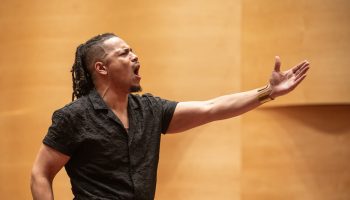
American soprano Nicole Cabell continues to share her expertise with Chautauqua Opera Conservatory as a member of the faculty hosting a master class at 10 a.m. today in McKnight Hall. Best known as the 2005 winner of the BBC Cardiff Singer of the World Competition, Cabell is a distinguished member of the voice faculty at her alma mater, the University of Rochester’s Eastman School of Music, with a special place in her heart for the beauty of Chautauqua Institution.
“This is a very unique place to learn. There’s a slow pace of life and safety here that I think allows our students to decompress and live amongst the beauty, natural as well as architectural, and the friendliness of the community while they’re learning,” Cabell said, reflecting fondly on her back-to-back summers spent on the grounds in the early 2000s. “That’s really special.”
During her time at Chautauqua, Marlena Malas was the head of the Voice Program, who proved to be incredibly instrumental for both Cabell and the organization. Many of Cabell’s peers from the time such as Quinn Kelsey, Elizabeth DeShong, Matthew Rose and Alyson Cambridge have gone on to great success and look back on their time in the program with great appreciation.
“I think all of us can say that we wouldn’t be where we are today were it not for this program,” Cabell said. “It means a lot to me to be returning on the other side of the table after all these years as a teacher. I can truly relate to our singers and know what they are going through.”
Crediting the operatic style as being an Olympiadic form of music making, Cabell emphasizes the innate gifts and vocal components such as an abundant vibrato that indicates a voice as one lends itself to classical music — a voice that needs to be significantly honed in order to reach its full potential.
She cited aspects including language, diction, stage craft, vocal pedagogy, technique, endurance and longevity as all being crucial to the training of artists in the discipline.
“Everything you need to train to be a classical vocalist is extensive,” Cabell explained. “It takes many, many years.”
Not only does Cabell hold the community and operatic art form in high regard, but cites the Conservatory students as some of the best singers currently studying in America. With remarkable base talent and an overwhelming receptivity towards new concepts, Cabell said she feels as though she has the ability to immediately tackle advanced and high-level information with each of the students.
“The first thing is to know your singer, know how to communicate with them and how to get their most authentic tone,” she explained, highlighting the primary pedagogical goals she carries into a master class. “And then on top of that, try to make sure that it’s balanced enough so that it’s aesthetically pleasing.”
Despite her affinity towards warmer sounds and accolades for her velvety timbre, Cabell’s main focus in her instruction is locating a balanced, healthily produced sound that may differ in warmth or register for each individual singer. Having spent extra time with the students in the past week, she has been able to take into account the singularity in each singer’s voice and learning style, presenting her with a unique opportunity for today’s master class.
“I’m very curious how I might approach this particular class knowing these singers a bit better,” she said. “But I will continue and hopefully aim to approach a more accessible teaching style for those in the audience that don’t know as much about technique. So that’s what I would think is maybe a little bit distinctive in my master classes.”
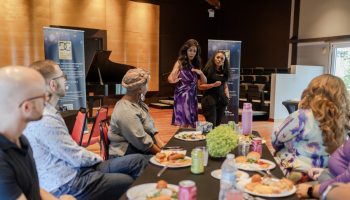
Noting the shared vision and support among the Conservatory faculty, Cabell said the cohesiveness of the department influences the student experience and atmosphere.
“That sort of camaraderie and lack of competition and general support of each other has trickled down already in the first week to the students,” Cabell said.