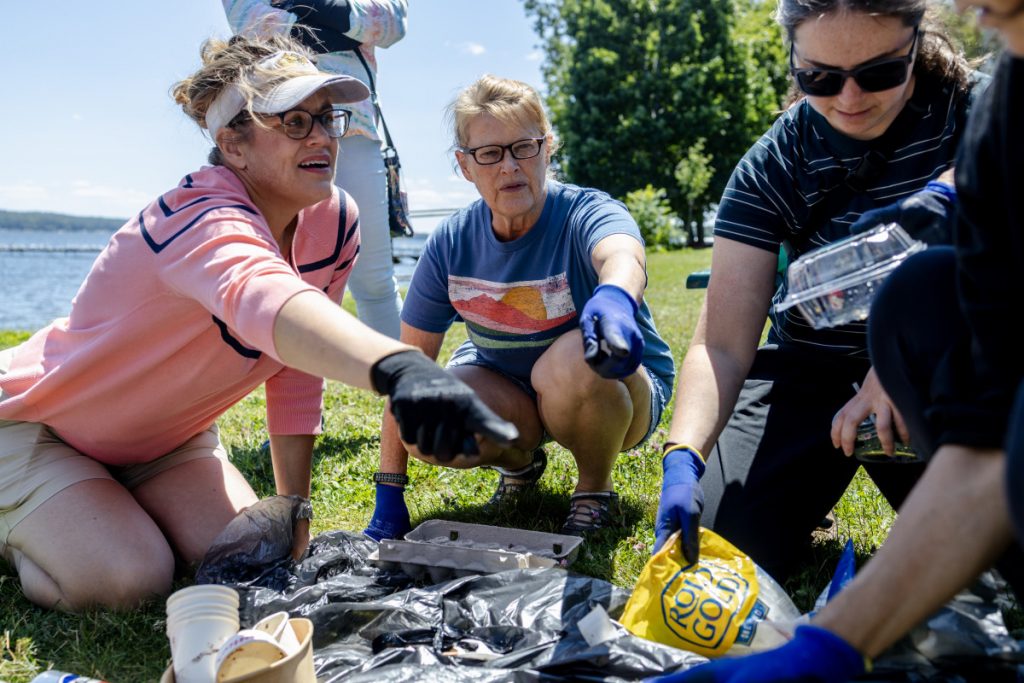
Chautauquans sort out the contents of a public recyling bin during a waste management experiment Thursday at Heinz Beach. Chautauquans and Lake Erie high schoolers in an environmental science camp led by Sherri “Sam” Mason sorted the contents of recycling bins from different areas on the grounds and discussed what they learned from the contents.
GUINEVERE MACLOWRY
Multimedia Journalist
Reduce, reuse, recycle, right? While an admirable and important creed, in practice, it isn’t as simple as one may think. According to Mark Wenzler, Peter Nosler director of the Chautauqua Climate Change Initiative and senior gift officer, waste management education is severely lacking at Chautauqua Institution and across the country. On July 23, Wenzler teamed up with Sherri “Sam” Mason, director of Project Nano & Polymer Technology for Water and Neural-networks in Erie at Gannon University, and Rachel Zoe Miller, an ocean conservationist, author and National Geographic Explorer, for a citizen science project involving recycling on the grounds.
For this trash-sorting experiment, Wenzler emptied recycling cans at three locations across the grounds: Bestor Plaza, Brick Walk Cafe and the Amphitheater. From there, Mason, Miller and the participating Chautauquans were tasked with deciphering which pile of garbage came from where.
At Chautauqua, the only recyclable materials are plastic bottles and aluminum cans. From their sample, the team found that despite this being labeled on each of the public recycling bins across the grounds, garbage made its way to nearly every recycling bin sampled. Trash of all kinds was found in every recycling bin the group sampled. Miller took the data back to her lab and created data visualizations of the waste in each pile.
Her findings showed that less than half of the contents of the recycling containers were actually recyclable. The cans outside the Brick Wall Cafe contained “some kind of disgusting food,” said Wenzler. Bestor Plaza’s recycling cans had a mix of materials, but almost all were non-recyclable, and the Amphitheater cans contained lots of other waste, such as paper and metal.
“That was kind of unnerving, that people seemed to be using our recycling bins simply as extra trash cans,” Wenzler said.
When any garbage is found in a recycling bin, the entire contents must be thrown away. Wenzler said he believes the community and the Institution must work together to tackle these issues. Because there are many problems with existing waste management infrastructure, Wenzler explained, solutions can take many forms. For instance, creating new and improved signage on cans, hosting more educational experiments like this one or forming a group of dedicated climate activists to raise money and awareness can be potential ways to address the problem, according to Wenzler.
“Finally, I think we need to do a little bit of a job distinguishing what the Institution recycles in our own cans and what the community can recycle in their own homes,” Wenzler said. “Because there is a difference.”
This data collection, Wenzler said, is the first step toward solutions. He stressed the importance of educating oneself because different communities approach waste management in different ways.
“The information is out there, you just need to find it,” Wenzler said. “I think if all of us in every community throughout the United States invest a little bit of time in learning about what’s recyclable in our communities, the compliance is going to go up and we’re going to recycle more.”
If you’d like to learn more about waste management at Chautauqua and watch Wenzler, Mason and Miller’s experiment unfold in real time, a video is available on Instagram at @chqdaily and the Daily’s website at chqdaily.com.