
LILY RESLINK
Staff Writer
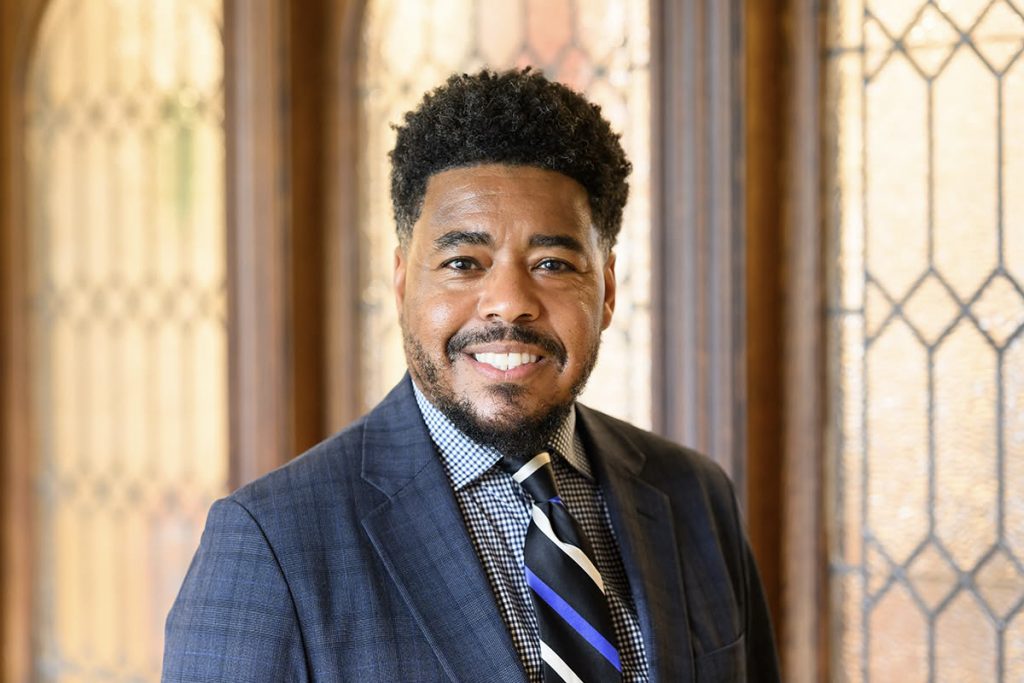
Beyond the texts themselves, Harvard religion scholar Terrence L. “Kojo” Johnson is interested in how people interpret them. Johnson examines religious sources as simultaneously “sacred” and “dialogical.” When engaging with sources — person or text — Johnson advocates for understanding context, seeking background information and asking questions.
With a focus on understanding how lived experiences shape one’s religious and political lens, Johnson will — fittingly — speak from his own lived experiences to deliver his Interfaith Lecture at 2 p.m. today in the Hall of Philosophy.
Through his lens as a multitudinal scholar in political theory, Africana Studies and religious ethics, Johnson will cover shifting perceptions of liberalism, the influence of politics and tradition’s role in shaping worldviews.
Johnson used the U.S. Constitution to explain his perspective on how “speaking back” to a book allows people “to read it from the context of where they are standing.” He said this textual dialogue also involves understanding historical contexts of the text, its origins and debates relating to it.
In bringing this material to Chautauqua Institution, Johnson said he wants to generate conversation around why some terms — such as “liberalism” — are now contested.
He said he aims to direct curiosity toward questions of “What does it mean that some people want a post-liberal America?” and “What does it mean when people say that freedom and equality or freedom and justice are not compatible … in the American context?”
He referenced 1 Corinthians 14:34–35, which states that women should remain silent in the church, as an instance where critical analysis and questioning is necessary.
“We must demand that when people make proclamations from the pulpit, and especially those proclamations that limit how people can behave in church settings, we ask the minister or the rabbi or the imam … (for) the context of the Scripture.”
In faith communities, Johnson said censoring oneself due to fear of consequence may actually be a misjudgement of the resilience within one’s congregation. Alternatively, he encourages open communication and dialogue.
“I believe that the more information we give people … the more inclined they are to ask questions and the more they’re going to feel as if they’re being … included in the ecclesiology,” Johnson.
Professionally, Johnson applies his passions to academia as Charles G. Adams professor of African American Religious Studies, professor of African and African American studies, director of religion and public life at Harvard Divinity School and starting August 2026, dean of the Candler School of Theology at Emory University.
Personally, Johnson said his orientation of the world comes from growing up in a small Black Baptist church in Indiana, where most of the members were factory or day workers and part of the great migration from the South.
From that setting, Johnson said he learned “what it means to accept difference, what it means to engage people who are complicated and what it means to hear things … through multiple registers.”
Johnson, first-time speaker at Chautauqua, hopes to instill the audience with the idea that their tradition contains “fragments for … healing the world and fragments for producing knowledge.”