Column by Mary Lee Talbot
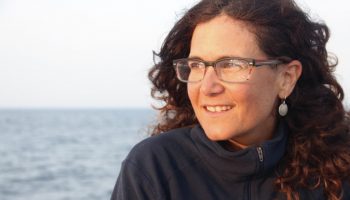
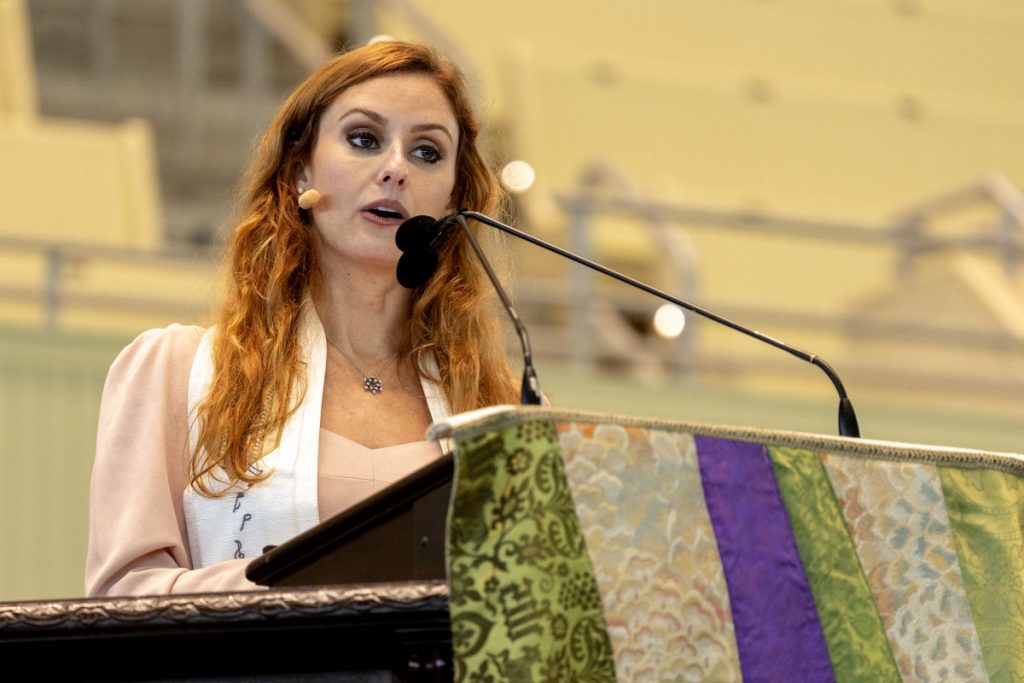
At the 9:15 a.m. Wednesday morning worship service in the Amphitheater, Cantor Olivia Brodsky again opened her sermon with a solo, “Yerushalayim Shel Zahav.” She was accompanied by Sonya Subbayya Sutton on the Steinway piano.
“I am going to begin with an easy topic today,” Brodsky said with a smile. “I just sang ‘Jerusalem of Gold,’ the unofficial Israeli second national anthem. It perfectly captures the centuries of Jewish longing for Jerusalem as an anthem of return.” Brodsky’s sermon title was “The Biblical Origins of Zionism,” and the Scripture reading was Ezekiel 37: 21–28.
The anthem, “Jerusalem of Gold,” was written in 1967 by Naomi Shemer. The longing for Jerusalem in the song came from Psalm 137: 5: “If I forget you, O Jerusalem, let my right hand wither!” Brodsky said, “The melody is modern, but the longing is ancient.”
She asked, “Why does that one place — Zion, Jerusalem, the land of Israel — loom so large in Jewish life? How does it relate to political Zionism?”
Homeland is another dimension of Jewish identity. Brodsky visited Israel for the first time when she was 15. Before that, in her mind, from reading Biblical stories, Israel was like Narnia. “I truly came to appreciate it as the birthplace of Jewish civilization and the place where that people, my people, continue to live today.”
Brodsky told the congregation that Zionism is a very misunderstood term. She said that people think they know what it means, but she believes a definition is needed before discussing the idea. “Zionism is the political movement for the Jewish’s people’s right to self-determination and their ancestral homeland. It is thought to establish a secure, recognized haven for the Jewish dispersed population to escape persecution.”
Originally, Zion referred to the fortress captured by King David, but over time it became the Bible’s name for Jerusalem and the term for the land of Israel more broadly, she told the congregation. “Modern Zionism is merely the latest chapter of a story that has been unfolding for nearly 3,000 years.”
God made a covenant with Abraham in Canaan, and the land was not incidental to the covenant, Brodsky said. “The land of Israel did not begin in 1948 but 3,000 years ago. Jacob took the people to Egypt to avoid a famine, but a place of refuge became a place of oppression.”
When the Jewish people left Egypt, they were not invading an unfamiliar land but going back to ancestral land. Jerusalem had a central role when David established the united monarchy there. Solomon built the temple and Jerusalem became the spiritual center. “Jerusalem became the spiritual center of Jewish life where worship and national identity converged,” Brodsky said.
The enduring problem for the Jewish people was to maintain sovereignty over the land. In 536 B.C.E., Babylon conquered Israel by destroying Solomon’s temple and taking the people into exile.
“Removed from their homeland, Jerusalem was transformed from being the center of Jewish life to the object of spiritual Jewish longing,” Brodsky said. “For many civilizations, exile marks the beginning of cultural collapse; but for the Jewish people, it became a new chapter, one in which ritual evolved to sustain memory. Speaking for the Jews in exile, the prophet Ezekiel declared, ‘for Zion’s sake I will not keep silent and for Jerusalem’s sake I will not rest.’”
Memory is also an act of resistance, Brodsky told the congregation. By carrying their homeland with the Jewish people and centering the longing for it in ritual, exile did not become amnesia. When the people were permitted to return and to rebuild the temple, “This first return to Zion, as it is called, became the pattern through which later generations imagined other returns.”
In 70 C.E., the Romans destroyed the second temple and renamed the area Palestine, after the ancient enemy, the Philistines. Palestine became the standard name, used for almost two millennia.
The Jewish community never completely disappeared from the area, Brodsky said. The prophets, like Ezekiel, said God would take the people from the nations, gather them and make them one nation. “Jewish liturgy ensured that this vision would be remembered.”
The anthem for the morning, “R’tzei,” is a prayer that is repeated three times a day by Jews. Brodsky said, “What began as prophecy became prayer. It asks God to accept our prayers and to restore worship. It concludes, ‘may our eyes behold your return to Zion in mercy.’ The language echoes the vision that Jerusalem and its temple would one day be restored.”
These visions by the prophets, whether taken literally, historically or in a messianic context, predate modern Zionism. The ancient longing for Jerusalem remains part of Jewish ritual. The longing for Zion is not new.
What changed in the 19th century was the realization that the safety of the Jewish people was not guaranteed. The dream to exercise political sovereignty was given urgency by pogroms and the Holocaust, where one-third of the world Jewish population was murdered.
The survivors of the Holocaust, Brodsky said, knew that Jews could not survive without a homeland, and in 1948, the ancient longing came to fruition. She told the congregation that this island of safety came into being during an era where there were broad nationalistic desires.
“Jews sought to restore self-government in their homeland. An ancient longing had been fulfilled. Almost half of all Jews live in Israel,” Brodsky said. “One of the oldest threads of continuity in Jewish ritual is at the end of the Seder when we say, ‘Next year in Jerusalem.’”
For millennia, Jerusalem was a spiritual destination. The Jewish people endured during the diaspora through memory and ritual. “Israel remains central to Jewish life. You can’t separate Judaism from Zionism. This is an important step for understanding Judaism and the Jewish people,” Brodsky concluded.
Robert Wilson-Black, director of the Department of Religion, presided. Arlene Hoffman, who oversees programming at the Everett Jewish Life Center, read the scripture. The prelude was Aeolian Sonata “Shalom” by Dan Locklair, played on the Massey Memorial Organ by Interim Director of Sacred Music Sonya Subbayya Sutton. For the anthem, the Motet Choir sang “R’tzei” by Stephen Richards. The choir sang in Hebrew under the direction of Sutton and accompanied by organ scholar Owen Reyda on the Massey Organ. Cantor Olivia Brodsky served as soloist. For the postlude, Reyda played “Toccata from Symphony No. 5,” by Charles-Marie Widor on the Massey Organ. Support for this week’s chaplaincy and preaching is provided by The J. Everett Hall Memorial Chaplaincy and The Randell-Hall Memorial Chaplaincy.