
ROCCO PRIOLETTI
Staff writer
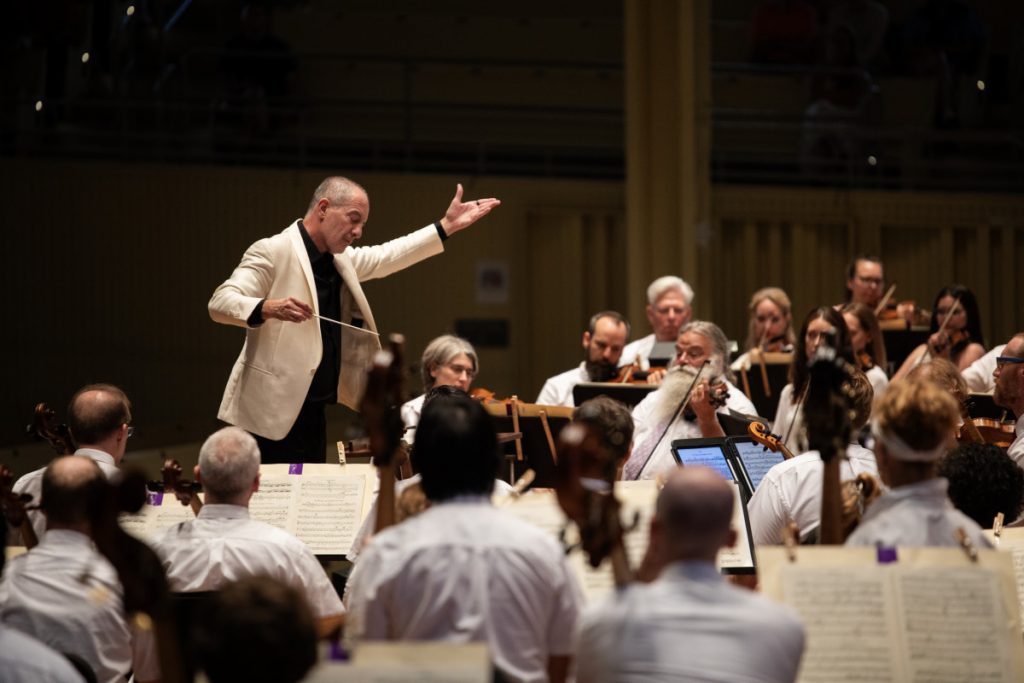
When Chautauqua Symphony Orchestra Music Director Rossen Milanov received the opportunity to have two rehearsals for tonight’s program, a rarity amid the CSO’s nonstop schedule, he ventured for repertoire that the orchestra was previously unfamiliar with.
“I personally have never conducted any of these two pieces. I always wanted to program the ‘Mysterious Mountain’ and it never really materialized, for some reason,” Milanov said.
For the first time, Chautauquans will see Milanov guide the CSO through spiritual and political revolution in Hovhaness’ Symphony No. 2, “Mysterious Mountain,” and Shostakovich’s Symphony No. 12, “The Year 1917,” during the 8 p.m. CSO performance tonight in the Amphitheater.
Milanov noted that, despite being written immediately after the end of World War II, the “Mysterious Mountain” Symphony does not embody the overtly avant-garde sensibilities of the period. Instead, the piece harkens back to the Baroque style of Johann Sebastian Bach. Visible even in the piece’s title, Hovhaness’ interests here lay within the elusive.
“The ‘Mysterious Mountain’ is different because it’s not about a mountain that exists somewhere geographically. It’s about the idea of climbing our own spiritual mountain,” Milanov remarked. “… Contrary to Shostakovich, this is not music based on conflict. This is music of living, through the course of this 20-some minutes of music, and feeling that we are spiritually elevated.”
In past seasons, the CSO ventured into the world of Shostakovich primarily through the lens of the symphonies he wrote during World War II. However, Milanov wanted something different and more “enigmatic” for tonight’s program.
Continuing from where Shostakovich’s Symphony No. 11, “The Year 1905,” left off — which the CSO performed in 2025 — “The Year 1917” Symphony unfolds the events of the October Revolution in a particularly “cinematographic” fashion.
Although the piece is rooted in the onset of socialism under Vladimir Lenin, Shostakovich’s symphony is defiant against one singular musical, narrative or philosophical interpretation.
“But, for people that know the music of Shostakovich, there is always a meaning that is somewhat under the surface. In this particular piece, one could read a lot of things that were, probably, more current to the time when it was written in the 1960s,” Milanov said.
Shostakovich’s Symphony No. 12 can be viewed retrospectively, detailing how, as oppression then circumvented the initial freedoms that originally attracted so many to the revolution, idealistic societal depictions of Lenin were corrupted under Joseph Stalin’s leadership. This is an aspect that Shostakovich has embraced throughout his life in music.
“In that particular piece by Shostakovich, one could sense that repression, that repressive, repetitive music — the usage of genres that always feel almost as a musical abuse on the ears of the audience,” Milanov said. “… He does side from [the] grotesque. He does not side from a musical caricature. And, he does not side from presenting the negative and the violent force[s] as something that we could physically live through as part of the performance.”
For Milanov, it’s important for audiences to know the symphony is not only a celebration of an important historical moment at large, but also Shostakovich’s “response, as an artist, to what he was [experiencing] as a human being and what many of his friends and compatriots were going through at the time.”
This evening concert follows in Milanov’s season-long mission to bring American music to Chautauquans in celebration of 250 years of the United States. Tonight’s repertoire specifically highlights longer, underrepresented pieces.
“The idea was to present some of the bigger works, which will continue throughout the season,” Milanov said. “I think it will culminate with the ‘Jeremiah’ Symphony by Leonard Bernstein [at] our last concert.”