
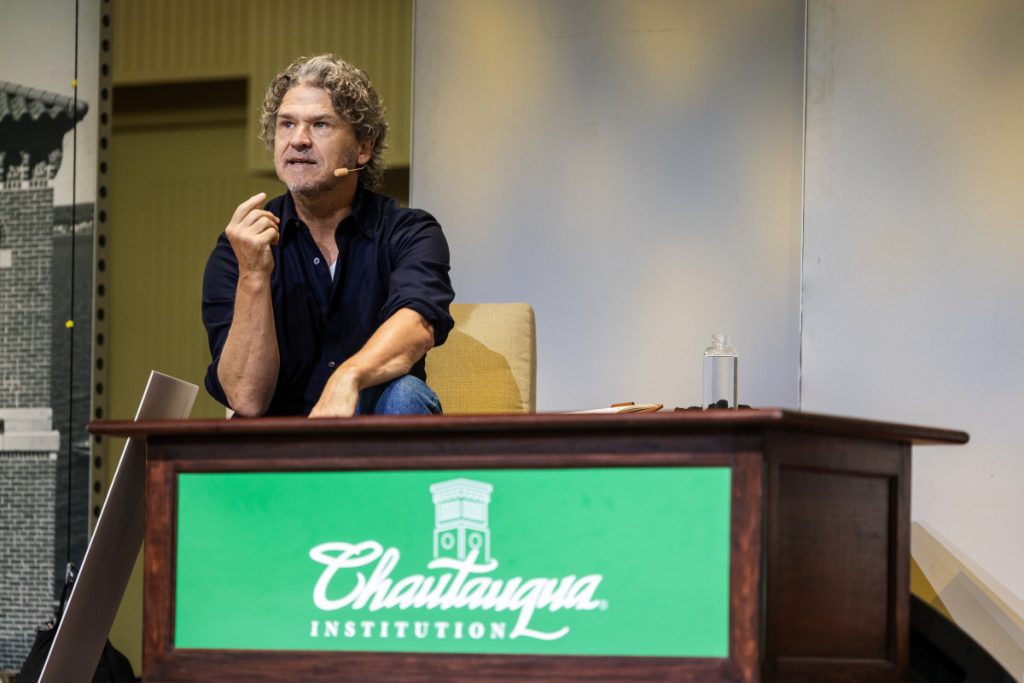
Author and McSweeney’s founder Dave Eggers speaks about the banned books list, his work on developing writing tutoring centers for children and the use of artificial intelligence in writing and storytelling Friday in the Amphitheater.
ARIANNA NEVAREZ
Staff writer
To round out Week Five’s “Art and Artists Against the Odds,” author Dave Eggers recalled a time the odds were stacked against him after his book not only made a banned-book list but was also placed in a stack labeled “to be destroyed” in Rapid City, South Dakota.
“You haven’t been doing it right if no one has found anything bannable or objectionable in what you’ve done,” Eggers said.
At 10:45 a.m. Friday in the Amphitheater, Eggers demonstrated how he personally fought the odds in his career and helped others find their way through adversity.
When Eggers learned The Circle, his tech-dystopia fiction novel, and four other books were being banned in South Dakota, his interest was piqued. First, he called a local bookstore in Rapid City to see if they would work with him on a project; he told them he was willing to pay for any student who wanted all five of the books on the banned list.
They ended up giving away 300 sets of the books.
“If they had not been banned, like six kids would have read that,” Eggers said. “Everybody wants to read the banned books.”
Eggers said he learned the school board member who made the decision to ban his book didn’t even have children enrolled in the public school, and she had won her election in a landslide due to low voter turnout and engagement. Eggers said he tried to talk to the school board and principals, but the people who actually wanted to talk about book banning were the teachers.
The teachers were at the forefront of the issue, fighting “tooth and nail” to continue teaching the books that had been in the curriculum for years.
“Instead of saying, ‘This is an interesting, complicated text; we actually have experienced teachers (who can) guide you through these texts and actually give you the context.’ Instead, they ban them,” Eggers said. “We go out there, and the teachers are fighting school boards. The principals have hidden all of the books. … This was raging the national debate for a long time.”
As the teachers were working to make a change, Eggers said students were upset because they were being deprived of more book options due to inappropriate content, while they had access to the internet with no guidance. The next school board election turnout tripled, and Eggers said he saw students advocate for themselves at town halls in Rapid City.
He also said there had not been complaints about the books in the first place.
“Book bans are un-American, and they’re nonpartisan in a way that nobody wants them,” Eggers said. “It’s this tiny, tiny sliver of people that … has stirred up all of this trouble across the country. You will not find librarians that have seen authentic complaints.”
This wasn’t the first time Eggers had dedicated time to support young people. In 2002, Eggers said he noticed that grade school students raised in Spanish-speaking households could benefit from more one-on-one time with teachers. He realized he knew writers who could assist, and he set himself to work.
In San Francisco, Eggers said he found a potential building where he hoped to establish a writing and tutoring center he called 826 Valencia, but the street was zoned for retail. “Naturally,” he said, the organization turned the entrance into a pirate supply store. The store sells seafaring necessities and novelties, from eye patches to messages in a bottle, and serves as a unique fundraising tool, which functions as a way to meet retail zoning requirements and destigmatize something that students might otherwise be intimidated by or think has a negative connotation.
The informal, fun nature of the center became something that “destigmatized” it. Eggers said it became a space that could function beyond its initial purpose of tutoring and amplify people’s writing by publishing them in books, newspapers and magazines. 826 Valencia has since opened 74 locations worldwide and published more than 10,000 books by students, according to Eggers.
“They didn’t have to go into the place for kids falling behind or kids learning English. They went to a pirate store,” Eggers said. “They went really willingly, and we had a lot of homeschooled kids and kids that work with learning differences. For them, they know that if they are a little out of mainstream, like every kid is, and [like] we were, they are going to be understood by the people that work at the pirate store. It’s a signal that we get you. We are all strange.”
Eggers said he and his collaborators aim to make the centers “a third space” for students. He said it’s gotten tougher each year, but these spaces are a “celebration of human intelligence.”
He said 826 Valencia has a no-screen policy and that teenagers don’t want technology but feel pressured to have it to be connected to others. Instead, Eggers said 826 Valencia offers an “authentic alternative.”
“We do find unequivocally and without exception that if you give young people a choice between a screen alone and a human that’s listening to them and that’s going to publish them and put it on a microphone in front of their parents and peers to read their poetry and then they have this book permanently on the shelf of a library, they will choose that over the screen alone,” Eggers said. “Of course, we have to give them an authentic choice; we can’t assume they want more screens because they don’t want more screens.”
The conversation then shifted to artificial intelligence, which Eggers said is “the catastrophe that [society is] facing right now.” He said he was invited to an OpenAI event after publicly speaking out about AI, but he said the people inviting him didn’t see the negative effects of AI because they’re “in such a bubble.”
At the event, Eggers asked developers about the true, safe use of artificial intelligence. He said that in K–12 settings, it doesn’t allow children to learn the same way as they do without it, and that college students are under significant pressure and are likely to cheat using AI. Eggers also said this affects teachers because they need to spend more hours working in order to check for AI usage.
Eggers said the solution his friends who are educators have found is reverting to pen and pencil and ridding classrooms of screens.
“We can say, at every metric since screens and computers were introduced en masse in schools, every score has gone down,” Eggers said. “… So we experimented with that. The experiment failed. Now we have to go back to what we did for 1,000 years, which is paper, pencil and experienced educators who are allowed to do their jobs.”
Eggers also talked about his newest book, Contrapposto, a novel about human connection through friendship and love, as well as artistic journeys. The book centers around two characters, Cricket and Olympia. In the book, the two have known each other for 65 years, navigating life and art together and apart.
As Eggers was thinking about this idea in his 30s, he said it didn’t seem possible for people to still relate and be in one another’s lives for 30 more years. When he turned 50, his friends from kindergarten were still in his life; Eggers said the key to maintaining these relationships is to invest time in them and be understanding.
“If you told me at age 23 that I’d have the same friends, and we act in the same immature way to each other, and we fight about the same things, and we are fiercely devoted to each other, and we’ll come across the planet and help (each other), I wouldn’t believe you that it could go for this long.”
Eggers talked about what reading means in closing his lecture. He said humans have always told stories to help those who come after understand culture and to convey feelings effectively to make others feel less alone.
“You exult some aspect of the human experience through the magic of certain words in a row,” Eggers said. “The highest kinds, the most sublime kinds of art, are exalting the human experience and creating something higher than our day-to-day pedestrian existence. All of these things are only things that humans can do,” Eggers said. “We are sharing what it’s like to be human, alive on the planet.”