DEBORAH TREFTS
Staff writer
The late theoretical physicist Richard Feynman’s observation, “If you want to master something, teach it,” is too often overshadowed by the expression, “If you can’t do, teach.”
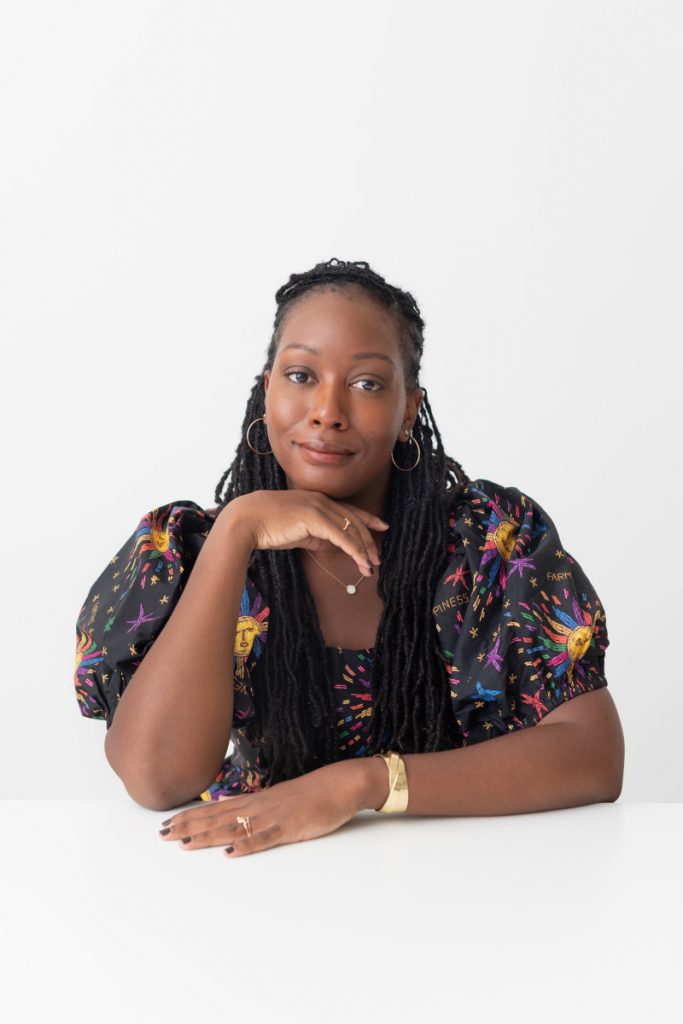
Sarai Johnson’s success in both writing and teaching provides evidence for the former and demonstrates the naivete of the latter perspective.
Johnson’s book, Grown Women: A Novel, made the Best Books of 2024 list for The New Yorker, the Chicago Public Library, The Atlanta Journal-Constitution and TheGrio. It won the Hurston/Wright Foundation’s 2025 Zora/Legacy Award for Debut Fiction and the NAACP’s 2025 Image Award for Outstanding Literary Work by a Debut Author.
While she was writing it, she was — and still is — teaching about writing and literature at Howard University in Washington, D.C. At 3 p.m. Saturday in the Hall of Philosophy, Johnson will deliver a talk for the Chautauqua Women’s Club’s Contemporary Issues Forum titled “Grown Women: Intergenerational Healing through Fiction.”
“My life story and my book are quite related,” she said. “Writing in general has helped me figure out my mother … and that relationship. That’s how the book came to be.”
According to Goodreads: “In this stunning debut novel, four generations of complex Black women contend with motherhood and daughterhood, generational trauma and the deeply ingrained tensions and wounds that divide them as they redefine happiness and healing for themselves. … In masterful, elegant prose, debut novelist Sarai Johnson has created a rich and moving portrait of Black women’s lives today.”
Born in the “tiny little town” of Greenville, Texas, Johnson said she moved to Nashville, Tennessee, when she was 2 years old. She remained there through high school.
“I wanted to be a journalist, a very formal journalist,” she said. “In high school I wrote a column for a local newspaper. It was called, ‘Bridging the Gap.’ I talked to older people. I would choose a topic, like music, and I would talk to one of my classmates who wanted to be a musician, and then I would talk to an older person and ask for their advice. I wanted to write, and I thought the way to do that was through journalism.”
At Howard University, Johnson majored in print and online journalism and minored in English.
As a college sophomore and junior, she worked as the editorial fellow at Modern Luxury in Washington, D.C., hiring, training and managing a team of five interns. Johnson also “edited and managed content for society pages” and “produced content for online and print publication.”
During the summer before her senior year, she was the Pulliam fellow at The Indianapolis Star and worked as a multimedia reporter on the entertainment/arts beat. At the Aspen Institute in D.C. during and after her senior year, Johnson read and edited seminar and presentation transcripts, wrote posts for The Aspen Idea Blog, and edited documents for The Aspen Idea magazine.
After earning her B.A., she served as the creative writing teaching intern at Writopia Lab in D.C., a nonprofit organization that, among other endeavors, runs creative writing workshops and camps and college essay workshops. There, Johnson assisted lab instructors by preparing lesson plans and providing class and workshop instruction. She also worked at Local Media Connection in Alexandria, Virginia, as an editorial assistant.
“I realized (journalism) wasn’t the kind of writing I wanted to do,” Johnson said.
In September 2015, she began her ongoing association with Shout Mouse Press in D.C. — “a nonprofit writing and publishing program dedicated to amplifying underheard youth voices” — as a story coach. In this role, she supported workshops by “providing one-on-one and group conversations with middle school and high school students.”
“I’ve worked for Shout Mouse Press on and off for years,” Johnson said. “I’m working now on a project for them, a graphic novel. Anytime I get to write that closely with young writers inspires me. I learn. I think more about what makes a good story.”
At American University in D.C., she pursued a Master of Arts in literature rather than a Master of Fine Arts, and took courses in the teaching of writing.
“I chose American University because of its teaching element,” she said. “… I chose the teaching track versus the academic track, and I chose composition and writing. I had to shadow a teacher at the university. … I was really quite young — 24 and 25 — and not that much different in age as the students.”
As a graduate student, Johnson also served as a writing consultant for the Writing Center at American University, tutoring college and grad students, and as a graduate assistant in the Department of Literature. Even before receiving her MA, she taught as an adjunct professor in AU’s Writing Studies Program.
Johnson began teaching at Howard University during fall 2019, a semester before COVID-19 pandemic precautions abruptly necessitated alterations in curricula and interpersonal interactions. She spent a year as an adjunct lecturer in the English department’s First-Year Writing Program before being promoted to teach expository writing and literacy studies, persuasive writing and research and women in literature in the English department.
“I spent a lot of time reading,” Johnson said. “I’m going to talk about how reading plays a role in my emotional health.”
Much of Grown Women was written before her children were born. “It came out when my son was 6 weeks old,” she said. “I’m full-time at Howard. Personal matters do come up. … I spend a lot of time with students. … I think I’ve finally reached an age where I can do that for them. I’m going into my seventh year at Howard and I’ve taught these classes over and over. I’m a mom now, and I’m coming into my maturity.” She’s also writing her second novel.
It is Johnson’s hope that Chautauquans “will be attracted to talking through intergenerational conflicts” because she thinks that online social media has changed the standard.
“It’s not ‘honor and obey our parents,’” she said. “I think we see a lot more because we’re online more. There’s more talk about releasing parents — becoming more estranged. We’re seeing it more and talking about it more. I think I’m going to offer a perspective that’s in the middle.”