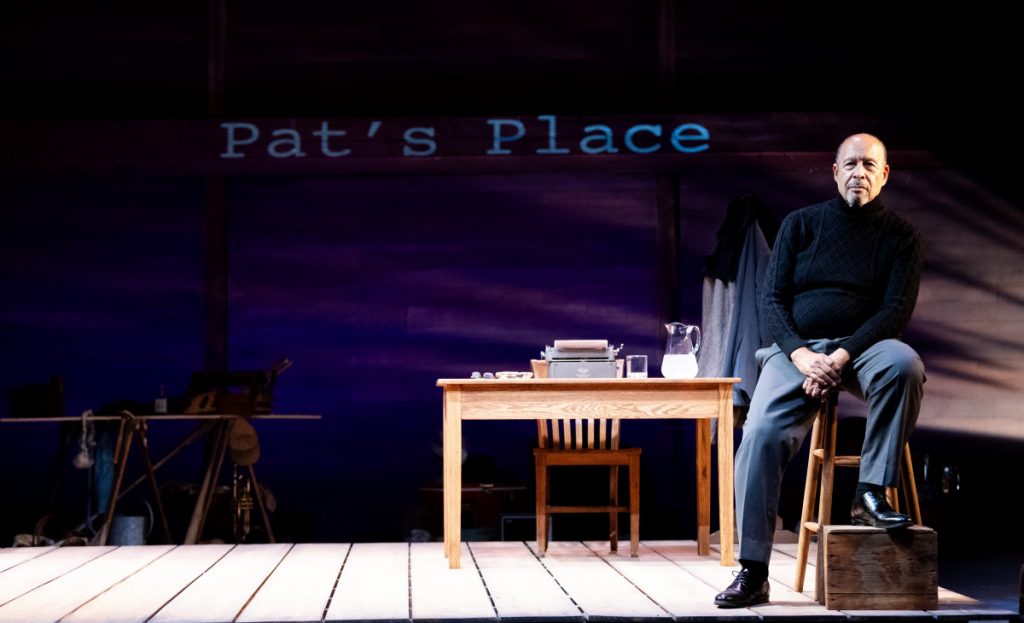
Chautauqua Theater Company Guest Actor Lance E. Nichols performs the role of August Wilson during a tech rehearsal of How I Learned What I Learned Thursday in Bratton Theater.
SOPHIA ROOKSBERRY
Staff Writer
Two years before his death in 2005, American playwright August Wilson wrote and performed an autobiographical one-man play titled How I Learned What I Learned. In less than two hours, the play recounts Wilson’s upbringing in Pittsburgh, where he fought systemic racism and oppression on every step of his journey to becoming a Pulitzer-winning playwright.
The play has been reprised around the world countless times in the two decades since. At 6 p.m. today, a rendition directed by Chautauqua Theater Company Producing Artistic Director Jade King Carroll will open and run until Aug. 16.
The version premiering at Chautauqua is three years in the making, having completed runs at Portland Stage Company in Maine and Le Petit Theatre in Louisiana. Portland Stage Company’s Artistic Director, Anita Stewart, met Wilson while she was a graduate student at the Yale School of Drama, the institution where many of his Broadway-bound plays found their starts. Several years later, Stewart met King Carroll when Wilson recommended she direct one of his plays, Ma Rainey’s Black Bottom, at Portland Stage Company.
This was the first of many Wilson-centered collaborations between Stewart and King Carroll. Early in 2023, King Carroll directed How I Learned What I Learned as her seventh August Wilson play at Portland Stage Company, for which Stewart designed the set she is now reimagining for Bratton Theater.
The simplistic set, made up of a simple table, podium and assorted detritus, is designed to draw attention to the production’s focal point: Lance E. Nichols as August Wilson. Like Stewart, Nichols has been involved in the play since it opened at Portland Stage Company and has delivered an uncanny portrayal from the beginning.
“There are moments when I feel like he is totally channeling the guy I knew,” Stewart said. “When he puts on the broad-brimmed, fedora-type hat, he looks exactly the way August looked.”
The likeness is due equally to Nichols’ ability to embody a character and the detail-oriented costume design of Loyce Arthur. The aforementioned fedora is just one of the pieces Arthur used to encapsulate Wilson’s essence onstage.
“Since it is autobiographical in nature, I gathered as many images and photographs of August Wilson that I could at different stages of his life,” Arthur said. “… There’s a change of jackets and hats that really specify the shifts for him. When he was younger, he was much sportier with the blue cap, and then as he got older, he adopted that black fedora … I always think that he looks like the famous jazz men of the time, he looks like Dizzy Gillespie. His instrument is the pen and his words, but the way he weaves language is very much like a jazzman.”
The influence of jazz on Wilson’s life extends beyond the play’s costume design. Germán Martínez has served as the production’s sound designer and composer since 2023, and he also included nods to the musical genre in his design.
“When we are talking about John Coltrane, we hear a little bit of music swelling in and swelling out,” Martínez said. “The vision when we started at Portland Stage was, ‘How is the music engulfing the space when it needs to?’ … I’m really interested in movement when it comes to sound in a space, how we are experiencing it as an audience. There’s that John Coltrane moment where he talks about how jazz moves so rapidly … and so it starts from one motion and then it grows out into the house.”
In addition to a personal affection for Wilson and his aim to design as many of his plays as possible, Martínez’s design was motivated, much like Arthur’s, by the minute details that comprise a person’s energy.
“All the elements really are working together to make sure … we are living this moment here,” Martínez said. “How are we taking away our disbelief? … I think the devil is in the details when it comes to that … These subtle sound effects help us transition one to the other … to guide us as an audience.”
Unlike Martínez and the other designers, Lighting Associate Stacey Boggs is brand new to the How I Learned What I Learned team. The production’s original lighting designer, Betsy Chester, was unable to work on Chautauqua’s production of the play, so Boggs stepped up and implemented parts of her vision to the existing design.
“I came at it from the heat required to make art and the pressure that has to happen, the catalytic conversion, basically, to make change,” Boggs said. “What does heat and pressure and all of these things … mean in lighting, and how do you create that tension and really embrace the beautiful space that we have here, and then make it feel extremely intimate?”
Intimacy is almost inherent in the play, as a one-man show puts the audience’s relationship with the character blatantly in front of them. While this creates unique challenges for Nichols, it also affects how the designers materialize their vision for the sake of the audience.
“You’re just looking at that one person for the whole show, so that’s another good reason why that ability to shift into different looks for [Nichols] is good, because costumes allow [the audience] to establish where we are, who we’re talking to, and then get accustomed to that,” Arthur said. “You want to be able to shift them into a different mood or a different phase, and something very simple in a costume change, like the change of a hat, can do it.”
In addition to helping the audience keep track of the narrative, the design also helps Nichols track his own position in the script.
“It’s a really dense monologue, essentially, and so to help give [Nichols] a mnemonic device to go, ‘Oh, great! This song helps me jump into this story,’ so how are we helping our performer to make sure that they have all the elements that they need?” Martínez said. “I think especially a one-man show is so vulnerable, and to take on this role of somebody else, to do it authentically and truthfully and very genuinely, is a big ask and a heavy lift, and so … we found that these were our markers to help give him that push.”
Although these design elements are useful for Nichols as he navigates a difficult role, the designers believe his performance is so effortless that audiences would never guess he incorporates those tools into his acting.
“It all feels seamless, and [Nichols] is so amazing with the text that you’re going to feel like you know the man … and his stories are hard,” Stewart said. “We see a side of America that many of us who are white don’t ever see, and it’s from an era that’s in the past, but it also plays into the present.”
This connection between eras of time was a major topic of conversation between the director and the designers as they prepared to premiere the play.
“What’s so important about August Wilson now that we still keep him in the canon, that we still are making his work come alive?” Martínez said. “That ‘why’ is where our prologue starts … In the sequence, we hear this version of Kendrick [Lamar’s ‘Alright’] that then morphs into ‘Old Jeremiah,’ a hymn that then takes us into [Nichols’] opening sequence, and so it’s really trying to tie now to then, and more of the ancestral portion of what is at the heart of August Wilson.”