

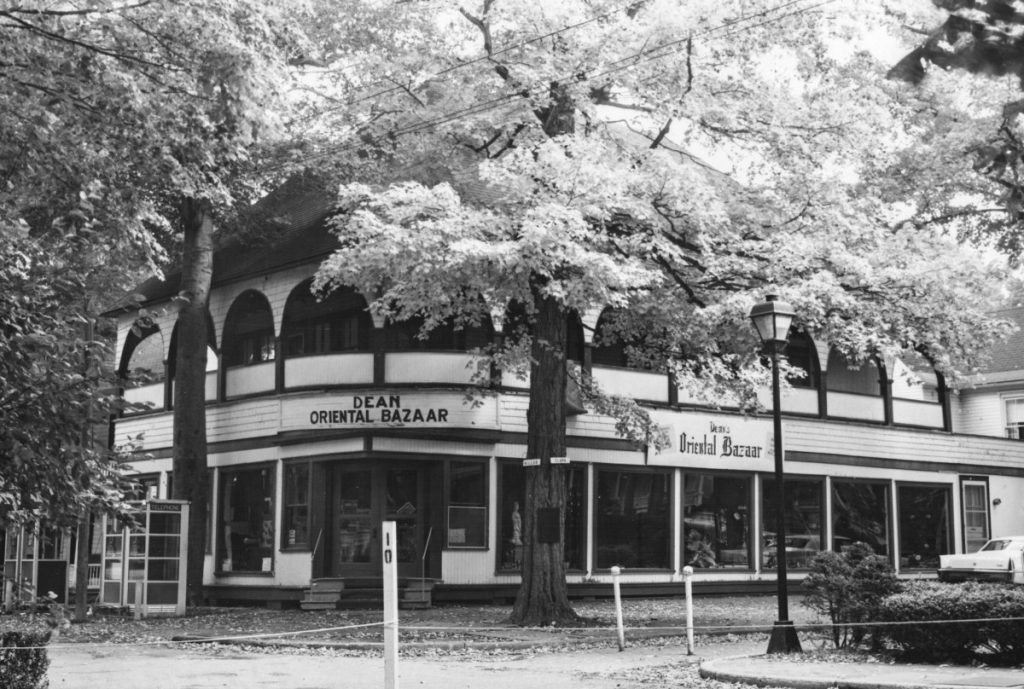
Dean’s Oriental Bazaar, formerly the Old Administration Building and Halaby’s Oriental Bazaar, Sept. 24, 1976.
Column by John Warren
Chautauquans of recent vintage raise an eyebrow when you tell them what preceded Hultquist Center on Miller Avenue, by Smith Memorial Library.
There was a retail outlet that would seem, well, bizarre by today’s standards. For much of the previous century, a building called The Oriental Bazaar occupied the space.
The Oriental Bazaar was an Asian oasis that emerged in the midst of Victorian- and Edwardian-era culture, a curated hodgepodge of imported rugs, knick-knacks and bric-a-brac of porcelain, brass and carved wood.
In the Victorian era, there was a fascination with the cultures of Asia and the Middle East, a trend today known as “Orientalism.” It was a holdover from the era, and its earliest, longest-lasting incarnation was overseen by the Rashid brothers, V.S. and S.M., of Syria. S.M. is the brother who achieved prominence in Chautauqua’s early 20th-century records and became something much more than a retailer to the early 20th-century institution.
There was an educational aspect to the bazaar. S.M. Rashid was aware this resonated with longtime Chautauqua president Arthur Bestor, with whom he became close friends, hosting Bestor’s family when they traveled to the Middle East. It dovetailed well with the Institution’s programming and its hosting of missionaries.
As much as selling goods, Rashid was interested in educating Chautauquans in the ways of Asian culture, including the practice of haggling for goods. Customers could learn the art of bargaining and how to discriminate among different levels of workmanship.
Americans went bonkers for all things Asian following the 1876 Philadelphia Centennial Exposition and the 1893 Chicago World’s Fair, where there were living exhibits such as “Street in Cairo” and “Turkish Village.”
The trend encouraged Americans to view the region as exotic, mysterious and romantic, which was reflected in art and film culture. American painters produced depictions of bazaars, mosques and harems. 1921’s silent film “The Sheik,” with Rudolph Valentino, was one of the first movies to break the million-dollar threshold.
The Rashid brothers made the most of the opportunity on the Chautauqua grounds, beginning in 1902 in the old Pier Building below present-day Miller Park. After the building was razed, the seasonal operation was moved to its penultimate location on (what would become) Bestor Plaza, in a building that had previously housed The Chautauqua Assembly Herald and The Chautauquan Daily.
Riding the wave of Orientalism, rugs, as well as Japanese screens, lanterns, bamboo furniture, wood and ivory carvings, porcelain figurines, ceramics and fans became decorative objects in Chautauqua cottages around the grounds.
The advertisements in early 20th-century Daily newspapers are more eloquent precursors to the “everything must go” sales pitches to which we have become inured.
From the 1930s:
“Beautiful rugs … many of them from the royal palaces and richly furnished homes of Persia, Mesopotamia, Turkey, Caucasia and Syria … are now being offered at auction. The reason is that we must decrease our insurance and interest costs, and release some of our tremendous investment.”
Promoting “Damascus Day,” a 1932 advertisement begins with a quote from the Prophet Muhammad, and talks of the city’s “pink-tinted mosques,” and “the age-old cry of ‘Ya rezzak!’ (God give me a customer).”
The same year:
“During 1928 and 1929 I scoured Europe and the Near East for treasures of Oriental art and handicraft. Everything of beauty and charm that I could find I bought. I bought too much. And even since then I have been unable to resist buying lovely things whenever I found them. Now, with this huge stock of Oriental Rugs, European and Oriental Goods, our investment is far too heavy to wait to sell in the normal course of events. It is vital that we reduce this investment, and AT ONCE.”
For “Rashid’s Nineteenth Anniversary Sale” in August 1921:
“For the first time since I established my business at Chautauqua, I am able to sell Oriental Rugs less than I did the year before. In previous years it has always been going up: but this year owing to the money exchange they are down, and this is the time that you should invest your money in rugs, and particularly so as our stock is so large in variety, so beautiful in quality, so perfect in weave, and so reasonably priced. Many of them are one-half price.”
Promoting twice-a-day auctions, a 1934 ad reads:
“Camels slowly plod their way thru the deserts to bring inlaid brasses and silver of Damascus, the engraved woods of Syria, the gloriously soft and luxurious rugs of Persia.”
And, in realization that women drove household purchases:
“Linen is the most adorable and durable fabric that housewives use to adorn their homes. Lace has been the adornment of princess, queen, and empresses, and is still today the most sought article in which women pride themselves. Embroidery has been the passing time and amusement of the leading women of all times.”
In 1948, an advertisement featured a contest “to improve your knowledge of Oriental Rugs.” Chautauquans were encouraged to study up from Rashid’s library of books and literature on Oriental rugs. Those who could name the largest number in the window displays would vie to win rugs.
By the 1930s, the Bazaar offered daily auctions and end-of-season auctions. The end-of-season auction featured Persian and Oriental rugs, including hand-knotted Sarouks, Kashans and Kirmans rolled out across the plaza grass. Also offered were brass urns, carved teakwood furniture and Chinese silks.
Chautauquans brought lawn chairs and blankets to behold the spectacle, a theatrical event in which the auctioneer interwove history lessons in the trades.
By the 1950s, the bazaar was run by the Halaby family as Halaby’s Oriental Bazaar, and was later operated by Virginia Wareham Dean from the 1960s into the 1970s.
The store eventually closed in the late 1970s, and with a $668,000 donation from the Hultquist Foundation, Inc., the building was gutted and renovated. The building was dedicated as the Hultquist Center for Continuing Studies on June 28, 1999.
As the Hultquist Center, the building remains a hub of a different sort of commerce in the Institution, hosting adult-education classes, community events and key administrative functions. For those who experienced the labyrinth of display cabinets and carved figurines and the layers of sprawled carpets that spread onto its porches, the association will always be something more exotic.


