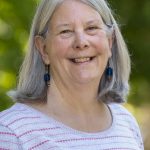

The Rev. Frank A. Thomas delivers his sermon “Weeping over Jerusalem” Sunday in the Amphitheater.
Column by Mary Lee Talbot
The Rev. Frank A. Thomas, Ph.D., began his sermon with a confession to the congregation. “I lied to someone I cared for. Faith required me to be honest, to be brave and to be kind, but I purposely left out information on a project. Why did I lie? Because I did not have the courage to tell the truth,” he said.
Thomas preached at the 9:15 a.m. Monday morning worship service in the Amphitheater. His sermon title was “The Things that Make for Peace: To be honest, To be brave, To be kind.” The Scripture reading was Luke 19:41–46 from the New American Standard Bible translation.
David, the main character in author James Baldwin’s book Giovanni’s Room, lied “about something sacred because he wanted to be innocent.” Thomas said, “Our first lie is to ourselves because we cannot take the consequences of telling the truth. It might lead to rejection. Some lies might be diabolical, but mostly they are to protect the purity of innocence.”
People lie in many situations, in business, to a teacher about how much artificial intelligence is in a paper, to be part of a group. He told the congregation, “We never put our cards on the table because we have been hurt. We don’t trust others and we don’t want to be hurt like that again. But the truth will emerge.”
If we have lied, we must be brave. What happens when people lie to protect their innocence is what Thomas said happened at the 250th anniversary of the United States: There were lies to protect the country’s innocence. He cited Sacvan Bercovitch, who noted that America functions between the twin dynamics of empire with unmatched violence versus the creative energy released and hope unsurpassed.
“We have not been honest about the violence,” Thomas said, which was used to conquer the peoples who lived here. The Cherokee people were removed from the eastern states between 1830 to 1850 so white settlers could take the land. More than 10,000 people died on the journey from the Carolinas to Oklahoma. “We lied to protect our innocence; this was never mentioned at our 250th celebrations.”
The taking of land from Native Americans is still happening. Thomas talked about lithium mining permits in Nevada that severely impacted the Northern Paiute (Numu) and Western Shoshone (Newe) tribes. Reports from organizations like Human Rights Watch and the American Civil Liberties Union state that approvals occurred without free, prior and informed consent, violating ancestral land and religious rights. “We are still doing it; we lie about something sacred.”
He added, “When we live with a basic level of dishonesty, it becomes normal and then gets installed in the office and boardroom. Only God knows what is in AI. When this happens, God raises up a prophet. On Palm Sunday, Jesus wept, but he was honest, brave and kind.”
Jesus knew what makes for peace. “Our innocence blinds us to the truth. Jesus had to be honest, brave and kind,” Thomas said. “Jesus told the people in Jerusalem that they will be surrounded. It would be less than love not to say it.”
Hemming in a city was a well-known military practice that was fulfilled in 70 A.D. “If we aren’t honest, brave and kind, our enemies will surround us. Dishonesty has consequences; it disintegrates unity,” he said.
He continued, “Now for the kind part: Jesus, James Baldwin and I believe that the end of innocence is the only way to freedom. We must take responsibility and engage the horrors of the past to find freedom that recognizes human connections beyond land and money, that reconciles us with each other. We have to apologize.”
Thomas said he lied to someone and saw their pain. Could he tell more lies or be honest in a way that is brave and kind? Baldwin said, “We vomit up the truth.”
When Thomas committed himself to restitution, he found the apology letter he was writing was to himself to be more honest, brave and kind. In that situation, the person said they would never forget the lie but opted to move forward with the relationship. “Sometimes there is no bridge back. The real deal is to be honest, brave and kind.”
He continued, “When you write the letter, make a commitment to yourself and God to be honest, brave and kind. These are the things that make for peace.” Thomas closed his sermon using the “Loving Kindness Prayer” to pray for Native peoples.
Jo Wolfe, manager of the Presbyterian House at Chautauqua, presided. The Honorable Kevin Rudd AC, former prime minister of Australia and current CEO of Asia Society, read the Scripture. Sonya Subbayya Sutton, interim director of Sacred Music, played Johann Sebastian Bach’s “Trio Sonata, BWV 526, Vivace,” for the prelude on the Massey Memorial Organ. The Motet Choir, under Sutton’s direction and accompanied by Owen Reyda, organ scholar, on the Massey Organ, sang “Distant Land,” composed by John Rutter to honor the fall of the Berlin Wall and the release of Nelson Mandela from prison. Reyda played “Concerto, BWV 593.1,” by Bach on the Massey Organ for the postlude. Support for this week’s preaching and chaplaincy is provided by The Rev. Leonard J. Ebel Chaplaincy.