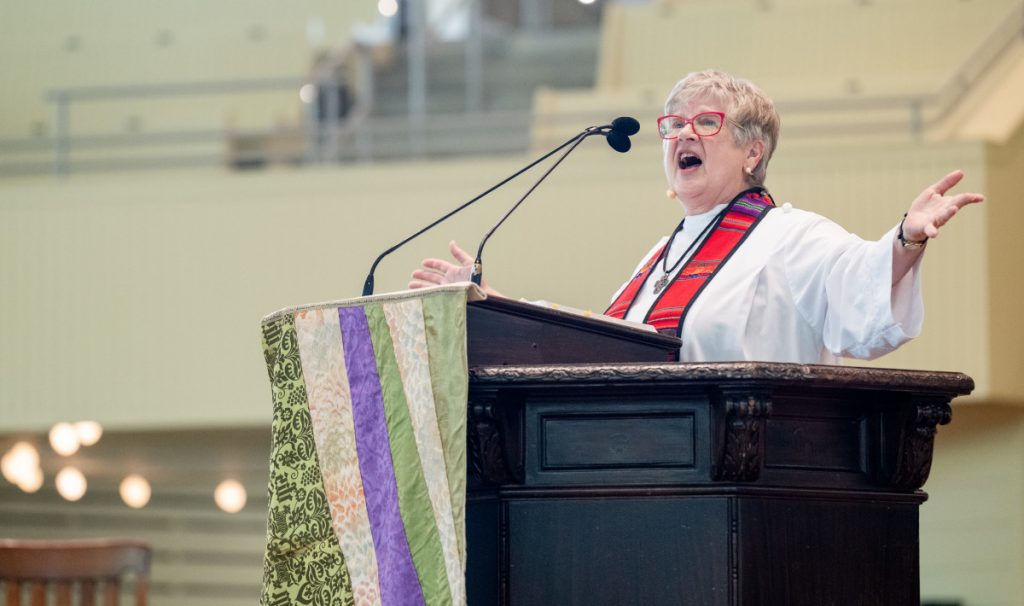
The Rev. Natalie Hanson delivers her sermon “Invitation to a Feast” during morning worship Sunday in the Amphitheater.
Column by Mary Lee Talbot
“Before we can talk about who is at the table, we have to talk about the table, the physical table,” the Rev. Natalie Hanson said. She preached at the 9:15 a.m. Monday morning service in the Amphitheater. Her sermon title was “Who’s at the Table?” and the Scripture reading was Luke 14:12–24.
Hanson and her husband, Paul, live in a part of Chattanooga, Tennessee, where they are surrounded by young adults. When they are out walking, they say hello to their neighbors, but they don’t get to know their neighbors that way. “It is not until we invite them into our home, to sit at our table, tell stories and listen to who they are, that we get to know them. Listening is a way to get to know our neighbors face-to-face. That is especially important in these days of the internet, where people say awful things because they are not looking at someone face-to-face.”
The kind of table doesn’t matter. It could be a formal dining room, a kitchen table, a picnic table, a cloth on the ground. Sitting at a common location and sharing a feast creates the opportunity for holy encounter.
“When I invite people to my table, I tend to invite people I know, people I know will make me laugh, who have the same politics,” she said. In Luke’s Gospel, a homeowner has a party and invites his friends, but one by one they say, “I cannot come.” The host then sends his servants to bring in the blind, poor, crippled and lame.
Hanson said, “These categories are important because these are the people who are ignored or sidelined for lack of access. But there is still room (at the table), and the host sends out his servants again to compel them to come in so the house is full.”
The Greek in Luke 12:23, “that my house may be filled,” is in the passive voice, Hanson said, and it means completion — that the party as a whole is as inclusive as it can be. “The table cannot be full unless those who were not included before are included now. It is not truly a feast without them in the eyes of the master. The unexpected and the undervalued make a full table.”
Hanson said that in parts of the South, after the violence against the Civil Rights Movement had died down, some cities paired a Black family and a white family to have dinner together once a month. This was an effort to bridge the racial divide with no agenda except to sit down as if they were friends until they became friends.
“In some places, this was so deeply successful that it has continued down to the fourth generation. It is a way to concretely, personally break barriers by sharing their lives at the table,” she said.
Hanson gave the congregation a quiz. “Who at Chautauqua have you not sat with at table? The maintenance staff, the administrative staff, like the office managers, the staff in the coffee kiosk or the bookstore? I know of a van driver who made an afghan for a homeowner along their route because the homeowner talked to them, asked about their life and family, and always waved if they were on the porch.”
She continued, “Who can we invite? If you are a knee-jerk liberal Democrat, how many Republicans have you invited? If you are a fiscal conservative, how many progressives have you invited? Think about your hometown. I always preach to myself first, and I think about the Latino community in Chattanooga and the people who replaced my porch railings.”
Hanson told the congregation, “Community is not defined by walls or theological orthodoxy; it is defined by its heart. It is found at dining tables, picnic tables and kitchen tables. If we don’t have diversity at the feast, it is not yet real. When we do have diversity, we begin to taste heaven together. Thanks be to God. Amen.”
Beth Brockman Miller, co-president of the Chautauqua Denominational Association and a year-round Chautauquan, presided. Mary Anderson, host of the United Methodist House, read the Scripture. Owen Reyda, organ scholar, played “Prelude (in form of a Pastorale), Op.88,” by C.V. Stanford for the prelude on the Massey Memorial Organ. The Motet Choir, under the direction of Sonya Subbayya Sutton, interim director of Sacred Music, sang a cappella “My Shepherd Will Supply My Need,” by Virgil Thomson. Sutton played “Christ, Forgive Thy Servants,” by Marcel Dupré. Support for this week’s services is provided by The Samuel M. and Mary E. Hazlett Memorial Fund. Support is also made possible by Week Eight Presenting Sponsor Highmark Blue Cross Blue Shield, AHN Westfield Memorial and HealthNow Administrative Services. Hanson, chaplain for the week, will be having a table conversation at noon today at Hurlbut Memorial Church, where lunch is available. She will also be available on Thursday after morning worship on the porch of the Hall of Missions.