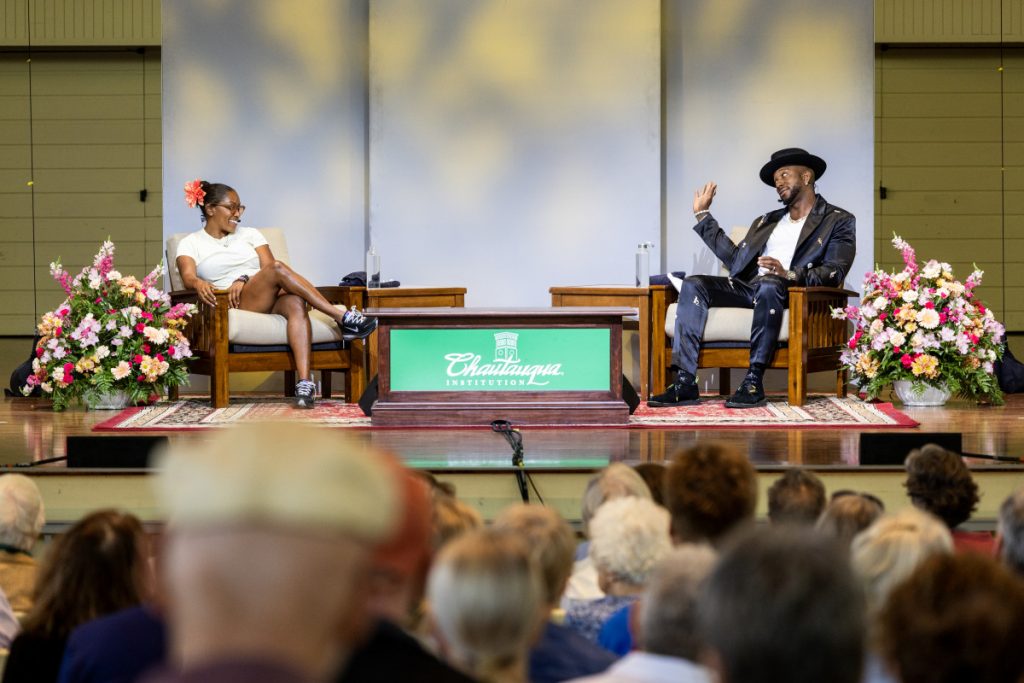
From left, Chef and Co-Star on “Next Level Chef” Nyesha Arrington joins in conversation with “Next Level Chef” Season 5 Winner and Restaurateur Darian Bryan about storytelling through cooking, restaurants as community spaces, and climate change’s effects on ingredients during her morning lecture Tuesday in the Amphitheater.
ARIANNA NEVAREZ
Staff Writer
From learning to use chopsticks on one side of the family to eating gumbo on the other, different foods and cultures in Nyesha Arrington’s family shaped her as a person and a chef. This contrast helped break down barriers through food and created “core food memories” for her that she strives to create for other people, she said.
The foundation from her childhood helped her name her restaurant, Native.
“Everyone is a native of something or has a story to tell, and so I’m always aiming to celebrate that,” Arrington said. “I’ve traveled the world, and I take different nuances and techniques from different places from around the world.”
At 10:45 a.m. Tuesday in the Amphitheater, Arrington, chef and co-star on “Next Level Chef,” joined in conversation with Darian Bryan, “Next Level Chef” Season 5 winner and restaurateur, about Arrington’s personal food journey and her perspective on the future of food.
In talking about food and how it helps one understand their own culture, Arrington said food can tell a story. She said different ingredients grow differently around the world and how they are used can bring a new perspective to a dish. In her demonstration on Sunday, she said the uniqueness in her cooking lies in the ability to use what is in season and create something new.
“You use these elements of what Mother Nature has to offer and what she’s giving us,” Arrington said. “Because what is in season here may not be in season across the world, so it’s using that as a medium or an element of self-expression.”
When Arrington cooks, she said 100% of it is autobiographical, but it is also important to understand technique. She said one can have the most pristine goat or ribeye, yet if they don’t know how to make the best use of it, they won’t fully understand the “sacrifice of that animal.”
Arrington said cooking is a craft that must be a mix of practiced technique and one’s own background and craftsmanship.
“My authorship in a dish is extremely unique,” Arrington said. “I approach food not just to celebrate one lens of cooking.”
Though Arrington said the digital age can aid people in understanding different kinds of foods or how people in other countries are approaching cooking, she said nothing beats the tangible feeling of learning and “the moments that make it tactile.”
As a child, Arrington said her parents were adamant on having dinner as a family and asking questions about her life at the dinner table.
“Those moments make you feel connected as a kid to your family. They give you roots. They give you a backbone. They give you confidence,” Arrington said. “There’s a lot more that’s happening, eating together, sharing a moment, than just eating for fuel or eating for pleasure.”
In the same way, Arrington said restaurants can also be a place of connection because they invite people in to make memories. She said it takes a certain type of person to be in the service industry while also trying to create nourishing dishes for customers.
Though these chefs are trying to create nourishing meals for those who visit their restaurants, Bryan asked how chefs have to adjust to climate change affecting their ingredients. Arrington responded by talking about sustainability and how one interacts with produce.
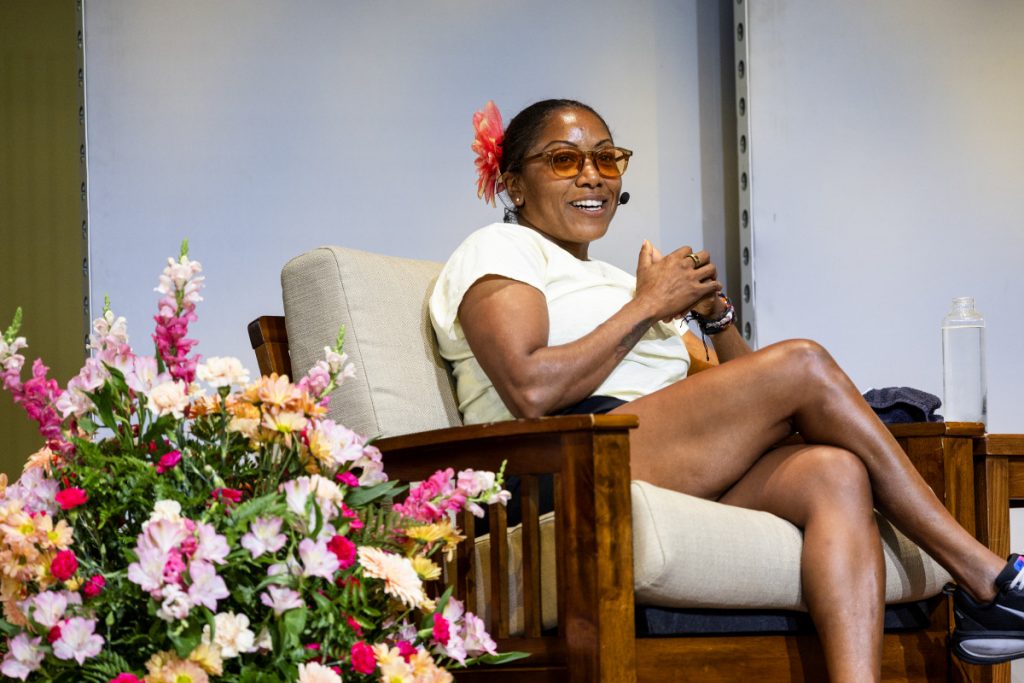
From left, Chef and Co-Star on “Next Level Chef” Nyesha Arrington speaks about storytelling through cooking, restaurants as community spaces, and climate change’s effects on ingredients during her morning lecture Tuesday in the Amphitheater.
She said approaching “a plate with intentionality” and understanding the product one is using can lead to higher productivity and less waste.
“There’s just an incredible amount of power in understanding where everything comes from and how to use it, start to finish,” Arrington said. “… It’s important to understand culture. It’s important to understand fundamentals.”
Looking at technology in cooking, Arrington discussed using artificial intelligence in vertical farming, which combines indoor stacked crop production with AI to control environmental settings for optimal growing. She said she is overall a “big proponent” of celebrating the growth of vegetables and produce, whether that is done through vertical farming or soil.
Arrington prefers soil because she said it closes the loop from buying the produce to putting roots back into the soil for compost. This is one way of investing in the future of produce, she said.
“We’re not getting any new soil unless we make it, so you really have to understand the value of creating that and putting the nutrients back into the soil to then grow new product,” Arrington said.
The next generation will be the future of food, according to Arrington. Specifically, she said it will be the people “that celebrate and don’t take shortcuts in the cooking process.” She also said that as times change, fine dining has shifted within this generation.
Looking back, Arrington said fine dining was gold leaf and caviar, but she said that was not sustainable, nor did it have a story. Now, she said people look for the deeper meaning in what they consume, and there is an “essence of expression.”
“Today, people want to feel something,” Arrington said. “They want to hear a story, and [food] has to have meaning and purpose without being pretentious.”
Arrington said she hopes people don’t lose the tradition of honoring food. She said there are many kitschy sayings about food, but she said, “Food is so powerful.” As the advancement of the digital world enters food, she recognizes its benefits for the business side of cooking, but she said, “The food component can never be forsaken.” “Honoring the Earth” and replenishing what one uses will be vital for future generations, according to Arrington.
Going back to her childhood and the start of her wanting this career, Arrington said she remembered a shared meal as “a sense of community.” She recognized at a young age that adults worked because it was routine, not because they enjoyed it.
At 8 years old, Arrington was roller skating around her neighborhood, and the idea hit her like “a ton of bricks.” She wanted to be a chef because she wanted to do something with her life that she loved.
What excites Arrington about being a chef is that the food aspect is simply the root, but there are branches. They include business, art, celebrating the Earth and eating — for fuel and for pleasure. She remembers realizing this and looking at the sunshine.
“Food is the axis,” Arrington recalls her younger self thinking. “It hits all these things, and it’s an incessant journey.”