
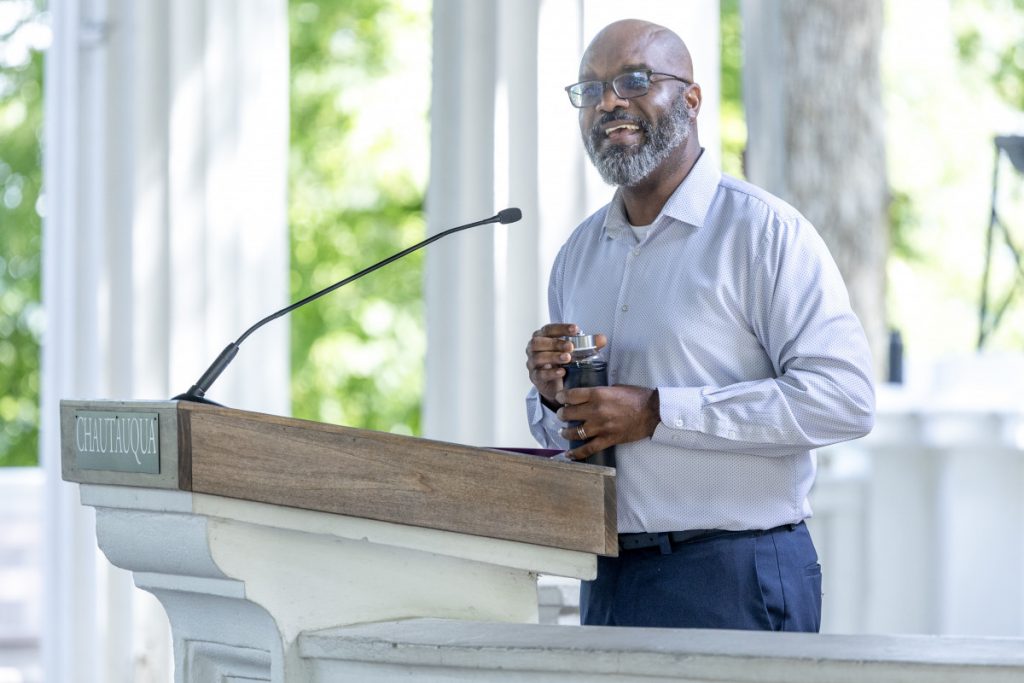
Creation Justice Ministries Director of Theological Education and Formation and Active Executive Director Derrick Weston speaks about the theme “feast and fast” during his interfaith lecture in which he discusses America’s culture of over consumption, the importance of cooking, and the spirituality of food Tuesday in the Hall of Philosophy.
LILY RESLINK
Staff Writer
Derrick Weston — writer, filmmaker, podcaster and director of Theological Education and Formation at Creation Justice Ministries — delivered a lecture at 2 p.m. Tuesday in the Hall of Philosophy, framed around the “theology of eating.”
He opened by asking the audience to take a deep breath with him. Weston shared how his experiences in the New Clergy Cohort at Chautauqua 16 years ago shaped his perspective on how “interfaith done well” involves the “seeking of common ground without negating the specificity of our own text and our own traditions.”
Christianity, he said, is his “native tongue” for theology, which he offered as a “disclaimer” for his interfaith exploration of the intersections of food and spirituality and justice.
Weston noted the prevalence of food systems as a topic in environmental circles, which he connected to the work of Creation Justice Ministries to “educate, mobilize and equip Christians” for a “better relationship to creation.”
He also noted race and gender’s intersections with food systems, where he said the stereotype of white male farmers contradicts the reality that “the average farmer is a brown woman.”
Weston presented a paradigm he said encapsulates American eating habits: “The problem with how we eat these days is we’re either compelled to eat like the Flintstones or eat like the Jetsons.” He said “The Flintstones” portrays large portions of freshly-dead meat, and “The Jetsons” portrays a mechanical detachment from food’s source and preparation altogether.
“Neither of these cartoons was meant to be instructive in a culinary sense, but here we are,” he said.
He linked large portion sizes in the U.S. to what he called “the perils of overconsumption.” He said this impacts not just one’s health but also reinforces the mindset that the world has endless resources and that humans are entitled to infinite, endless consumption. It is with this mindset, Weston said, that humans “give into the sin of gluttony.”
He said equating the human body to a machine is a common but harmful metaphor. He said he can’t overlook “the history in [the United States] of reducing human bodies to units of cheap labor to maximize profits that began with African enslavement and continues into underpaid migrant workers,” and he also can’t overlook the “move in [the United States] to undervalue humans through automation by [artificial intelligence].”
He said, “We have created a mechanized system of food production that makes us just one more machine in the chain.” He said he wants to talk about food not as a commodity, product, issue or weapon, but as a relationship, love and “the miracle that it is.”
Weston listed relationships with food, other humans and “non-human kin” as examples he said humans must change. “The examination of these relationships are what religious traditions do when they’re at their best.”
He said finding “awe and wonder” — which he called the foundations of any spirituality — is a way for humans to reorient themselves to what he sees as an effective application of interfaith theology.
Awe and science should not be enemies, Weston said; rather, awe is “the appropriate response to the beautiful world that science opens up to us.”
Weston is an advocate for hands-on approaches to making the change he wants to see in the world: “Having our hands in the dirt may in fact be the shortest route to introduce a sense of awe into our food system.”
He said hasty eating — something he sees in the U.S. — inhibits connection and savoring.
In speaking on the complexities of “gratitude and lament” as coexisting emotions humans feel toward food, Weston used Thanksgiving and grappling with poor treatment of animals to exemplify how these emotions “need each other to be genuinely felt.”
He said anger is another emotion that plays a prominent role in navigating spirituality and food, noting that anger can blend with lament about food injustice.
“When the rich and powerful seem to continually get away with profiting on the suffering of the weakest and most vulnerable, then our righteous fury is certainly called for,” Weston said.
Weston said faith offers resources to express anger; he said anger can be corrosive and violent, but “holy anger often becomes fuel for righteous actions.”
Lament from responses to food systems, he said, can result in anger.
“Gratitude, lament, awe and holy anger are all parts of the work of our spiritual traditions,” he said, which are emotions he connects to food’s conception as a spiritual matter.
“Food is an incredible vehicle for an exploration of the divine,” Weston said.
He distinguished overconsumption from feasting, which he said is a communal celebration of people full of laughter and conversation.
Fasting, in religious contexts, he said, reminds people of humanity’s interdependence and that it can serve as a reminder of non-physical needs and foster solidarity with those experiencing hunger, which he said the nation would benefit from doing more often.
He left the audience with the suggestion of a practice: “savor.”
He said to savor is to slow down, enjoy and “not just be machines that take in calories and nutrients.”
He said this means savoring the goodness of water and land, the beauty of plants and animals and the senses through which humans experience life.
He concluded by saying, “I think we really need to taste and see that we are in a world of goodness, that we are in a world of abundance, that we’re in a world of love.”