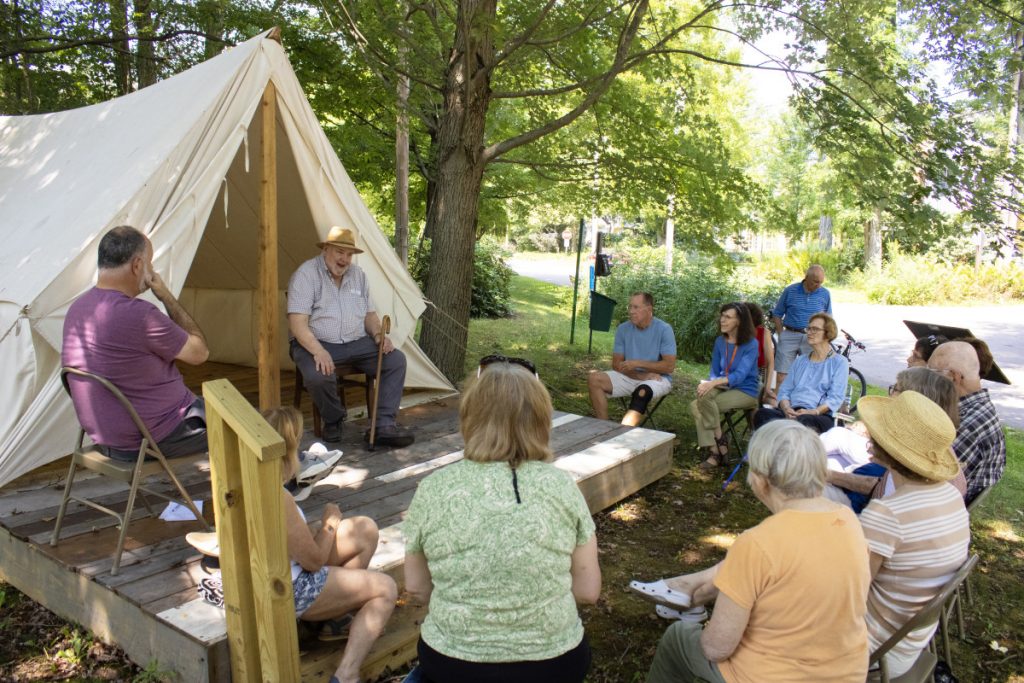
Jon Schmitz answers questions during his biweekly “Tent Talk” Tuesday outside the Oliver Archives Center.
Guinevere MacLowry
Multimedia Journalist
Jon Schmitz is a well of knowledge. Ask him anything about Chautauqua’s history, and he’ll have some kind of answer. At 1 p.m. each Tuesday and Friday of the season, community members are invited to do just that during his biweekly “Tent Talk” series outside the Oliver Archives Center.
After serving as Chautauqua Institution’s archivist and historian from 2002 to 2025, Schmitz now serves as historian emeritus. The “Tent Talks” are informal and unscripted, guided by whatever questions visitors bring and whatever historical tangents Schmitz chooses to follow.
“I don’t prepare anything; there’s no topic,” Schmitz said. “Every session has been quite different from the others.”
For Schmitz, the past is meant to be investigated, questioned and unpacked rather than filed away in a locked drawer collecting dust. Although he is a lifelong lover of history, becoming an archivist was not always his intention.
Though he had an academic background in history, philosophy and classics, he struggled to find employment in academia. He applied to as many Canadian grants as he could and ended up in Toronto at the College of Physicians and Surgeons of Ontario. Originally offered a three-month contract, Schmitz ended up staying for a year and eventually worked his way into the Medical Review Committee, first as a coordinator and later as a medical inspector.
While working as a medical record inspector, he honed his skills as an archivist without any formal training. He would visit the City of Toronto Archives in the evenings and on weekends to study their collection. “I read everything they had in their library, and then I thought, ‘Well, you know, I should really get certified,’” Schmitz said.
He went on to attend George Brown College, the only archival practice program at the time, to attain his graduate degree. Later, he would go on to teach the program’s archives, records management and preservation class himself.
“When I was doing my certificate, we were asked to make up an archive as an assignment, so I made up the Chautauqua Archives,” Schmitz said. “I didn’t really know that Chautauqua still existed.”
As his career as an archivist gained traction, Schmitz came face-to-face with the pitfalls of working in academia. Schmitz “became very disillusioned with universities,” constantly jumping through hoops until he realized that public archives weren’t the place for him.
Beyond the stress of climbing the professional ladder, Toronto became increasingly expensive for him and his family. One former student of his who had been coming to Chautauqua for years pointed toward the Institution, and sure enough, it was seeking an archivist.
Western New York was the best of all worlds for Schmitz: He could raise his kids away from the chaos of the city, pursue the outdoor activities he enjoyed and work in a corporate archive. Working in privatized archives offered something different. The work was practical, hands-on and allowed him to wear many different hats.
“One of the things I love about being a corporate archivist is that you do it all,” Schmitz said. “You do the acquisition, you do the appraisal, the arrangement, description, preservation, you deal with copyright and freedom of information access, all of it.”
What began as a new job and a new home became a 23-year career.
For more than two decades, Schmitz served as the Institution’s primary steward of its records, artifacts and institutional memory. He helped organize and modernize its historical collections, oversaw preservation and digitization projects and worked to make archival materials accessible to researchers and the public. One of his major accomplishments was overseeing the opening of the Oliver Archives Center as the new home of the Institution’s archives.
“I ended up researching things I never, ever thought I’d be researching,” he said. “It’s been a wonderful education — much better than one receives in a formal setting.”
Following years of becoming acquainted with the Institution’s archives, Schmitz began to investigate and debunk certain stories that had long been accepted as Chautauqua history.
“One of the things I learned very quickly here… there’s a lot of false stories, a lot of false ideas,” Schmitz said. “Just because you see it in print, no. Just because you see it in print in three different places, no. You have to look for evidential records to be in any way confident that it’s actually true.”
That distinction between evidence and information is central to his philosophy. An informational record can tell researchers about an event, while an evidential record provides a direct connection to something that actually happened, he explained.
“What I’m saying is not evidential just because I’m saying it,” Schmitz said. “That’s informational.”
The Oliver Archives Center hosts a wide variety of items that are not archives at all. For something to be considered a true archive, it must be an original, unique record of human interaction.
“Most of the records we have are not archival,” Schmitz explained. “They are things like photocopies, printed stories about things, stuff that aren’t really archives. Archives are really the records that are a … natural byproduct of business activity and other human dealings.”
Schmitz said he is rarely wrong, but when he is corrected by a Chautuaquan, he isn’t bitter. In fact, he’s excited to set the record straight. “I’m very grateful that they bothered to correct me … because I read it somewhere, and it’s wrong,” he said.
That humility is central to his understanding of historical research.
“History is a fabric that knows no end, and you have to learn and learn and learn and learn,” Schmitz said. “And anybody who says that they know it all, they don’t.”
Preserving that history requires more than simply keeping old documents. During Schmitz’s tenure, the Institution undertook major preservation and digitization efforts, including putting many archival photographs online and digitizing the archives of The Chautauquan Daily. But Schmitz has never believed that everything should be digitized automatically.
“I’ve always said progress is one of the most evil ideas ever created,” he said. “You do what works. You do what the situation calls for.”
Digital collections provide enormous benefits, including remote access and searchability, Schmitz explained. He has experienced those benefits firsthand, using digitized issues of The Chautauquan Daily to conduct research that would previously have required reading every issue individually.
At the same time, he cautioned that digital preservation requires continual investment.
“IT people are always saying, ‘Storage is cheap,’” Schmitz said. “I know it’s cheap. But setting it up right isn’t cheap. And maintaining it. You can’t just create these things and walk away.”
Ultimately, Schmitz views archives as places where preservation and discovery meet. There is never a shortage of knowledge to be collected, and he has dedicated a quarter of a century of his life to making sure Chautauqua’s history is not just remembered, but brought to life.
“With archives, you’re also hands-on,” he said. “You’re dealing with a real thing. You’re … sort of the frontline of history, both in preservation and discovery.”
That philosophy continues in his “Tent Talk” series. For Schmitz, understanding history is about remaining excited to learn.
In the epilogue of his upcoming book How We Lost the Museum, he writes, “There is simply no way to tell the truth of a story by examining the story itself. The only way is by relying on the evidence.”
Sometimes the evidence provides an answer. Sometimes it changes what people thought they knew. And sometimes, as Schmitz acknowledges, the evidence leaves historians without a clear answer. For an archivist, that uncertainty is not a failure. It is part of the work, and perhaps the reason there will always be another question waiting at the next “Tent Talk.”