LILY RESLINK
Staff Writer
At 1 p.m. today, the Amphitheater will legally transform into a federal courthouse to host the first naturalization ceremony at Chautauqua Institution. The ceremony will bring 30 new citizens from 18 countries: Argentina, Bangladesh, Belarus, Bhutan, Burma, Canada, Chile, Congo (Kinshasa), Cuba, France, India, Iraq, Jamaica, Nepal, Pakistan, Somalia, Spain and Ukraine.
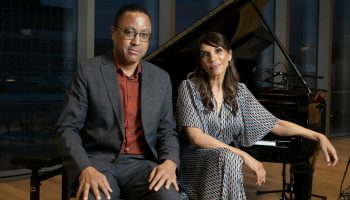
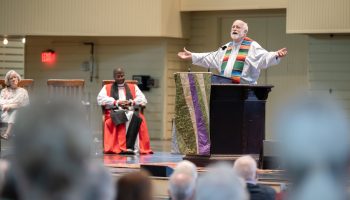
The ceremony will include a keynote address from Judge George B. Daniels, a performance of “The Star Spangled Banner” by Lara Downes and Kurt Elling, remarks by Erie County Executive Mark Poloncarz, a presentation of motion from U.S. Citizenship and Immigration Services Officer Cavarello, the administration of oath from Daniels, a recitation of the Pledge of Allegiance led by one of the new citizens and distribution of certificates. The ceremony will close with remarks by Dennis Galucki, who founded Buffalo Day at Chautauqua and first proposed the idea of hosting a naturalization ceremony at Chautauqua.
“He brought the idea to us,” Interim Chief Advancement Officer and Senior Director of Belonging & Community Relations Amit Taneja said. “[Interim Associate Director of Belonging and Community Relations] Makayla [Santiago-Froebel] and I were the two lead staff members who took this on as the Institution liaisons to say, ‘This is a really important thing for us to do because it really represents Chautauqua values.’”
In the event’s earliest planning stages, Galucki consulted with a contact who had retired from Homeland Security to ask about the naturalization ceremony; his contact affirmed Chautauqua would be a suitable venue.
He said he got a green light to proceed from Director of Communications Jill McCormick and set up site visits with Homeland Security in October to scope out the smaller venues of the Hall of Philosophy and the Hall of Christ.
The ceremony’s evolution to a large-scale Amphitheater event began after Galucki crossed paths with Taneja last December during an impromptu visit to a snow-covered Chautauqua. When Galucki shared plans for the naturalization ceremony, he said he saw Taneja’s eyes light up.
“It was his commitment that really solidified it and moved it to another level,” Galucki said.
Galucki said the Institution wanted to hold the event in the Amphitheater for a “host of reasons,” including visibility amid national attention on immigration.
Taneja said creating a space to conduct the ceremony at Chautauqua lent itself to specific logistical considerations because citizenship ceremonies must be held in a federal courtroom.
“The good news is that the judge can declare any space a federal courtroom,” he said. “So, the Amphitheater, for the first time in its history, will be a federal courtroom for the purposes of the ceremony.”
The ceremony is concurrent with Chautauqua’s annual “Buffalo Day,” which welcomes all residents of Buffalo, New York, to the grounds for free. Galucki said the idea emerged as he explored ways to emphasize Buffalo Day’s connection with America’s 250th.
Santiago-Froebel said Galucki organized a meeting with McCormick, USCIS members and a retired Immigration and Customs Enforcement agent to discuss possibilities for the ceremony at Chautauqua. From there, she said the plans blossomed.
Despite her initial hesitation to ask others to take on an additional workload for the ceremony, Santiago-Froebel said there was an immediate outpouring of support. She said, “I have about 12 staff members who reached out to me personally and said, ‘I want to be a part of this day. How can I help?’ ”
Kendall Crolius served as the volunteer coordinator who, according to Santiago-Froebel, recruited and organized 23 volunteers, helped review training materials and will play a leadership role on the day of the ceremony. She also said she was met with people who jumped at the chance to contribute.
Crolius attributed her volunteer recruitment to connections with Common Grounds, a volunteer-run community center and coffee shop on the first floor of Hultquist Center during the off-season.
She said, “[The Common Grounds volunteers] are all people that I know to be incredibly welcoming, incredibly hospitable and just love to create a sense of belonging, and I thought, ‘That’s the team.’ ”
With no established template or pathway for coordinating a naturalization ceremony at Chautauqua, the enthusiastic commitment of staff volunteers and external partners — which began more than a year and a half ago — made it possible to host an event of this scale.
“To do it in an amphitheater setting at a historic institution like this requires a little bit more coordination and navigation, particularly because we’ve never done one before,” Taneja said.
Santiago-Froebel said the planning process involved representatives from the Safety & Security, Performing and Visual Arts and Programming departments to collaborate in planning the day’s events.
Taneja, who is a naturalized U.S. citizen, said his own experiences informed what he felt would be helpful for volunteers, guests of the new citizens and Chautauqua community members to know.
“I know that for my citizenship ceremony, the person to the right of me was a doctor, the person to the left of me was a refugee, and as we were taking our oaths of allegiance, there was not a dry eye,” he said.
In the planning process, Taneja said he applied his understanding of the ceremony’s emotional depth to how Chautauqua can best “welcome people into the ‘citizens club,’ so to say.”
Santiago-Froebel said she is excited for the number of first-time Chautauquans that Buffalo Day and the naturalization ceremony will bring. With new citizens and their families in mind, she said, “Every step of the way, all I keep thinking about is just how to make this day even more special.”
Throughout the day, resources will be available to first-time and returning visitors alike, including representatives from the Buffalo Passport Agency who can assist with obtaining passports and members of the League of Women Voters who can assist with voter registration.
Santiago-Froebel credited the Robert H. Jackson Center’s Director of Programs Elizabeth Hosier with providing guidance as an experienced coordinator of naturalization ceremonies. Santiago-Froebel said representatives of the organization will be available to answer questions about the ceremony and the process of becoming a citizen.
In case of any communication barriers, Santiago-Froebel said all volunteers will have a contact card of people to call who are proficient in other languages. There will also be accessible signage for buses and trams, a map marked with important locations for new citizens and an outline of the steps to enter the gates. New citizens will also be provided with pocket-sized editions of the Constitution and informational pamphlets about Chautauqua Institution.
Recognizing the contributions of ushers as well as the Institution’s Programming and Ticketing teams, Santiago-Froebel said the day has been “a huge lift that we have all been working together on.”
She noted that Sections 1 through 5 of the Amphitheater will be designated for new citizens and their families during the ceremony.
Taneja said their point of contact at the regional office of USCIS said the largest ceremony so far took place in Rochester, New York, and drew about 500 to 600 people.
“My hope is that we are going to set a record for our regional office with more than 1,000, 1,500 Chautauquans truly bearing witness to this historic moment,” he said.
Taneja said attending the ceremony, which he described as a “very incredible part of our democratic process,” offers an opportunity for people to “reflect upon their own perspective of being a citizen” and “what it means to participate in civic life.”
He encouraged Chautauquans to share their thoughts, emotions and takeaways from the experience during Chautauqua Dialogues programs to converse with others.
Crolius echoed the sentiment of shared dialogue. “Part of what’s really special about Chautauqua is we sort of retreat here and soak up learning and new experiences… but the whole point is to take that back to your home community,” Crolius said.
She said she hopes witnessing this event inspires the drive to vote, civically participate and prevent what she views as the tendency for U.S. citizens to take their citizenship for granted.
“My hope is that not only the volunteers, but any Chautauquans who are coming to the ceremony, will be inspired to recommit to the principles our country stands for and to the responsibilities that we owe our democracy as citizens,” she said.