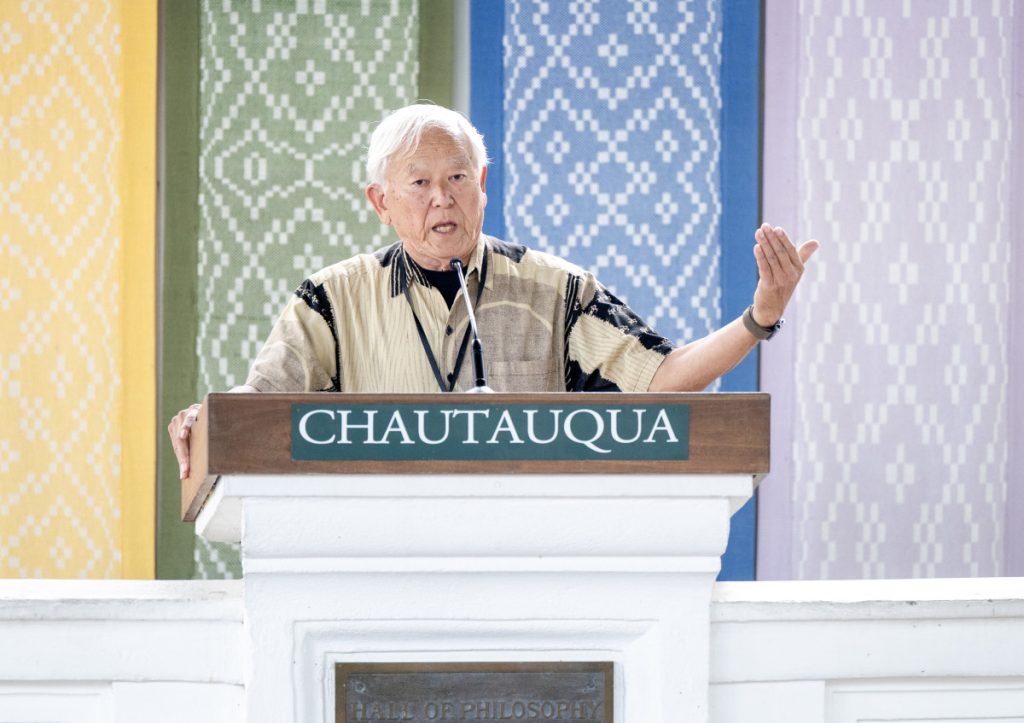
Professor Emeritus at University of Hawai‘i at Mānoa George Tanabe speaks about Obon’s role in Buddhism and secular Japanese spaces Thursday in the Hall of Philosophy.
LILY RESLINK
Staff Writer
George Tanabe delivered the final 2026 Interfaith Lecture at 2 p.m. Thursday in the Hall of Philosophy on the Japanese festival of Obon and its varied religious and cultural associations.
He said three dichotomies would encapsulate his explanation of Obon: “the living and the dead,” “the secular and the sacred” and “Japan and U.S.”
Tanabe, professor emeritus at University of Hawai‘i at Mānoa, said there would be a quiz on remembering those three at the end of the lecture.
Although he said Buddhism is at the core of Obon in Japan, this is not true for its U.S. renditions. In the U.S., he said Obon celebrations include dancing that is geared toward celebrating life rather than the Buddhist practices of memorializing the dead.
Tanabe said the Bon dance offers an understanding of Buddhism in the context that transcends any one religious lens.
He spoke of the secular etymology of the word Obon and defined its sacred meaning. He said Obon means “hanging upside down,” which stems from a Buddhist story about a monk who sees his mother suffering in hell as a “hungry ghost,” suspended upside down with an empty, bloated stomach. To save his mother, Tanabe said Buddha tasked the monk with making a donation to the temple, which the monk obliges.
He spoke about how Obon illuminates heavier parts of Japanese Buddhist practice that assert that the living have a responsibility to care for the dead.
In Buddhist tradition, he said there are many kinds of hells; he jokingly described the image of a group of Buddhist monks brainstorming, saying, ‘Can we come up with a really good hell?’”
“Buddhist monks had a lot of time sitting around receiving donations — not having to work and just writing these crazy philosophical texts that nobody could understand,” Tanabe joked.
Amid the abstract concepts, he said most religious traditions adhere to the belief that death is not final.
Returning to the word “Obon,” Tanabe said the story behind it conveys the idea that if the deceased mother was “better situated,” — if the living cared for her as instructed — she would have been reborn into one of the Buddhist heavens.
“So much of Buddhism is focused on postmortem rituals with ideas about what happens to you after you die,” he said.
Tanabe also said many of the postmortem rituals deal with feeding the dead.
“A really interesting conception of death in Japanese Buddhism is that yes, the body has died, the soul has gone on, but the soul still has bodily needs.”
He said this sacred meaning of Obon shines a light on “funeral Buddhism” in Japan, which is a term referring to the importance in Japanese Buddhism of funerals and visiting graves.
He said there is the idea that “If you don’t feed those loved ones who have passed away, they are going to get hungry. Like the mother of the monk in the story, they will become hungry ghosts … and they will forever be suffering.”
While saying this also includes giving real food, he said the best “soul food” is incense.
He spoke about “the separation of Obon in two different spheres”: Japan and the U.S.
The Obon season in Japan is July and August, which he said is the designated time for people to travel to hometown temples and graves. With no dancing whatsoever, he said loved ones perform death rituals and “do their duty of taking care of those who have passed away.”
Contrarily, Tanabe said Obon dances common in Hawaii and California have nothing to do with Buddhism or “the sacred.” While in Japan, it is a memorialization ritual, in the U.S., it is a celebration of life.
“Only in America do we conflate secular Bon dance … and the memorialization of the dead,” he said.
He emphasized that his lecture is only the first part of Chautauqua’s introduction to Obon, and there will be opportunities for Chautauquans to participate.
“When you do the dance on Sunday, think about those three things: Think about the loved ones you have lost, think about the ways in which we celebrate farming and agriculture and business and all the other secular activities that keep us alive.”