

The Corry Journal Press Room Manager Phil Griffis checks the print quality of the Aug. 24 edition of The Chautauquan Daily as the first papers roll off the press during a print run Aug. 23 in Corry, Pennsylvania.
JULIA WEBER
Assistant Editor
Each night, after articles have been filed, photographs have been taken and pages have been designed, a small group of The Chautauquan Daily’s staff do their final checks — headlines, captions, proper names and so forth — and send the paper off to a man named Phil Griffis in Corry, Pennsylvania, to be printed.
Griffis is the press room manager at The Corry Journal’s headquarters, where the Daily is printed six days per week. He has worked there since he began as a paper carrier in the late 1970s, later progressing to the Journal’s mailroom. After high school, he went to college and returned to the area upon graduation to look for a job. A friend of his from high school was in charge of the press room and hired Griffis, and he gradually worked his way to his current role.
Griffis said his favorite Daily cover page is from July 28, 2018, commemorating the Chautauqua Symphony Orchestra’s performance soundtracking a screening of “Harry Potter and the Chamber of Secrets.” In his office, a clipped-out front page hangs next to a printed-out photo of a squirrel enjoying a cup of coffee.
When the Daily sends the next day’s pages to Griffis, his first step is to download them and check them for any printing errors that could arise. Then, he’ll plate the designs so they can be printed and recreated in multiples for each copy.
“Once we make the plates, we have to bend them (and) put them on the press,” Griffis explained. “The press will run 17,000 [copies of a newspaper] an hour, but we run at about 12,000, 13,000 an hour.”
When Griffis started in the press room, the design process was fairly different. There were only a couple of reporters — maybe two or three, at most — and paginators who would take the finished articles and proofread them, lay them out, proofread again and then set the final design.
From there, articles went to Griffis to be printed. He would use a large camera in his office to photograph the final page layout, turn it into a negative, burn the image and develop it so it could be printed.
Now, the paper is made digitally; writers submit their article in a document, where editors make any changes, photos are stored on a computer and all of the elements that go into the paper are formatted by graphic designers in a software called InDesign. From there, pages are laid out and sent to the printer as PDFs.
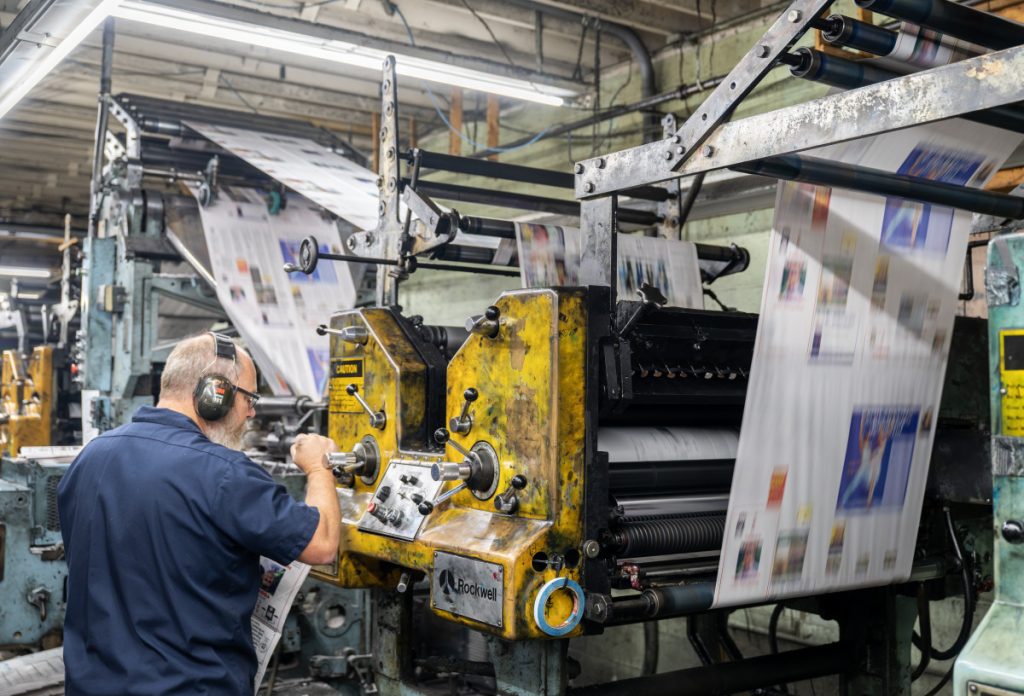
Griffis adjusts the press to ensure each of four color printing plates are in alignment. The alignment of the plates, known as registration, is critical for images to print clearly.
The press room consists of a handful of presses, each taller than Griffis himself. Before he starts, he dons a pair of protective ear muffs. When the presses are operating, Griffis maneuvers through the room with expertise; he checks for color levels and alignment, pulling papers off the line to see how the ink has registered. Each printing press can be adjusted side to side and up and down, which Griffis tweaks constantly for precision.
These adjustment dials account for registration, or how the four individual color plates — cyan, magenta, yellow and black — align to make a clean color print. Each press prints one of these four colors, and if they don’t line up precisely, colors blur and pictures become unidentifiable.
“It’s not like a copier where you just press a button and it spits out the same thing print after print. Mine is constantly moving and adjusting; it’s always moving,” he said.
Outside his role, Phil enjoys car shows, making automobile-themed sculptures and collecting memorabilia. Throughout the summer, Griffis attends car shows, proudly showing off his 1977 Mercury Bobcat Villager station wagon.
“Around 2004, when my wife and I got married, I was doing demolition derbies,” he said. The car he had that year had an issue with its transmission, causing it to only drive forward, no matter what he tried. As he and his wife searched newspaper ads for replacements, Griffis found himself saying the cars being advertised should be repaired, not destroyed.
“After about two weeks of that, she goes, ‘If you think we should be going to car shows instead of derbies, why are we going to derbies?’” Griffis recalled.
From there, Griffis and his wife identified what they were looking for in a car. They wanted something unique that could fit their three sons, so they opted for a station wagon.
On occasion, he’ll even make sculptural trophies out of spare parts for the winning cars at the shows he attends. One sculpture is composed of a wagon wheel, a shock and two Hot Wheels. It’s even outfitted with electrical work so the smallest details can be observed. Another sculpture started with Griffis lowering a wagon and attaching side pipes to it. From there, he said, “I added and added and added and added.”
Griffis is also an avid collector; for as long as he can remember, he has been collecting Hot Wheels cars. Now, he said, they have taken over the better part of his house.
“I just like Hot Wheels; they were the hold-me-over until I could actually get a real car,” he said. “Since I got real cars, I don’t buy as many as I used to.”
In both his hobbies and his job, Griffis is keenly attuned to detail with a propensity for precision. Griffis keeps a watchful eye on the papers as they are printed, swiping them off the ever-piling stack to check for registration.
“I am multi-multitasking,” Griffis said. Each adjustment he makes takes about 40 papers to be reflected, which means time is of the essence once the presses start producing copies.
“If something’s out of whack, it’s taking 40 papers before I notice, and then another 40 or 50 before my correction shows up on the paper. We could lose 100, 200 papers before I get something straightened out again,” he said. “Over the course of time, you learn how to just do your microadjustments.”
After the approximately 2,000 papers are printed each night, they are driven 40 minutes to the Institution and delivered to the newsroom, where they are sorted and distributed early the next morning for carriers to deliver to homes across and nearby the grounds.
Griffis said through the years, he has developed relationships with the editors of the papers he prints. He said trust is developed over time, which he doesn’t take for granted.
“I like working with the paper,” Griffis said. “I try to build a good reputation with every paper that we do so that they trust me to make whatever changes may need to be made on my end.”
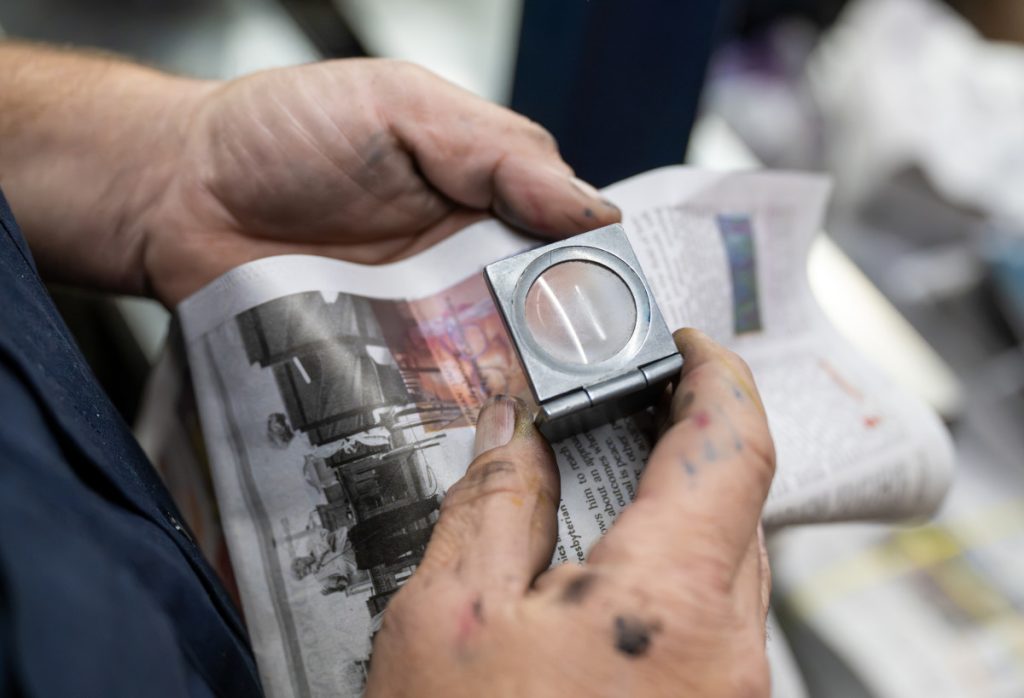
Griffis uses a magnifying glass to check that each of four color printing plates are aligned.